
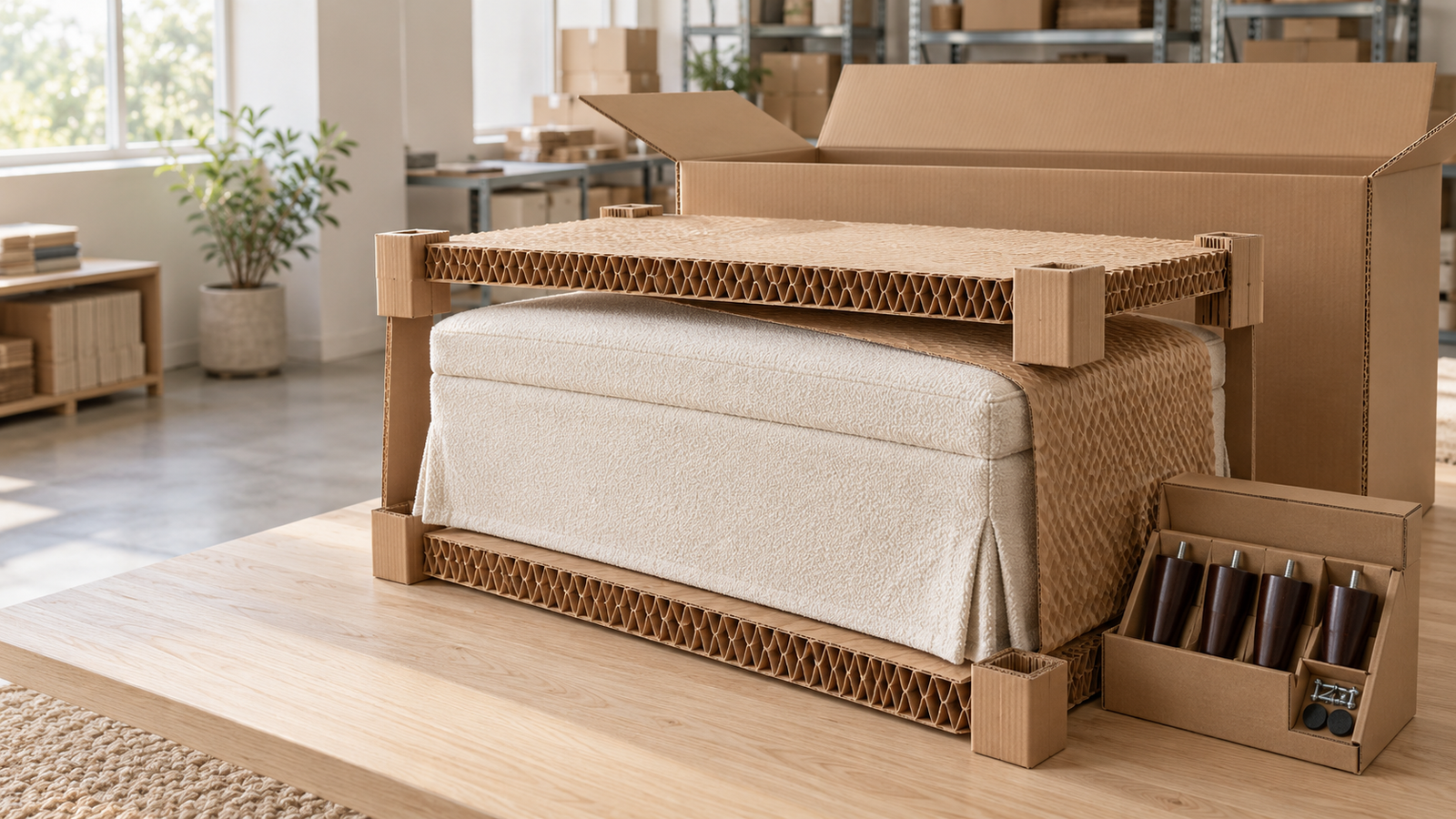
Quick Answer: Sustainable packaging for ottomans should reduce unnecessary plastic without weakening product protection. A practical system may combine honeycomb paper panels, corrugated corner supports, paper wrapping, a fitted export carton, and a packing structure designed around the ottoman’s fabric, lid, legs, and vulnerable edges. Fully plastic-free claims should only be made after every packaging component and the required transit testing have been confirmed.
For home-furnishings buyers, packaging is no longer a decision made after the product is approved. It affects landed cost, damage risk, warehouse handling, customer unboxing, and whether a sustainability claim can be supported with real material information.
This is especially important for upholstered ottomans. The product is lightweight relative to its volume, but the fabric, corners, lid, pleats, and internal frame can all be damaged by compression or movement.
Market Signal: Sustainability Is Moving Into Product Execution
High Point Market’s Spring 2026 Preserve direction highlighted sustainability, craftsmanship, and material responsibility as influences on contemporary home furnishings.
For buyers, the practical implication is clear: a sustainable product story should not stop at the upholstery fabric or timber specification. Packaging materials, carton volume, recyclability, and shipping efficiency are also becoming part of the sourcing review.
At trade fairs, the strongest supplier discussion is therefore moving beyond “We can use eco-friendly packaging.” Buyers want to see the proposed materials, packing sequence, carton measurements, and protection points.
A Packaging Review for a Box-Pleat Storage Ottoman
A recent Teruier packaging review involved a cream box-pleat storage ottoman intended for bedroom and entryway retail.
The first packing proposal used a plastic bag, foam sheets, foam corner blocks, and a conventional corrugated carton. It protected the main surfaces, but the buyer identified three problems:
- The amount of visible plastic weakened the sustainability story.
- Loose foam pieces made unpacking less convenient.
- Pressure on the carton sides could flatten the tailored pleats.
The product designer and packaging team reviewed the ottoman together. The objective was not simply to replace foam with paper. The new packaging had to protect the upholstery and preserve the shape of the pleated skirt.
The revised direction used:
- Honeycomb paper panels above the lid and below the base
- Corrugated paper corner columns to control side pressure
- A paper sleeve around the upholstered body
- A separate internal compartment for removable legs and hardware
- A fitted outer carton designed to limit movement without compressing the fabric
The ottoman structure was also adjusted so the removable legs could be packed inside the storage cavity. This reduced wasted carton space and prevented the hardware pack from moving around the upholstered exterior.
The buyer accepted the revised direction because it reduced loose plastic components, made the packing sequence easier to understand, and protected the product detail that mattered most at retail: the clean box-pleat silhouette.
Why Honeycomb Paper Works—and Where It Does Not
Useful Applications
Honeycomb paper packaging can provide rigid surface and edge protection without the loose particles associated with expanded foam. For ottomans, it can be used as:
- Top and bottom load-distribution panels
- Corner or edge protection
- Internal partitions for legs and hardware
- Reinforcement between the product and outer carton
Its flat paper surfaces are also easier for buyers and consumers to separate for recycling, subject to local recycling systems.
Practical Limitations
Honeycomb paper is not automatically suitable for every product or shipping route. It can lose performance if exposed to moisture, and an overly rigid insert may mark soft upholstery if pressure is concentrated in the wrong place.
A plastic free packaging claim also requires more than removing foam. Buyers must review bags, tape, labels, hardware pouches, surface films, and moisture protection. In humid or high-risk shipping conditions, a limited protective barrier may still be required unless testing confirms that an all-paper solution is adequate.
Traditional Foam vs. Paper-Based Ottoman Packaging
| Packing approach | Main advantage | Buyer consideration |
|---|---|---|
| Foam sheets and corner blocks | Familiar protection and moisture resistance | More visible plastic and more separate packing pieces |
| Honeycomb paper and corrugated supports | Paper-based, structured, and easier to separate | Requires careful pressure-point and moisture review |
| Reduced-plastic hybrid pack | Balances paper protection with limited barrier material | Should not be marketed as fully plastic-free |
| Minimal carton-only pack | Lower material use and packing time | Usually insufficient for upholstered details and export handling |
The right ottoman packaging system depends on the product structure, upholstery, carton size, delivery route, and whether the item is shipped to a warehouse, store, project site, or individual consumer.
Sample Shipping Should Test the Packaging, Not Only the Product
During sample shipping, buyers often focus on whether the sample looks correct. The condition of the carton and internal protection should be recorded as well.
After delivery, the review should check:
- Whether the product moved inside the carton
- Whether the upholstery was marked or compressed
- Whether pleats and corners recovered their intended shape
- Whether hardware remained in its compartment
- Whether the packaging was easy to remove and separate
- Whether the carton size still supports the target landed cost
A sample arriving safely once does not prove that the packaging is ready for bulk distribution, but it provides useful evidence for the next packaging revision.
Consolidated Shipping Requires a Different Review
Consolidated shipping can reduce the cost and complexity of moving samples or smaller orders from several product categories, but mixed loads create additional pressure and handling risks.
Ottomans may be loaded with mirrors, ceramic décor, storage boxes, or accent furniture. The packaging plan therefore needs to consider carton strength, stacking direction, weight distribution, labeling, and which products must not be placed underneath heavier cartons.
In Minhou, coordinating the ottoman maker, packaging supplier, and consolidation team allows the carton structure and loading information to be reviewed before shipment. Final packing specifications should still be confirmed for each order and distribution route.
Buyer Summary
- Sustainable packaging must protect the product before it supports a marketing claim.
- Honeycomb paper can replace some foam panels and corner protection in ottoman cartons.
- Product structure and packaging should be reviewed together to reduce unnecessary carton volume.
- Sample shipping should document carton and internal-pack performance.
- Consolidated loads require clear stacking, labeling, and weight-distribution rules.
- Plastic-free claims should only be used when every packaging component has been verified.
FAQ
Can ottoman packaging be completely plastic-free?
It may be possible for some products and shipping routes, but the complete pack must be reviewed for moisture protection, tape, labels, hardware bags, and surface protection. Transit testing should be completed before making a plastic-free claim.
Is honeycomb paper strong enough for export packaging?
It can provide effective panel, edge, and compression protection when properly specified. Its thickness, position, moisture exposure, carton structure, and product pressure points must be reviewed together.
What information should a buyer request before approving packaging?
Request the packing-material list, packing sequence, carton dimensions, gross and net weight, product orientation, loading quantity, handling marks, and the proposed testing plan.
CTA
Better packaging and shipping starts with the product structure, not with a material slogan. Teruier works with buyers to review ottoman construction, paper-based protection, carton efficiency, sample delivery, and consolidated export planning before bulk orders are released.



