The Buyer Story: The Sustainable Carton Failed the Mirror Test
A U.S. home décor buyer received samples from three suppliers.
A ceramic vase arrived in molded paper protection and remained intact. An upholstered ottoman arrived in an oversized carton filled with plastic foam. A decorative mirror used minimal paper packaging but reached the buyer with a broken corner.
All three suppliers claimed their packaging was suitable for export.
Only one had matched the packaging structure to the product risk.
The lesson was clear: plastic free packaging is not successful because it uses less plastic. It is successful when it protects the product, controls shipping volume, and supports the buyer’s sustainability goals at the same time.
What U.S. Trade Markets Suggest About Packaging Decisions
High Point Market remains a primary platform for discovering new home-furnishings products and sustainability-related design directions. Las Vegas Market encourages buyers to inspect products, materials, and construction in person, while Atlanta Market supports cross-category sourcing across thousands of home, gift, and lifestyle brands.
For buyers, the practical implication is that packaging should be reviewed together with the product—not after the assortment has already been approved.
A fragile ceramic object, upholstered ottoman, and oversized mirror cannot use the same packaging logic.
What Is Plastic-Free Packaging?
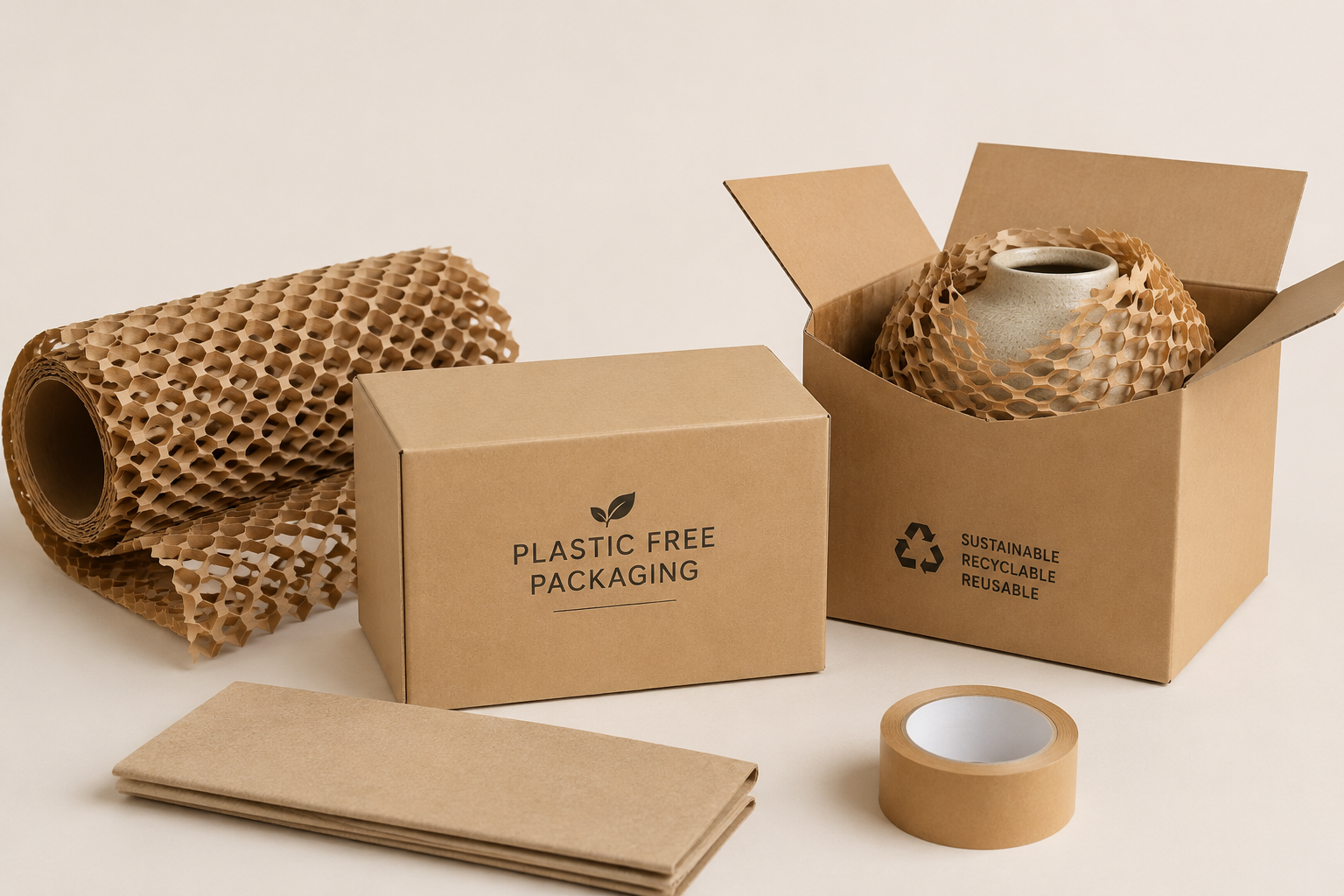
Plastic-free packaging replaces materials such as expanded foam, plastic bags, and plastic air cushions with paper-based or fiber-based alternatives where practical.
Common options include:
- Honeycomb paper
- Corrugated inserts
- Molded pulp
- Paper corner guards
- Kraft wrapping
- Paper cushioning
- Reinforced corrugated cartons
Plastic-free does not automatically mean lower cost or lower environmental impact. Buyers should also consider carton size, material weight, product damage, and disposal complexity.
The objective is not simply to remove plastic.
It is to reduce unnecessary material without increasing product loss.
Honeycomb Paper Packaging: Where It Works Best
Honeycomb paper packaging uses a lightweight cellular paper structure to absorb pressure and create separation.
It can be useful for:
- Ceramic décor
- Decorative trays
- Small mirrors
- Furniture panels
- Protected void filling
- Corner and edge support
Its performance depends on thickness, orientation, compression strength, and how closely the insert fits the product.
Buyer Questions
Is the honeycomb structure load-bearing or only decorative cushioning?
Does it prevent movement inside the carton?
Can it protect corners and edges?
Has it been tested with the final product weight?
Does humidity affect its performance?
A paper structure should be approved as a complete packaging system, not as an isolated material sample.
Ceramic Packaging for Shipping
Effective ceramic packaging for shipping must prevent three risks:
Impact.
Movement.
Piece-to-piece contact.
Small ceramic items may use molded pulp or fitted corrugated inserts. Larger vases often need reinforced bases, neck support, and clear separation from the carton walls.
Buyers should check:
- Distance between the product and carton
- Support around narrow necks or handles
- Protection for rims and bases
- Internal movement after sealing
- Multi-piece separation
- Carton strength
For reactive-glaze or matte ceramics, the insert should also avoid scratching or rubbing the surface.
Mirror Packaging Breakage Prevention
Mirror packaging breakage prevention requires stronger attention to corners, glass pressure, frame movement, and carton bending.
A typical mirror packaging system may combine:
- Paper or corrugated corner guards
- Edge protection
- A fitted inner carton
- Honeycomb panels
- Reinforced outer carton
- Clear handling orientation
The glass should not carry pressure from the frame, hardware, or surrounding cartons.
Oversized Mirror Checkpoints
Confirm the final carton size and gross weight.
Review pallet or LTL requirements.
Check whether the mirror can ship individually.
Test the packaged product in both vertical and horizontal handling positions.
Approve the packaging only after the final frame, glass, hardware, and weight are confirmed.
Reducing plastic should never mean reducing structural support.
Ottoman Packaging: Protect Fabric Without Wasting Volume
Ottoman packaging has different priorities.
The main risks are:
- Upholstery stains
- Compression marks
- Damaged corners
- Loose legs or hardware
- Lid movement
- Oversized carton volume
Paper wrapping, tissue, fabric sleeves, corrugated corner protection, and fitted cartons can reduce plastic use.
However, paper should not rub against delicate bouclé or shearling-style upholstery during long-distance transport.
Buyers should also compare fully assembled and knock-down structures. A smaller carton may reduce freight, but customer assembly and stability risks must be considered.
Sample Shipping: Test the Product and Packaging Together
Sample shipping is not only for approving design.
It should test:
- Product construction
- Finish consistency
- Packaging protection
- Carton dimensions
- Unpacking experience
- Shipping damage
- Assembly instructions
The supplier should send the sample in packaging close to the proposed production structure.
A carefully hand-carried sample does not prove that the product is ready for parcel or freight delivery.
After arrival, the buyer should photograph the outer carton, internal protection, product condition, and unpacking sequence.
Consolidated Shipping: Efficiency Creates New Risks
Consolidated shipping combines samples or orders from several suppliers into one shipment.
It can reduce freight cost and simplify delivery, but it can also create mixed-load risks.
Heavy cartons may be placed above fragile ceramics.
Mirror cartons may be loaded flat when they were designed for vertical handling.
Different suppliers may use inconsistent labels or carton references.
Consolidation Checklist
Use one master packing list.
Identify fragile and heavy cartons clearly.
Confirm carton dimensions and weights before collection.
Separate mirrors from concentrated loads.
Protect upholstered products from moisture and sharp carton edges.
Photograph the load before dispatch.
Consolidation works best when one party is responsible for loading logic and document control.
A Practical Packaging Approval Process
Stage 1: Define the Shipping Route
Parcel, pallet, LTL, air freight, and container shipping create different risks.
Stage 2: Identify Product Vulnerabilities
Review glass, ceramic edges, upholstery, moving hardware, and surface finishes.
Stage 3: Select Materials
Compare paper, honeycomb, molded pulp, corrugated structures, and limited plastic only where necessary.
Stage 4: Approve the Packed Sample
Evaluate protection, volume, weight, and unpacking.
Stage 5: Confirm Production Packaging
Record carton dimensions, material structure, inserts, markings, and approved photos.
Structured Buyer Summary
Plastic-free packaging uses paper-based and fiber-based materials to reduce plastic while maintaining product protection.
Honeycomb paper packaging can protect edges, fill voids, and create internal support when correctly engineered. Ceramic packaging should prevent impact, movement, and contact. Mirror packaging should control corner damage, glass pressure, and carton bending. Ottoman packaging should protect upholstery while avoiding unnecessary shipping volume.
Sample shipping should test both the product and its proposed packaging. Consolidated shipping requires clear labeling, weight control, and careful loading of mixed product categories.
Final Buyer Takeaway
Sustainable packaging is not the smallest possible carton with the least possible material.
It is packaging that:
Protects the product.
Uses space efficiently.
Avoids unnecessary plastic.
Supports practical disposal.
Reduces replacement shipments and claims.
For U.S. buyers, the strongest packaging programme is designed by product category, tested through real shipping, and documented before production begins.
FAQ
What is plastic-free packaging for home décor?
It is packaging that replaces unnecessary plastic foam, bags, or fillers with paper, corrugated board, molded pulp, honeycomb structures, or other fiber-based materials.
Is honeycomb paper suitable for fragile products?
It can be suitable when its thickness, structure, placement, and compression strength are matched to the product and shipping route.
How should ceramic décor be packaged?
Ceramics should be immobilized, separated from carton walls, and protected at rims, handles, necks, bases, and other vulnerable areas.
How can buyers prevent mirror breakage?
Buyers should use fitted corner and edge protection, reinforced cartons, controlled glass pressure, and packaging tested with the final mirror configuration.
What should buyers check during sample shipping?
They should inspect the product, outer carton, inserts, internal movement, surface condition, unpacking process, and actual carton dimensions.
What is consolidated shipping?
Consolidated shipping combines products or samples from multiple suppliers into one shipment. It requires coordinated labeling, loading, weight distribution, and protection.