The Sample Looks Good. Wonderful. Now Let’s Be Slightly Suspicious.
Every home décor buying meeting has this moment.
Documentation workflow note: for screen capture and documentation, this Snagit Pro is a useful related reference.
Someone places a sample on the table.
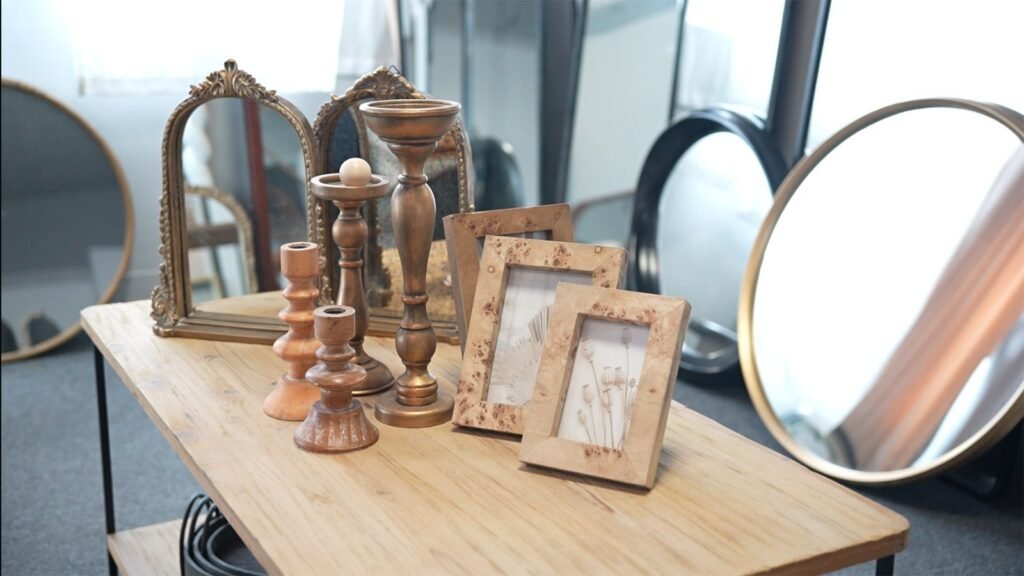
The mirror frame looks refined.
The ceramic glaze feels soft and expensive.
The ottoman fabric has the right texture.
The colour is calm, warm, and very “European apartment with good lighting.”
Everyone nods.
Then the German buyer asks the question that ruins the mood, but saves the business:
“Can this be repeated in bulk?”
That is the whole point of home decor materials and finishes.
A beautiful sample is not enough. A material must be stable. A finish must be controllable. A fabric must be available again. A ceramic glaze must not turn into a different personality in the next production batch.
For German buyers, home décor merchants, and interior designers, materials and finishes are not decoration details. They are commercial decisions.
Because if the finish cannot be repeated, the product is not a product.
It is a charming accident.
What Are Home Decor Materials and Finishes?
Home decor materials and finishes refer to the physical materials and surface treatments used in home décor products.
This includes:
Ceramic bodies
Ceramic decor glaze finish
Matte ceramic decor surfaces
Mirror frame materials
Metal finishes
Wood tones
Resin and stone-look effects
Woven materials
Ottoman fabric texture
Upholstery materials
Decorative storage finishes
Paint, coating, plating, glaze, stain, and texture
In simple buying language:
Materials decide what the product is made of.
Finishes decide how the product looks, feels, and sells.
A ceramic vase is not only “ceramic”. Its glaze decides whether it feels rustic, modern, cheap, handmade, calm, glossy, matte, or slightly confused.
An ottoman is not only “fabric”. The ottoman fabric texture decides whether it feels cosy, durable, premium, casual, dusty, flat, or ready for a markdown corner.
A mirror is not only “glass and frame”. The frame finish decides whether it belongs in a German design store, a hotel project, a community home shop, or nowhere in particular.
Very small differences. Very large consequences.
Why German Buyers Care About Finish Control
German buyers usually do not ask detailed material questions because they enjoy making supplier emails longer.
They ask because finishes create risk.
A finish can affect:
Retail price
Product positioning
Customer trust
Assortment consistency
Packaging requirements
Claim rate
Reorder stability
Project suitability
Shelf presentation
Long-term supplier confidence
A buyer is not only asking, “Does this look good?”
The better question is:
Will this still look good when 500 pieces arrive, under real lighting, after shipping, next to the rest of the assortment?
That is the buyer’s job.
A supplier who only understands the sample table is not enough. The supplier must understand bulk production, material tolerance, packing risk, finish variation, and reorder control.
Less glamorous than styling a shelf? Yes.
More useful than another beige mood board? Also yes.
Ceramic Decor Glaze Finish: The Surface Is the Selling Point
Ceramic décor is one of the clearest examples.
A simple ceramic vase can become highly sellable because of the glaze.
A warm matte beige.
A soft stone grey.
A speckled off-white.
A muted sage.
A reactive brown.
A quiet sand tone.
A handmade-looking surface that does not look like it came from a hotel breakfast buffet.
The ceramic decor glaze finish is often what creates perceived value.
But glaze is not always easy to control.
It can vary because of:
Clay body
Firing temperature
Glaze thickness
Kiln placement
Batch size
Humidity
Surface texture
Hand-applied process
Colour tolerance
For German buyers, variation is not automatically bad. Some ceramic products need natural variation to feel alive.
But there is a difference between controlled variation and production chaos.
Controlled variation says: “Each piece is slightly different, within this approved range.”
Production chaos says: “We are also surprised.”
The second one is not a buying strategy.
Matte Ceramic Decor: Calm Look, Strict Requirements
Matte ceramic decor is popular because it feels modern, quiet, and easy to coordinate.
It works well with warm wood, brushed metal, textured upholstery, woven baskets, neutral storage items, and simple mirrors. It also photographs well, which is helpful because apparently every product now needs to look like it has a peaceful inner life.
But matte ceramic decor has a problem.
It shows things.
Dust.
Fingerprints.
Rubbing marks.
Pressure marks.
Small scratches.
Colour transfer from poor packaging.
Uneven surface contact.
A glossy surface may hide small problems better. A matte surface often tells the truth immediately, and sometimes rudely.
So buyers should check:
Does the matte surface mark easily?
Does it rub during packing?
Does the colour remain stable?
Does the surface feel pleasant or chalky?
Does the product look clean after unpacking?
Does the supplier inspect the surface after packaging, not only before?
A matte ceramic vase that looks perfect before packing but damaged after unpacking is not finished.
It has failed the real test: the journey from factory to buyer.
Textured Neutral Ottoman: Safe Colour, Not Always Safe Material
A textured neutral ottoman is one of those products that looks easy to sell.
It fits many rooms.
It does not scare customers.
It works with mirrors, ceramics, trays, and storage.
It can sit in bedrooms, living rooms, entryways, apartments, and boutique project spaces.
Very useful.
But neutral does not mean simple.
Neutral fabrics show problems clearly.
Cream shows dust.
Ivory shows stains.
Taupe shifts under lighting.
Soft grey can look dull if the texture is wrong.
Beige can go from “warm and modern” to “sad office chair” surprisingly fast.
The ottoman fabric texture matters because it gives the product value.
A plain neutral ottoman may look basic.
A textured neutral ottoman can feel warmer, richer, and more retail-ready.
But texture must be controlled.
German buyers should ask:
Can the fabric be sourced consistently?
Will the texture flatten during shipping?
Does the fabric rub at the corners?
Does the colour match the approved sample?
Is the fabric suitable for the target price?
Can the same texture be reordered later?
Will the fabric arrive clean after transport?
A textured ottoman that arrives dusty, compressed, or uneven is not “casual”. It is a problem with legs.
Ottoman Fabric Texture: A Commercial Detail, Not a Styling Detail
Ottoman fabric texture affects much more than appearance.
It affects:
Touch
Perceived value
Comfort
Photo quality
Retail display
Durability perception
Packaging requirements
Cleaning concerns
Price acceptance
Reorder stability
A bouclé-style texture may feel premium but attract dust.
A woven fabric may feel practical but show batch differences.
A velvet-like fabric may feel soft but show pressure marks.
A linen-look fabric may feel natural but crease.
A thick upholstery texture may look good but increase packing volume.
This is why German buyers should not approve fabric by photo only.
A photo can hide texture problems.
A sample can hide bulk supply problems.
A supplier can hide behind “similar fabric” if the original material is no longer available.
The buyer needs to know whether the fabric is not only attractive, but stable.
Because in wholesale home décor, “almost the same fabric” is often where the headache begins.
What Interior Designers Should Ask Before Requesting a Custom Size or Finish
Customisation can be very useful.
It can make a mirror fit a project wall.
It can make a ceramic finish match a room palette.
It can make an ottoman fabric work with a designer scheme.
It can turn a standard product into something more valuable.
But customisation also creates risk.
Before requesting a custom size or finish, interior designers should ask:
Does this change improve the project or only make it more complicated?
Will the material still be available for bulk production?
Can the finish be repeated later?
Does the custom size affect packaging or shipping?
Does the custom finish scratch, rub, or mark easily?
Will the colour tolerance be acceptable?
Does the change increase MOQ or lead time?
Will the product still fit the target price?
Can the supplier support replacement pieces later?
The most dangerous customisation request is the one that sounds small.
“Just make it slightly bigger.”
“Just make the glaze warmer.”
“Just change the fabric.”
“Just use a softer finish.”
The word “just” has caused many sourcing problems. It should be handled carefully, preferably with a calculator nearby.
Custom Size vs Custom Finish: A Practical Comparison
| Custom Request | What Usually Changes | Main Risk | Buyer Question |
|---|---|---|---|
| Custom mirror size | Product proportion, carton size, glass risk, loading quantity | Higher breakage risk or freight cost | Does the new size still ship safely? |
| Custom ceramic glaze finish | Colour, surface feel, firing result, batch tolerance | Variation, rubbing, chipping visibility | Can the glaze be repeated in bulk? |
| Custom matte ceramic decor | Surface treatment, touch, packaging protection | Marks, scratches, pressure points | Has the matte surface been tested after packing? |
| Custom ottoman fabric texture | Fabric sourcing, colour, texture, compression behaviour | Batch variation, dust, flattening | Can the same fabric be sourced again? |
| Custom metal or wood-look finish | Coating, plating, grain, colour tone | Scratches, mismatch, cheap appearance | Does the finish match the target assortment? |
Customisation is not bad.
Uncontrolled customisation is bad.
Good suppliers do not simply say yes. They explain what changes behind the yes.
Mixed Assortments Need Material Discipline
German buyers often build assortments, not isolated products.
A collection may include:
A warm-framed mirror
A textured neutral ottoman
A matte ceramic decor set
A decorative storage box
A woven basket
A tray with metal detail
A small accent table
Individually, each product may look fine.
Together, they must make sense.
This is where home decor materials and finishes become a range-building tool.
The buyer needs to check:
Do the finishes belong together?
Do the materials support the same price level?
Does one item look cheaper than the rest?
Do the ceramics fight with the mirror frame?
Does the ottoman fabric look too heavy or too flat?
Does the storage finish support the room story?
Can the supplier maintain the same finish direction across categories?
A cohesive assortment does not mean everything is the same colour.
It means the products look like they were chosen by someone with a plan.
Not by a committee with five catalogues and one deadline.
Teruier’s Merchant Profit Plan: Materials Must Support the Business
At Teruier, we often use the idea of a merchant profit plan.
This means the product must support the buyer’s actual business, not only look pleasant in a sample photo.
For materials and finishes, that means:
The finish should fit the retail price.
The fabric should match the sales channel.
The ceramic glaze should be repeatable.
The mirror frame should not scratch too easily.
The assortment should be easy to explain.
The product should ship without damaging the surface.
The material should support reorder stability.
A finish is not just a style choice. It is part of the buyer’s margin, risk, and repeat order strategy.
A beautiful but unstable finish may win the sample meeting and lose the shipment.
That is not success.
That is a very attractive trap.
Material and Finish Comparison for German Buyers
| Material / Finish | Why Buyers Like It | What Can Go Wrong | What to Check |
|---|---|---|---|
| Matte ceramic decor | Calm, modern, easy to coordinate | Rubbing, dust, scratches, pressure marks | Surface test after packing |
| Ceramic decor glaze finish | Adds value and character | Colour variation, chipping, unstable batch result | Approved tolerance and batch control |
| Textured neutral ottoman | Flexible, warm, retail-friendly | Dust, compression, fabric variation | Fabric source and packing protection |
| Ottoman fabric texture | Improves perceived value | Flattening, rubbing, colour shift | Texture stability and reorder availability |
| Mirror frame finish | Strong visual anchor | Scratches, tone mismatch, corner damage | Finish durability and packaging compatibility |
| Mixed material details | Adds depth and design value | Different materials fail differently | Protect the weakest material first |
The buyer’s question should always move from appearance to control.
Does it look good?
Good start.
Can it be repeated, protected, shipped, and reordered?
Now we are having a real conversation.
Good Supplier vs Risky Supplier
| Topic | Risky Supplier | Strong Supplier |
|---|---|---|
| Finish approval | “Looks similar.” | Defines approved sample and tolerance |
| Customisation | Says yes quickly | Explains cost, risk, MOQ, and lead time |
| Fabric sourcing | Changes fabric when needed | Confirms fabric availability and records |
| Ceramic glaze | Calls all variation “handmade” | Defines acceptable variation |
| Matte surface | Checks before packing only | Checks before and after packing |
| Reorder | Restarts discussion each time | Keeps material and finish records |
| Assortment support | Sells individual products | Helps coordinate materials across categories |
German buyers do not need the supplier to be dramatic.
They need the supplier to be precise.
Drama belongs in theatre. Not in glaze control.
How to Approve Home Decor Materials and Finishes
Before approving materials and finishes, buyers should follow a simple process.
First, approve the visual direction.
Second, check the material source.
Third, confirm the production tolerance.
Fourth, test packaging compatibility.
Fifth, define inspection points.
Sixth, keep records for reorder.
This is especially important for:
Matte ceramic decor
Ceramic decor glaze finish
Textured neutral ottoman fabric
Custom mirror finishes
Mixed material products
Project-based custom finishes
A sample without records is only a memory.
A sample with material notes, finish tolerance, packaging test, and supplier confirmation becomes a buying tool.
Much less poetic. Much more useful.
FQA: Home Decor Materials and Finishes for German Buyers
What are home decor materials and finishes?
Home decor materials and finishes are the materials and surface treatments used in home décor products, including ceramic, glass, metal, wood, fabric, resin, woven materials, glaze, paint, coating, plating, and upholstery texture.
Why are materials and finishes important for German buyers?
They affect product value, retail price, assortment consistency, packaging risk, damage claims, and reorder stability. A product must not only look good once; it must be repeatable.
What should interior designers ask before requesting a custom size or finish?
They should ask whether the change affects production, material availability, packaging, shipping cost, finish stability, MOQ, lead time, and reorder potential.
Why is ceramic decor glaze finish difficult to control?
Ceramic glaze can vary due to clay body, firing temperature, glaze thickness, kiln position, and batch conditions. Buyers should define acceptable variation before bulk production.
Is matte ceramic decor risky?
It can be. Matte ceramic decor may show dust, fingerprints, rubbing marks, scratches, and pressure points more easily than glossy finishes. It should be tested with packaging.
Why does a textured neutral ottoman need material control?
Because neutral upholstery can show dirt, colour shifts, compression marks, and texture changes. The fabric must be stable, clean, and suitable for the sales channel.
Why does ottoman fabric texture matter?
Ottoman fabric texture affects perceived value, comfort, retail display, shipping risk, and reorder consistency. It is a commercial material choice, not only a styling detail.
Should buyers always customise products?
No. Buyers should customise only when the change improves project fit, assortment value, or commercial potential. Customisation without clear benefit can create cost and supply chain risk.
Final Thought: Materials Are Where Good Buying Becomes Serious
Home décor buyers can love beauty.
German buyers are allowed to like a warm ceramic glaze, a calm matte finish, a textured neutral ottoman, or a mirror frame that looks properly considered.
But good buying starts when the buyer asks what happens after the sample.
Can the finish be repeated?
Can the fabric be sourced again?
Can the ceramic glaze stay within tolerance?
Can the matte surface survive packing?
Can the custom size still ship safely?
Can the assortment look cohesive in bulk?
That is where real product value lives.
Not only in the first impression.
At Teruier, we believe materials and finishes should help buyers build products that are attractive, explainable, repeatable, and commercially useful.
Because a pretty sample is nice.
A stable product is better.