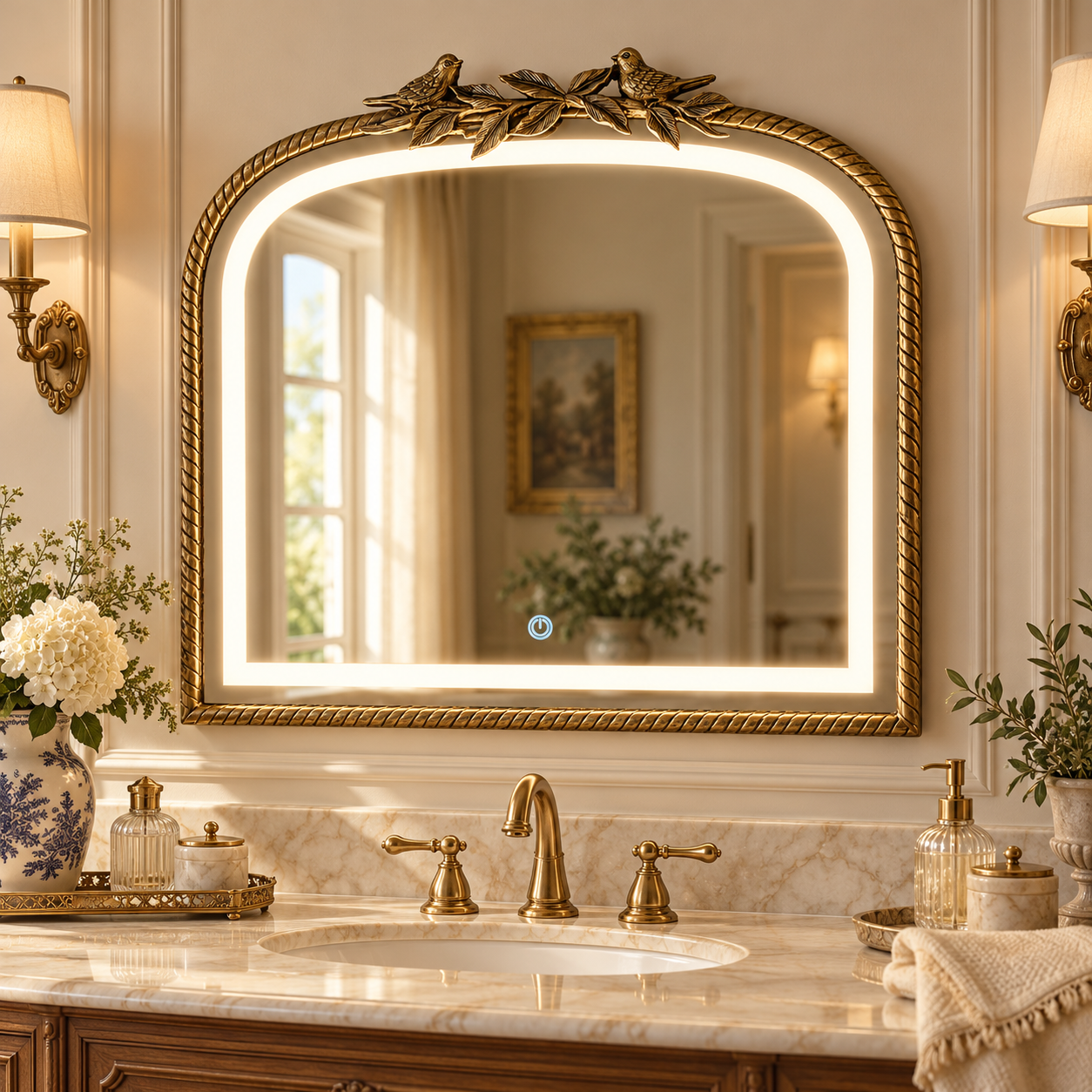
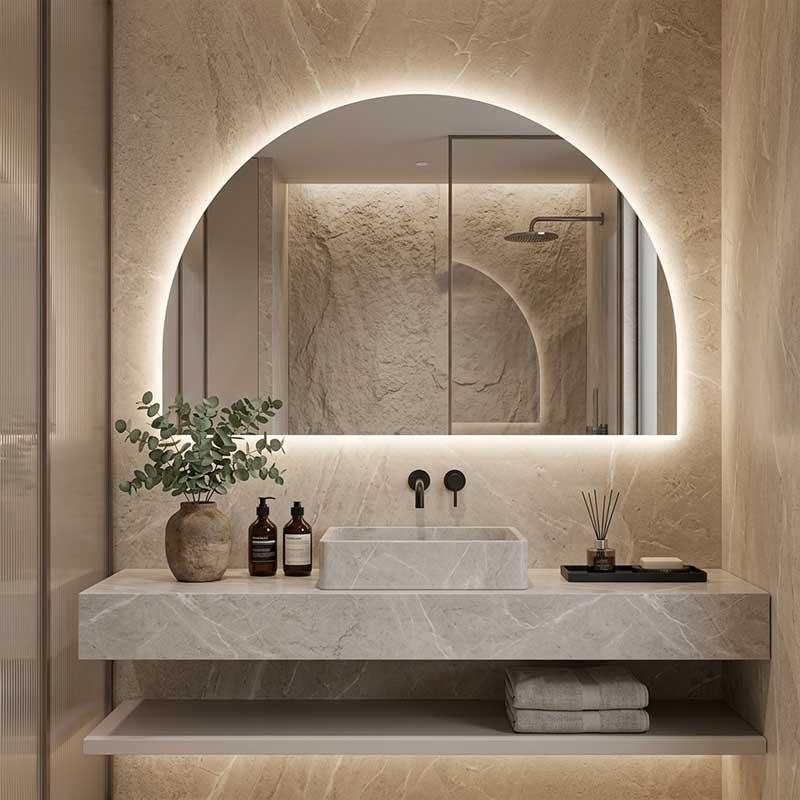
Why comparing LED vanity mirror prices without comparing specifications, electrical compliance and product construction can be a costly mistake.
Two suppliers quote the same LED vanity mirror.
Both show a beautiful product photograph. Both offer a similar size, a modern design and apparently comparable lighting.
But one quotation is 25% cheaper.
Which supplier would you choose?
For a buyer comparing dozens of products, the lower price can look like an obvious opportunity.
Until the samples arrive.
One mirror produces uneven lighting. Another has a different colour temperature from the approved reference. The touch controls behave differently. The anti-fog function is smaller than expected. The electrical documentation does not cover the configuration being ordered.
Suddenly, the cheaper quotation is no longer so attractive.
The problem with buying LED mirrors is not necessarily paying too much. It is comparing products that were never technically equivalent in the first place.
1. An LED Mirror Is Not Simply a Mirror With Lights Added
A conventional mirror has a relatively straightforward product structure.
Glass, reflective coating, backing, frame and mounting hardware are the main considerations.
An illuminated mirror introduces another layer of engineering.
Depending on the design, it may include:
- LED strips or integrated LED modules.
- Power drivers and electrical connections.
- Front lighting, backlighting or combined illumination.
- Touch switches or sensor controls.
- Dimming functions.
- Adjustable colour temperature.
- Anti-fog heating elements.
- Internal wiring and electrical enclosures.
- Installation hardware and connection accessories.
Each additional function introduces another specification that needs to be defined and verified.
A mirror with front illumination is not necessarily equivalent to one with backlighting.
A model with adjustable colour temperature is not equivalent to one with a fixed light setting.
A mirror with an anti-fog function needs additional consideration for the heating element, control method and usable heating area.
The product photograph may look almost identical.
The actual product configuration may be very different.
2. Stop Comparing LED Mirrors by Appearance Alone
A useful purchasing comparison should begin with the lighting itself.
There are several questions buyers should ask.
Front Lighting or Backlighting?
Front lighting directs light towards the user and can be useful for grooming and makeup applications.
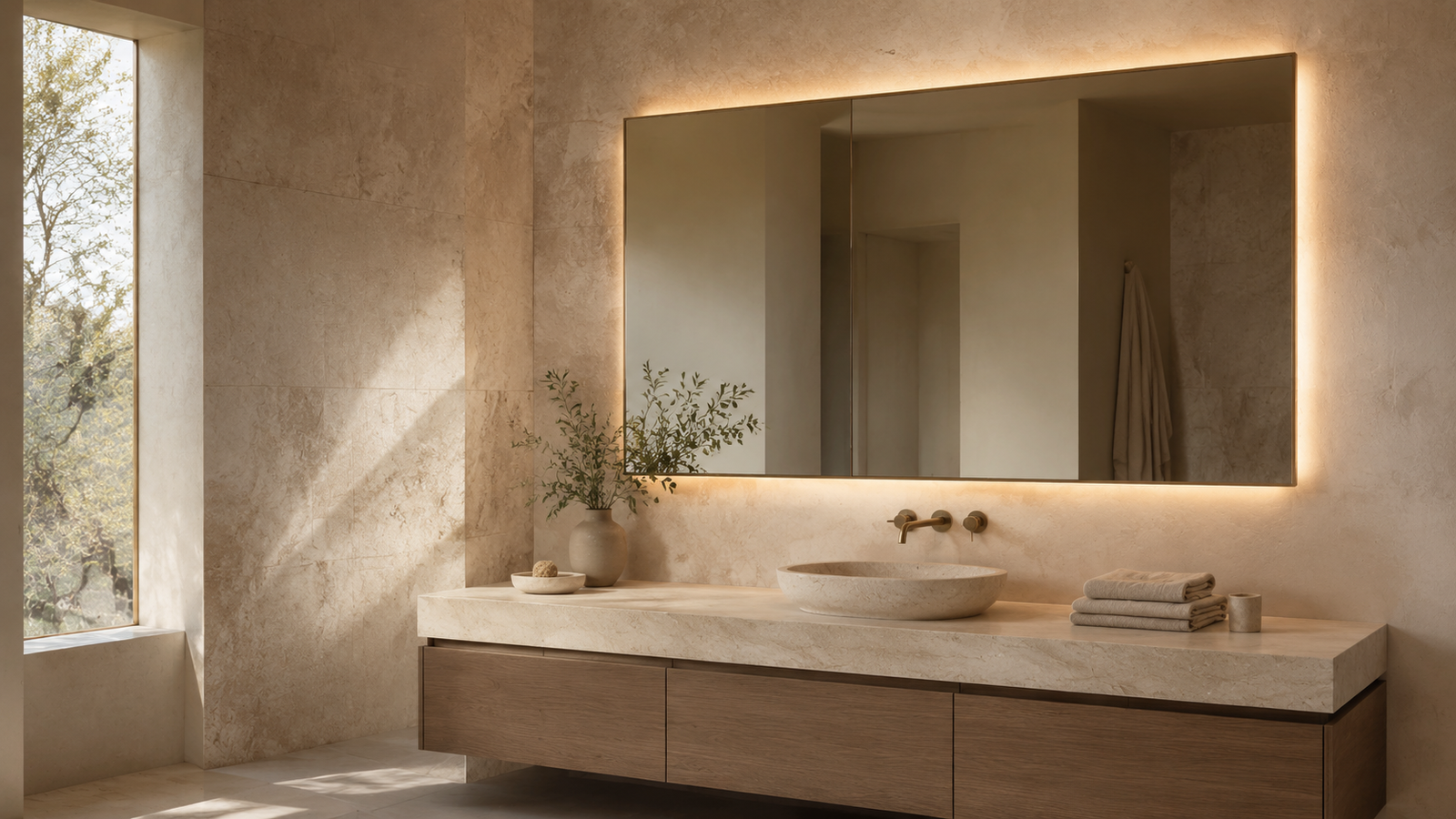
Backlighting creates an illuminated effect around the mirror and can contribute to ambient bathroom lighting.
Some products combine both.
The buyer should establish whether the primary purpose is facial illumination, decorative lighting or a combination of the two.
Fixed or Adjustable Colour Temperature?
Different lighting colours create different visual impressions.
Warm light can produce a softer atmosphere.
Neutral light can provide a more balanced appearance.
Cooler light can create a brighter, more clinical impression.
However, a product description that simply says three colour temperatures is incomplete.
The actual Kelvin values should be specified and verified on the approved sample.
What About CRI?
Colour Rendering Index (CRI or Ra) describes how accurately a light source renders colours compared with a reference source under defined conditions.
This matters particularly for vanity mirrors.
A mirror used for makeup application should be evaluated for colour rendering, not simply brightness.
If CRI is an important requirement, buyers should request supporting test information for the relevant lighting configuration rather than relying only on a marketing claim.
Is the Lighting Uniform?
A mirror may have a high advertised brightness but still produce visible bright spots or uneven illumination.
Buyers should examine:
- Light distribution.
- Brightness consistency.
- Visible LED hotspots.
- Diffuser quality.
- Differences between the centre and edges.
- Appearance at different dimming levels.
The actual lighting experience matters more than a specification number in isolation.
3. Tri-Fold LED Vanity Mirrors and Wall-Mounted LED Mirrors Are Different Products
This distinction is particularly important for buyers developing multiple mirror categories.
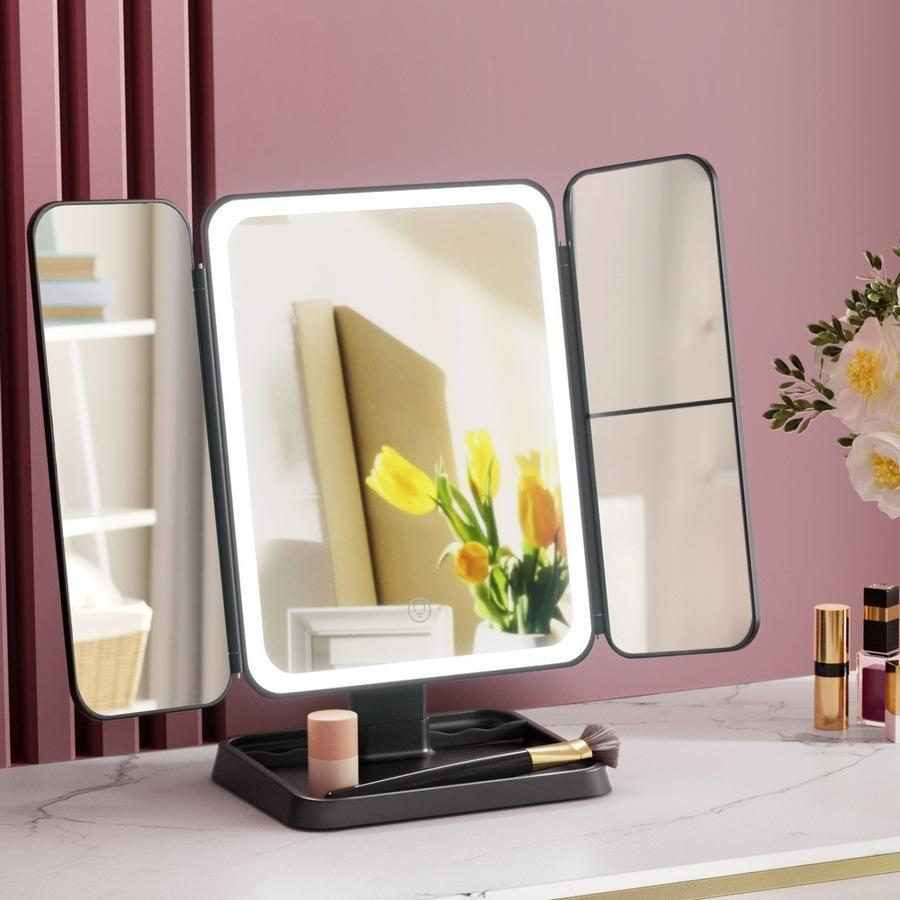
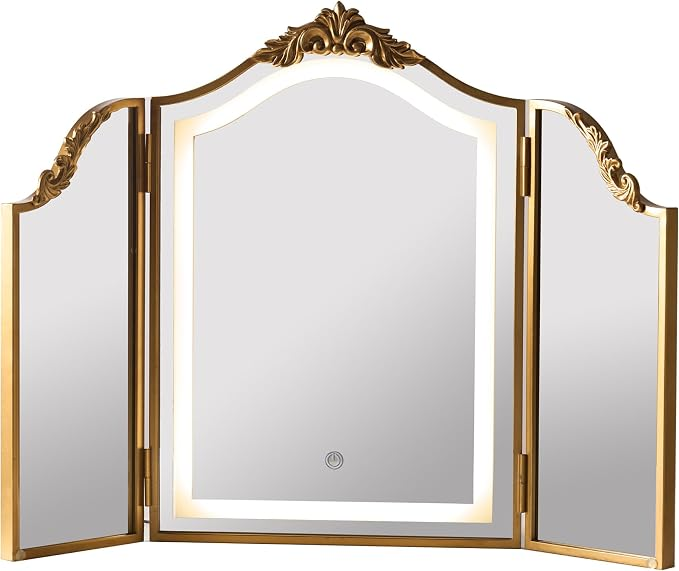
A tri-fold LED vanity mirror is usually designed for a dressing table or desktop.
Its purpose is to help the user see different facial angles while applying makeup or grooming.
A wall-mounted illuminated vanity mirror serves a different function.
It may be installed above a bathroom basin, dressing console or other fixed location.
The two products have different structural and commercial requirements.
| Consideration | Tri-Fold LED Vanity Mirror | Wall-Mounted LED Mirror |
|---|---|---|
| Main application | Makeup and grooming | Bathroom and dressing areas |
| Mirror structure | Multiple hinged panels | Fixed panel |
| Key design issue | Viewing angles and folding | Installation and mounting |
| Lighting priority | Facial illumination | Task or ambient lighting |
| Controls | Touch, buttons or other integrated controls | Touch, sensor or wall controls |
| Power arrangement | Depends on product configuration | Plug-in or hardwired |
| Additional functions | Magnification, adjustable panels | Anti-fog, dimming, integrated lighting |
| Packaging concern | Hinges, panels and desktop stability | Large glass surface, corners and mounting structure |
A buyer should not use the same product specification sheet for both.
For a tri-fold model, hinge durability, panel alignment, viewing angles and tabletop stability deserve particular attention.
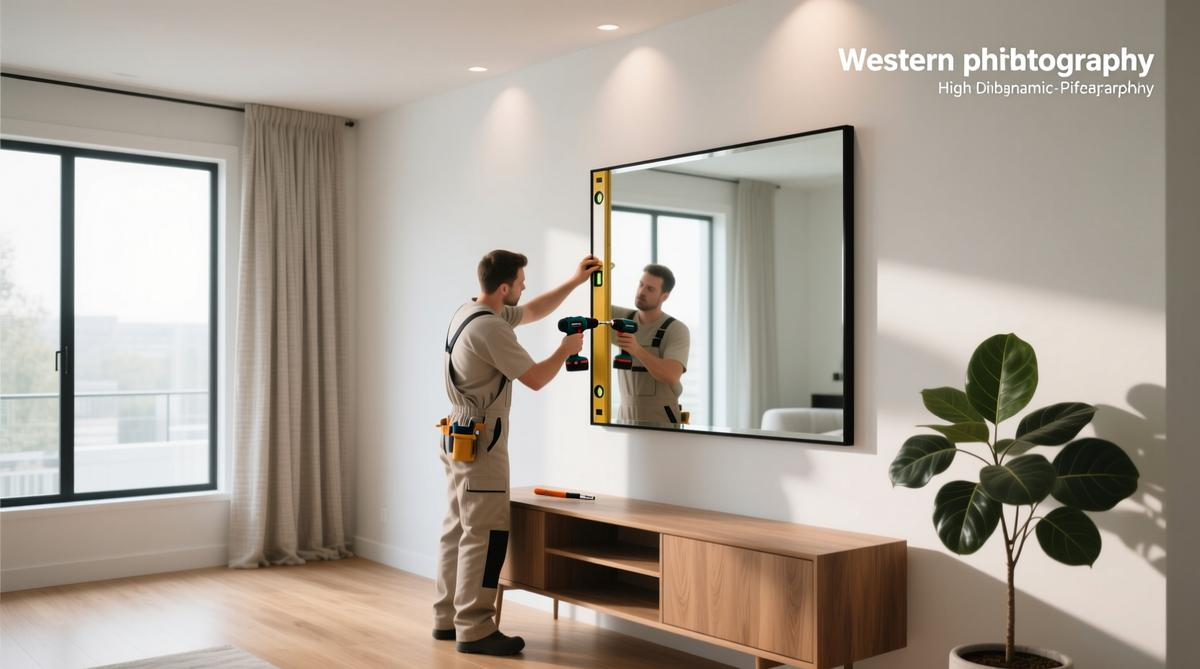
For a wall-mounted model, installation dimensions, mounting hardware, wiring arrangement and the intended installation environment become more important.
This is also why a supplier should not quote a custom LED mirror based only on a reference photograph.
The actual product structure needs to be established first.
4. The Certification Question: A Certified Component Does Not Automatically Mean a Certified Product
This is one of the most important points in international LED mirror procurement.
A supplier may show a certificate for an LED driver.
Another may provide a certificate for the LED strip.
A third may show a general company quality certificate.
None of these automatically establishes that the complete finished mirror has the required approval for its intended market and installation.
For U.S. buyers, UL or ETL documentation may be required by the applicable project, customer or authority. The relevant listing scope must cover the actual finished product and configuration.
For European and UK projects, the applicable conformity requirements and supporting technical documentation must be determined for the product and its electrical configuration.
Buyers should not assume that one certificate automatically covers every destination market.
They should ask:
What exactly has been evaluated?
- The LED driver?
- The LED module?
- The power supply?
- The complete mirror assembly?
- A specific model and size?
- A particular electrical configuration?
A change in dimensions, electronics, wiring, driver or construction may affect whether existing documentation remains applicable.
The exact certification route must be confirmed for the destination country and final configuration.
Useful starting points include the UL Product iQ certification database and the Intertek Directory of Listed Products.
For a buyer, documentation is not paperwork to collect after production.
It is part of the product specification.
5. Bathroom Mirrors Need More Than a Waterproof-Sounding Product Description
A lighted vanity mirror intended for bathroom use introduces another consideration: moisture exposure.
Some suppliers advertise IP44, IP54 or IP65.
These are ingress protection classifications, not general quality grades.
The first digit relates to protection against solid objects and dust; the second relates to protection against water ingress.
But the important question is not which number looks most impressive.
It is whether the declared rating applies to the complete product configuration and is suitable for the intended installation position.
A mirror installed above a bathroom basin may face different exposure from one installed inside a shower enclosure.
Buyers should establish:
- The intended installation location.
- The IP rating of the relevant finished assembly.
- The location of the driver and electrical connections.
- The installation instructions.
- The applicable local electrical requirements.
- Whether the requested functions are included in the evaluated configuration.
A supplier should not promise bathroom suitability simply because the mirror uses a moisture-resistant LED component.
For hospitality and residential projects, these details should be settled before the sample is approved.
6. Anti-Fog Is a Feature. But What Exactly Is Being Heated?
Anti-fog functionality is attractive because it addresses a real bathroom problem.
After a hot shower, a conventional mirror can become covered in condensation.
A heating element behind part of the mirror can help keep the relevant surface clear.
However, not all anti-fog configurations offer the same practical result.
Buyers should clarify:
Heating Area
Does the heating element cover the central viewing area, or only a smaller section?
Activation
Is anti-fog activated independently, through the main lighting switch or by a combined control?
Heating Performance
What is the specified operating time and the expected performance under the intended environmental conditions?
Electrical Configuration
How is the heating element connected and controlled?
Sample Verification
Can the supplier demonstrate the anti-fog function using an agreed test method?
A product description that simply says anti-fog mirror does not answer these questions.
For a retail buyer, the feature must provide a meaningful benefit.
For a project buyer, its performance and electrical arrangement need to be documented.
7. Customization Can Make a Good Mirror More Difficult to Control
Custom LED vanity mirrors are attractive to brands and project buyers because they allow differentiation.
A retailer may want a special shape.
A hotel may require a specific width.
A bathroom furniture brand may want a particular frame finish.
A designer may request front lighting, backlighting and anti-fog in one configuration.
But every customization decision needs to be considered as part of the complete product.
Changing the mirror dimensions may affect the LED layout.
Changing the lighting arrangement may require a different driver.
Adding anti-fog may affect the internal construction and power requirements.
Changing the mounting structure may affect installation and packaging.
A buyer should therefore avoid treating customization as a list of independent options.
Instead, the supplier should work from one controlled product specification.
A practical custom development brief should include:
- Product model or reference image.
- Overall dimensions and orientation.
- Mirror glass specification.
- Front lighting, backlighting or combined lighting.
- Colour temperature and CRI requirements.
- Dimming and control functions.
- Anti-fog requirements, if applicable.
- Power supply and connection method.
- Mounting and installation arrangement.
- Target market and requested documentation.
- Packaging and branding requirements.
This makes supplier quotations more comparable and reduces the risk of approving a sample that does not represent the final order.
8. The Packaging Problem: A Perfectly Working LED Mirror Can Still Become a Bad Purchase
Electrical performance is only part of the product.
The mirror must also survive transportation.
Large mirrors are vulnerable to corner impacts, surface scratches, frame deformation and pressure from poorly designed internal packaging.
LED mirrors add further components that may need protection, including rear housings, drivers, switches and protruding electrical connections.
This is why packaging should be reviewed alongside the product design.
For individual parcel shipments, ISTA Procedure 3A is a general simulation test for packaged products weighing up to 70 kg distributed through parcel delivery systems.
It includes different package types and transportation-related test conditions.
However, ISTA 3A is not automatically the right test for every mirror shipment. The appropriate procedure depends on the distribution channel and actual shipping configuration.
Teruier has discussed this distinction in Mirror Drop Test: Your Packaging Passed. Your Shipment May Still Fail.
The key lesson is that a test result must correspond to the product, packaging and distribution conditions being evaluated.
A test report for one mirror size should not automatically be treated as evidence for a substantially different design.
9. How Buyers Should Compare LED Vanity Mirror Suppliers
A useful supplier comparison should look beyond the quoted unit price.
| Evaluation area | What buyers should request |
|---|---|
| Product design | Drawing, dimensions and model configuration |
| Mirror construction | Glass type, thickness and backing |
| Lighting | LED layout, CCT, CRI and brightness information |
| Controls | Dimming, touch and sensor functions |
| Anti-fog | Heating area, control and performance requirements |
| Electrical | Driver, power supply and connection specifications |
| Compliance | Applicable finished-product documentation |
| Installation | Mounting method and installation instructions |
| Packaging | Carton structure and relevant test evidence |
| Commercial | MOQ, sample cost, lead time and warranty |
A supplier that provides a lower quotation may still be the better choice if its product configuration meets the buyer’s requirements.
Conversely, a supplier offering many features is not necessarily better if the features are not supported by clear specifications and test evidence.
The goal is not to purchase the most complicated mirror.
It is to purchase the right mirror for the intended customer and market.
Frequently Asked Questions
What should buyers specify when sourcing a custom LED vanity mirror?
Start with dimensions, mirror construction, lighting layout, CCT, CRI, controls, power arrangement, installation, destination market, documentation and packaging. Add anti-fog and other functions only when they are required.
What is the difference between a tri-fold LED vanity mirror and a bathroom LED mirror?
A tri-fold model is generally designed for desktop grooming and adjustable viewing angles. A bathroom LED mirror is usually a fixed installation with different mounting, electrical and environmental requirements.
Does a UL-certified LED driver mean the complete mirror is UL Listed?
No. Component certification and finished-product listing are different. Buyers should verify the actual certification scope and the exact model being purchased.
Is IP44 suitable for every bathroom LED mirror?
Not automatically. Suitability depends on the intended installation position, the applicable local requirements and the rating of the actual finished assembly.
Can a custom LED vanity mirror include anti-fog and adjustable colour temperature?
These functions can be combined in some designs, subject to electrical design, available components, construction and applicable product requirements. They should be confirmed in the approved specification.
What should wholesale buyers check before approving a sample?
Check appearance, lighting uniformity, controls, electrical configuration, anti-fog operation if applicable, mounting, documentation and packaging. The approved sample should represent the final production configuration.
Final Thought: Don’t Buy the Feature List. Buy the Verified Product.
LED vanity mirrors offer retailers an opportunity to develop products with more functions, more distinctive designs and a wider range of applications.
But additional features also create additional responsibilities.
A mirror that looks attractive in a catalogue is not necessarily a complete product specification.
A certified driver does not automatically certify the finished mirror. An impressive IP rating does not automatically make every bathroom installation suitable. A successful sample does not guarantee that a different production configuration will perform identically.
The best purchasing decision begins with a clear understanding of what is being bought.
A good LED mirror supplier should not only tell you what the mirror can do. It should be able to show you exactly how the approved product is built, tested, documented and prepared for delivery.
Teruier works with international home décor retailers, mirror brands, importers and project buyers on decorative mirrors, custom product development, material selection, sampling and export packaging.
Contact Teruier to discuss your LED mirror concept, target market, technical specifications and wholesale sourcing requirements.