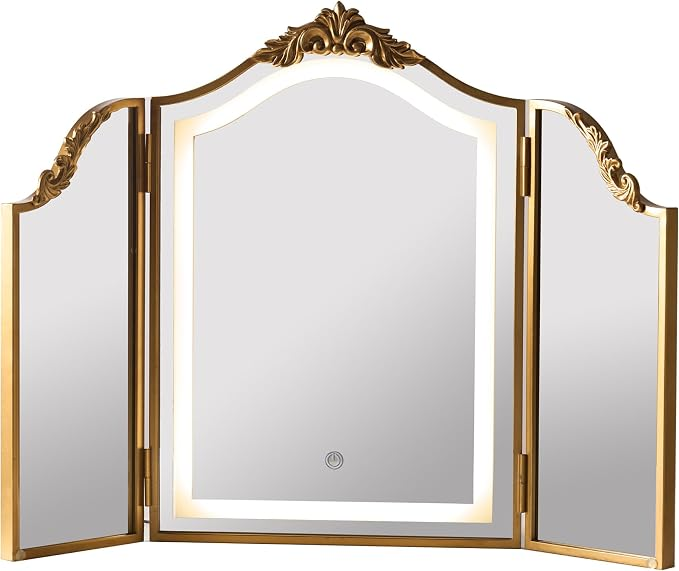
A tri-fold LED vanity mirror combines three adjustable mirror panels with integrated lighting, giving users multiple viewing angles in one dressing area. For U.S. home décor brands, however, developing a retail-ready version requires more than choosing an attractive frame and adding LED lights.
Successful home décor sample development must address hinge construction, lighting quality, frame proportions, electrical safety, stability, and packaging before a design moves toward production.
These details are especially important for decorative, furniture-scale vanity mirrors, where appearance and daily functionality must work together.
Why Tri-Fold LED Mirrors Require a Different Development Approach
Many familiar tri-fold makeup mirrors are compact beauty accessories made with lightweight plastic frames.
A larger decorative vanity mirror serves a different purpose. It becomes part of the bedroom or dressing-room furniture arrangement, where materials, finish, proportions, and lighting contribute to the overall interior design.
For private-label brands, this creates opportunities for product differentiation—but also additional development decisions.
| Product Factor | Compact Tri-Fold Mirror | Decorative Vanity-Scale Mirror |
|---|---|---|
| Primary role | Portable makeup accessory | Dressing-area furnishing |
| Design priority | Convenience and portability | Appearance and functionality |
| Frame structure | Typically lightweight | Potentially heavier decorative construction |
| Lighting | Compact integrated system | Lighting designed around viewing area |
| Sample priority | Controls and portability | Hinges, lighting, stability, finish and packaging |
Neither approach is automatically better. The correct choice depends on the brand’s positioning, intended use, and target customer.
The First Sampling Challenge: Three Panels That Work Together
A tri-fold mirror has two important advantages: adjustable side reflections and a flexible viewing arrangement.
But these advantages depend on its mechanical design.
Hinge Strength and Panel Alignment
Buyers should examine how smoothly the side panels open, whether the hinges maintain their position, and whether the panels remain properly aligned.
For a larger mirror, additional frame weight can increase the mechanical demands on the hinge assembly.
A development sample should be reviewed for:
- Smooth opening and closing movement
- Adequate holding resistance at intended viewing angles
- Consistent gaps between panels
- Secure attachment of hinges to the frame
- Clearance between moving parts and electrical wiring, where applicable
A decorative hinge cover may improve appearance, but it must not interfere with movement or future maintenance.
Stability and Overall Proportions
The center panel, side wings, and base or mounting structure must be designed as one system.
For freestanding models, stability should be evaluated with the wings both open and closed. For mounted designs, buyers should confirm the intended support and installation requirements.
This is why overall width alone is not enough when approving a sample. Open width, folded dimensions, depth, weight, and installation configuration all matter.
LED Lighting: Evaluate the Reflection, Not Just the LED Count
For makeup and grooming applications, lighting performance directly affects the customer experience.
Buyers should consider how light reaches the user’s face, whether shadows occur around the side panels, and how evenly the illuminated surfaces appear.
Important development questions include:
- Where are the LEDs positioned?
- Is lighting provided on the center panel, side panels, or both?
- Is brightness adjustable?
- Are different color temperatures required?
- How is glare controlled?
- Can the power connection be safely accommodated within the chosen structure?
When comparing samples, buyers can also request measured color temperature, color rendering information, and other relevant electrical specifications.
A larger number of LEDs does not automatically produce better makeup lighting. Their positioning, optical diffusion, and electrical design are equally important.
Combining Decorative Design With Practical Manufacturing
Teruier’s tri-fold LED mirror development direction explores the combination of multi-panel vanity construction, functional lighting, and decorative styling inspired by classic interiors.
The objective is to create a product that belongs in a coordinated home furnishing collection rather than appearing only as a standalone beauty gadget.
That design direction introduces practical manufacturing questions.
Consider an illustrative development decision: a vintage-inspired mirror concept includes raised ornamental detailing near the upper corners of the frame.
The detailing might enhance its visual character, but extending it too close to the moving side panels could create clearance problems.
One possible solution would be to reposition the ornamentation while retaining the overall design language.
The final decision would need to be evaluated through drawings and physical samples. This is an example of a design trade-off, not a claim about a completed customer project.
Teruier’s role as a home décor development partner is to connect design intentions with material choices, structural requirements, and manufacturing feasibility through its design collaboration and Fuzhou–Minhou supply network.
Buyers can also explore Teruier’s LED and smart mirror collection for related product directions.
What Should a Buyer Approve Before Mass Production?
A visually attractive prototype is not necessarily ready for manufacturing.
For tri-fold LED vanity mirrors, U.S. product development teams should establish a structured sample review.
| Review Area | What to Confirm |
|---|---|
| Structure | Hinge operation, alignment, stability |
| Lighting | Brightness, color appearance, diffusion and controls |
| Materials | Frame composition, glass, finish and surface quality |
| Electrical | Power configuration, wiring protection and applicable compliance |
| Packaging | Glass protection, hinge protection, carton construction |
| Production | Approved specifications, production reference and QC criteria |
Packaging deserves particular attention.
A three-panel mirror contains multiple glass surfaces and moving components. Protective inserts must consider both the folded product and the possibility of movement inside the carton.
Any packaging test should be defined for the actual product, carton configuration, and intended distribution channel rather than assumed from another mirror model.
For the U.S. market, applicable electrical safety requirements and certification needs should also be established for the specific final design. A component certification alone should not be treated as proof that the complete mirror is certified.
From Sample Approval to a Commercial RFQ
Before requesting a production quotation, buyers should provide enough detail to distinguish a standard catalog selection from a custom development project.
Useful information includes the intended retail channel, reference images, required dimensions, materials, lighting functions, target quantity, packaging expectations, and destination market.
For a broader purchasing process, our wholesale home décor catalog and sample review guide explains how buyers can organize product selection before approving samples.
Sampling costs, tooling requirements, minimum quantities, and production schedules should be evaluated after the product scope is defined.
FAQ
Can a tri-fold LED vanity mirror be customized for a private-label collection?
Potential customization includes frame shape, decorative finish, dimensions, lighting configuration, and packaging. Each change should be reviewed for structural, electrical, and manufacturing feasibility.
What is the most important part of a tri-fold mirror sample?
There is no single factor. Hinge function, stable positioning, lighting performance, and electrical design must work together. A strong visual concept cannot compensate for unreliable operation.
Does sample approval mean the product is ready for bulk production?
Not automatically. Buyers should confirm final specifications, applicable compliance requirements, approved production references, and quality-control expectations before authorizing production.
Develop a Custom Tri-Fold LED Vanity Mirror With Teruier
For U.S. private-label brands and home furnishing buyers, a tri-fold LED vanity mirror offers an opportunity to combine decorative design with useful lighting and multi-angle functionality.
The most effective development process begins with clear requirements and continues through design evaluation, sampling, and manufacturing planning.
Contact Teruier to discuss a tri-fold LED vanity mirror concept, review development requirements, or submit an RFQ for a custom lighted mirror project.