
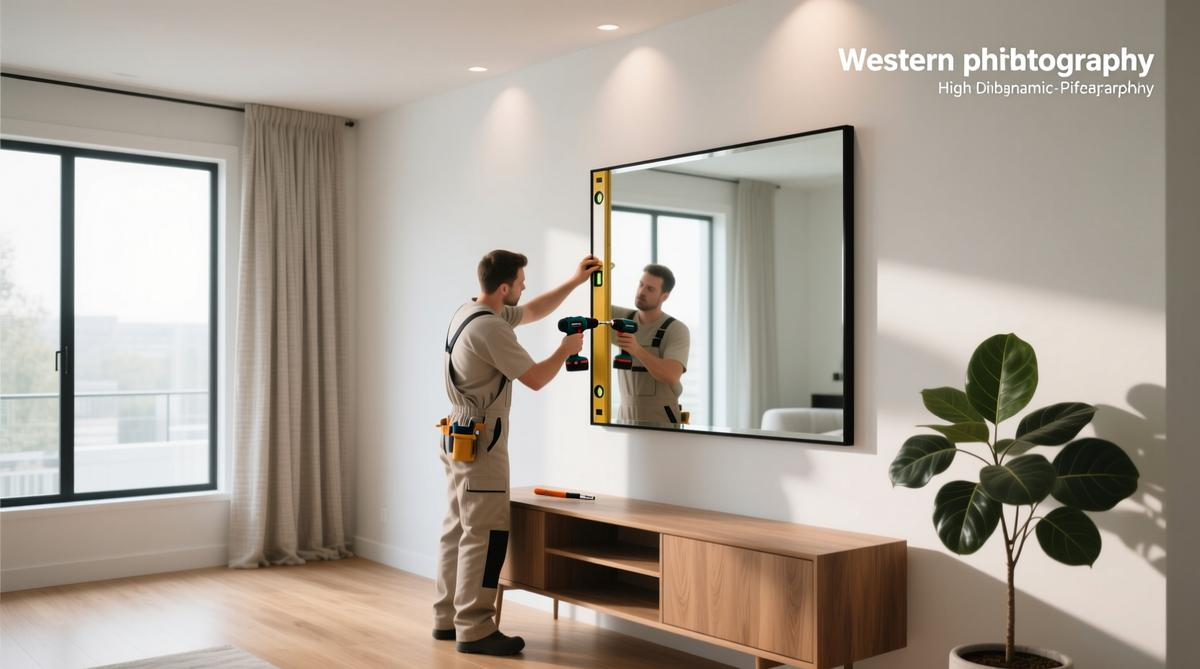
The mirror has arrived.
The packaging is intact. The frame looks exactly like the approved sample. The buyer is satisfied.
Then the installation team arrives.
The wall has no suitable fixing points. The mounting hardware does not match the site conditions. The mirror’s position conflicts with an electrical outlet, and nobody has confirmed whether the wall can support the selected installation method.
The product is fine. The project is delayed.
This is an overlooked problem in wholesale mirror sourcing: buyers spend considerable time approving the mirror but often leave installation planning until the product reaches the site.
For hotels, residential developments, retail fit-outs and commercial interiors, an installation guide should be part of the purchasing decision, not an after-sales document.
A Mirror Is Not Fully Specified Until Its Installation Is Understood
A mirror specification normally describes its dimensions, materials, frame, finish and weight.
But these details do not fully explain how the product will be installed.
Consider two mirrors with identical external dimensions.
One uses a rear hanging bracket. The other is designed for a mechanical mounting system or a manufacturer-approved adhesive installation.
They may look almost identical from the front, but their installation requirements are different.
Buyers should therefore evaluate three connected elements:
- The mirror itself.
- The mounting system.
- The actual installation environment.
A useful installation guide connects all three.
Teruier’s How to Read Mirror Specifications Before You Source a Collection explains why buyers should review the back structure, mounting method and packaging alongside the visible design.
Five Decisions to Make Before Placing the Order
1. Decide How the Mirror Will Be Mounted
There are several possible mounting approaches:
| Method | Typical Application | Important Consideration |
|---|---|---|
| Mechanical fixing | Wall-mounted framed mirrors | Brackets, fixing points and suitable wall anchors |
| Adhesive mounting | Certain mirror panels | Adhesive compatibility and substrate preparation |
| Combined fixing | Selected mirror constructions | Coordination of mechanical and adhesive requirements |
| Freestanding | Mirrors with designed support structures | Base stability and floor positioning |
The appropriate method depends on the mirror construction, weight, backing, wall conditions and manufacturer’s instructions.
Buyers should not assume that every mirror can use the same mounting hardware.
2. Understand the Wall Before Selecting the Hardware
This is where many installation problems begin.
Different wall constructions require different fixing solutions.
| Wall Type | What Needs Checking |
|---|---|
| Concrete | Suitable fixing points and substrate condition |
| Brick or masonry | Material condition and appropriate anchors |
| Timber stud wall | Position of structural supports |
| Gypsum board | Board construction and available structural support |
| Tiled wall | Surface condition and compatible installation system |
| Metal stud partition | Available support and approved fixing arrangement |
The supplier can provide product information and recommended mounting arrangements.
However, the actual wall condition must be checked by the project team or qualified installer.
A generic screw-and-anchor package cannot guarantee compatibility with every building.
3. Confirm Weight, Mounting Points and Orientation
A product’s overall dimensions are not enough.
The installation document should identify:
- Net product weight.
- Overall dimensions.
- Intended mounting orientation.
- Rear bracket positions.
- Distance between mounting points.
- Required wall clearance.
- Hardware supplied with the product.
For example, Teruier’s MY3105 Vintage Gold Arch Wall Mirror measures 89 × 4 × 60.5 cm and weighs 6.3 kg.
Its product information provides a useful starting point, but project buyers should also confirm the exact hanging hardware and mounting arrangement before approving installation.
See the MY3105 Vintage Gold Arch Wall Mirror.
A front-view product photograph cannot replace a rear-view technical drawing.
4. Coordinate Installation With the Room Layout
A technically suitable mounting system can still create problems if the installation location has not been coordinated.
Buyers and project teams should check:
- Electrical outlets and switches.
- Water pipes and other wall penetrations.
- Vanity units and furniture.
- Skirting boards and wall mouldings.
- Door-opening clearance.
- Adjacent lighting.
- Required mirror height and alignment.
For custom-sized mirrors, final measurements should reflect the actual finished installation environment.
This is particularly important in hotel rooms and multi-unit residential projects, where repeating the same incorrect measurement across several rooms can create a much larger problem.
5. Plan Handling and Installation Access
Large mirrors introduce another issue: getting the product from the delivery point to its final position.
Buyers should consider:
- Lift and corridor dimensions.
- Doorway clearance.
- Product weight and handling requirements.
- Number of people required for safe handling.
- Temporary storage and protection.
- Unpacking and installation sequence.
A mirror may fit perfectly on the wall but still be difficult to transport through the building.
This is why installation planning should connect with packaging and delivery planning.
The Hidden Risk of Choosing the Wrong Adhesive
Adhesive mounting is sometimes treated as a simple alternative to mechanical fixing.
It is not.
The adhesive must be compatible with the mirror’s backing and the supporting surface. The wall must also meet the preparation requirements.
For example, AGC Glass Europe’s Mirox MNGE and 4Green+ installation guide specifies requirements concerning clean and dry surfaces, porous-wall preparation, adhesive compatibility and ventilation behind the mirror.
Its guidance also explains why adhesive placement can affect the mirror’s protective backing and reflected image.
These instructions apply to the specified AGC mirror products and should not be treated as universal instructions for every mirror.
Buyers should always obtain the correct installation requirements for the actual mirror and adhesive system being used.
Reference: AGC Mirox Installation Guide.
The lesson is important:
The wrong installation method can damage a perfectly manufactured mirror.
What Should Be Included in a Professional Installation Guide?
For B2B purchasing, an installation guide should be more than a page showing a few screws.
A project-ready installation pack should contain the following information.
| Document | Required Information |
|---|---|
| Product drawing | Front, side and rear views |
| Dimensions | Overall size and mounting-point positions |
| Weight | Net product weight |
| Mounting specification | Approved installation method |
| Hardware list | Supplied components and their identification |
| Site requirements | Relevant wall and surface conditions |
| Installation sequence | Product-specific instructions |
| Safety information | Handling and installation precautions |
| Maintenance | Cleaning and care instructions |
| After-sales reference | Model number and relevant replacement components |
For LED mirrors, the pack should also identify electrical connection requirements, cable exit positions and relevant installation responsibilities. Electrical work must follow the applicable local requirements and be performed by appropriately qualified personnel.
A single generic instruction sheet should not be used for every model if their mounting systems are different.
Teruier’s Category Guides: How German Buyers Review Home Décor Before It Reaches the Floor also discusses why installation information needs to be confirmed before an order is placed.
Who Is Responsible When Installation Goes Wrong?
This question should be settled before the project begins.
A supplier, buyer and installer have different responsibilities.
| Participant | Main Responsibility |
|---|---|
| Supplier | Product drawings, weight, approved mounting information and supplied hardware details |
| Buyer | Confirm project requirements and communicate the intended application |
| Designer or project team | Confirm location, dimensions and coordination with surrounding elements |
| Installer | Examine actual site conditions and execute an appropriate installation |
The supplier should not assume responsibility for unknown wall conditions.
Likewise, the buyer should not assume that the installer can resolve missing product information after delivery.
Clear responsibilities reduce disputes and unnecessary project delays.
Run One Installation Trial Before Repeating the Order
For a hotel, serviced apartment or multi-unit residential project, a useful approach is to install one approved sample in a representative location before releasing the complete installation programme.
This allows the project team to check:
- Actual wall compatibility.
- Mirror position and height.
- Alignment and reflected image.
- Mounting hardware.
- Clearance from nearby furniture.
- Appearance under the actual lighting.
- Handling and installation time.
If the first installation reveals a problem, the mounting specification can be reviewed before the same issue is repeated across dozens of rooms.
This is a practical form of project risk control.
It is often cheaper to resolve one installation issue during a mock-up than to correct an entire completed building.
How Teruier Connects Product Specifications With Installation Planning
Teruier works with international buyers on decorative mirrors, full-length mirrors, vanity mirrors and project-related mirror development.
The product discussion can include dimensions, frame construction, glass specifications, backing, hanging arrangements, packaging and replacement considerations.
For example, the MY3105 mirror is not simply identified by its vintage-gold finish and arched silhouette. Its weight, dimensions, mounting hardware and intended orientation also need to be understood by the buyer.
For larger projects, this information should be incorporated into the product specification and installation documentation before production.
Teruier’s B2B Home Furnishings Sourcing: Plan for the First Replacement Before the First Order also explains why mounting components and replacement arrangements deserve attention during the initial purchasing stage.
For importers and distributors, Evaluate a Home Décor Supplier Before the Order provides a broader framework for reviewing product documentation and delivery coordination.
FAQ
Why do wholesale mirrors need an installation guide?
An installation guide helps buyers, project teams and installers understand the product’s mounting method, hardware, dimensions, wall requirements and handling precautions before delivery.
Should mirror suppliers provide wall anchors with every order?
Not necessarily. The correct anchors depend on the actual wall construction and installation arrangement. Suppliers should clearly identify which hardware is included and which fixing components must be selected for the site.
Can all mirrors be installed using adhesive?
No. Adhesive compatibility depends on the mirror construction, backing, substrate and manufacturer’s instructions. Some mirrors require mechanical fixing or another approved mounting arrangement.
What should hotel buyers check before ordering mirrors?
Confirm dimensions, weight, mounting points, installation method, wall conditions, packaging, access routes and the project approval process. A sample installation can help identify problems before wider deployment.
Should installation instructions be included with every SKU?
For products with different mounting arrangements, model-specific instructions are preferable. Buyers should be able to identify the correct document using the product model and revision.
A Better Mirror Purchase Starts Before Delivery
A beautiful mirror can pass design approval, sample inspection and production quality control, yet still become a project problem if its installation requirements are unclear.
For international buyers, the solution is straightforward.
Do not approve only the mirror.
Approve the mirror, its mounting arrangement, its installation information and its relationship with the actual project environment.
Teruier welcomes international importers, retailers, designers and project procurement teams to discuss decorative mirror development, product specifications, mounting arrangements and manufacturing coordination.
Contact Teruier to discuss your next mirror sourcing or commercial interior project.