A buyer may leave a market with dozens of images, material references, and product ideas. But the images that inspire a collection rarely answer the questions that decide whether it can actually be sourced.
What is the finished size? Which metal tone is acceptable? Where does the LED light sit? What voltage, wattage, and CCT are required? Which details are essential, and which can be adjusted to improve cost, packing, or production stability?
That gap is where a retail-ready spec pack becomes useful. It converts a design direction into a practical decision document—one that a buyer, designer, supplier, quality team, and packaging team can all use.
Market Signal: More Direction, More Detail to Control
Recent North American market direction has placed greater value on material character, considered finishes, and products that feel connected to the wider interior rather than isolated as standalone pieces. High Point Market’s Spring 2026 “Preserve” theme, for example, points toward elevated naturalism, heritage references, and more tactile material combinations.
For buyers, that means a product reference cannot stop at “warm wood,” “soft brass,” or “quiet architectural lighting.” Those ideas need to become controlled information before a sample is approved.
A Backlit Bathroom Mirror Brief: Where Ambiguity Usually Appears
Consider a buyer developing a backlit bathroom mirror for a North American residential or hospitality program.
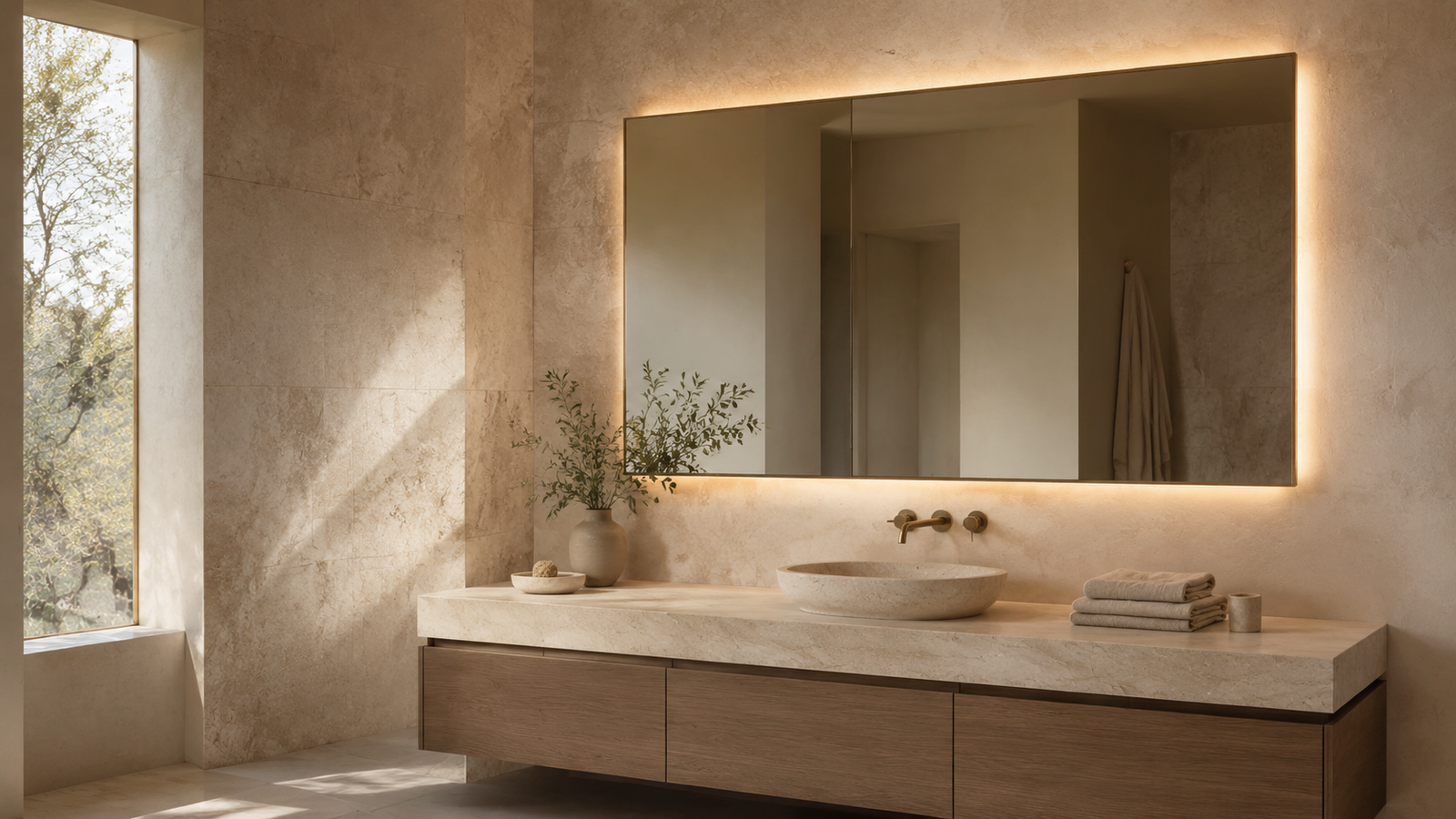
The visual brief may call for a thin metal frame, a warm LED halo, a clean reflective surface, and a finish that coordinates with bathroom fixtures. The designer may also want the light to feel soft rather than commercial.
Without a defined backlit bathroom mirror spec sheet voltage wattage CCT section, several issues can remain unclear:
- Is the requirement 120V for the intended market, or another electrical configuration?
- Is the stated wattage the total fixture draw or an LED-strip reference?
- Is the target color temperature 2700K, 3000K, or 4000K?
- Does the lighting sit behind the mirror, at the edge, or within a visible diffuser?
- How will the mirror be mounted, serviced, protected, and packed?
Each answer changes the product. A visually similar mirror can become a different commercial offer once electrical components, mounting, carton protection, and installation requirements are included.
What a Strong Spec Sheet Actually Does
It Separates the Non-Negotiables From the Adjustable Parts
A useful spec sheet identifies what must remain true to the design: overall proportions, visible frame width, finish family, mirror position, lighting effect, and installation intent.
It should also identify where the supplier can make informed recommendations. For example, a hidden rear channel may create a cleaner front view; a revised mounting plate may improve installation access; or a protective packing method may reduce the risk of finish abrasion in transit.
That does not dilute the designer’s intent. It protects it by making each change visible and reviewable.
It Creates Evidence for the Next Decision
A strong document set usually includes dimensions, material and finish references, structural notes, component information, lighting specifications, mounting logic, packaging requirements, approved-sample photos, and defined quality checkpoints.
This is why spec sheets and product notes should sit together. The sheet records the product. The notes record the reasoning behind the product.
For a mirror, one product note may state: “Front frame width must remain visually slim; any reinforcement must be concealed from the front elevation.” Another may record: “3000K warm white requested to coordinate with the intended hospitality bathroom atmosphere; confirm final LED component before bulk production.”
Those notes make future sampling, inspection, and reorders much easier to control.
The Value of a Designer Resource Center
A practical designer resource center for interior designers should not be a gallery of attractive downloads. It should help users move faster through real sourcing decisions.
The most useful resources are the ones that make comparison possible:
| Reference only | Retail-ready specification |
|---|---|
| Inspiration image | Dimensioned drawing |
| Color impression | Finish reference and acceptable variation |
| General “warm light” request | Voltage, wattage, CCT, and light-placement requirement |
| Product silhouette | Structure, mounting, and packaging notes |
| Sample approval by memory | Dated approval record and quality checkpoints |
At Teruier, this process helps move a concept from a visual direction into a product brief that can be sampled, reviewed, packed, and produced with fewer assumptions.
Buyer Summary
- A retail-ready spec pack makes sourcing decisions easier to compare and approve.
- The most important product details are often the ones not visible in an inspiration image.
- For backlit mirrors, voltage, wattage, CCT, mounting, and lighting position should be clarified early.
- Product notes preserve the design logic when construction or packaging needs to be adjusted.
- Better specifications support clearer pricing, sampling, inspection, and repeat orders.
FAQ
What should a backlit bathroom mirror spec sheet include?
It should include dimensions, mirror and frame materials, lighting location, voltage, wattage, CCT, mounting method, relevant component requirements, packaging expectations, and approved visual references.
Is a product photo enough to request a quotation?
A photo can begin the conversation, but it is rarely enough for an accurate quotation. Dimensions, materials, finish, construction, packing, and target-market requirements can materially change cost and feasibility.
When should product notes be locked?
Product notes should be refined during sampling and locked with the approved sample before bulk production. Any later change should be documented so quality expectations remain clear.
CTA
A strong product direction deserves a clear path to approval. Teruier helps buyers and interior designers turn design references into workable spec sheets, product notes, samples, packaging plans, and production-ready collections. Contact our team to discuss your next development brief.