Why the Arched Leg Bench Feels New Without Feeling Risky
Some products get attention because they are loud.
A great arched leg bench gets attention because it makes the room feel better almost instantly.
That is why I think this category deserves more respect from U.S. retail buyers in 2026. On paper, it sounds simple: a bench with a softer base silhouette. In practice, it does something much more useful. It takes a familiar furniture form and gives it enough architectural character to feel fresh, while still staying broad enough for real retail. In a market that is clearly rewarding softer lines, fuller silhouettes, and more emotionally legible home products, that is a very good place to be. Las Vegas Market’s official 2026 trend snapshot highlighted “Restorative Softness” as a key direction built around soft lines, lush textiles, and full silhouettes, while High Point Market’s official Future Snoops theme, “Club Kitsch,” framed the season around comfort, familiarity, and retro-modern optimism.
The buyer behind this keyword is not looking for a novelty piece
The person searching arched leg bench is usually not shopping for a one-off design statement. More often, it is a furniture merchant, chain-store buyer, or sourcing lead trying to find a product that can lift the assortment without creating unnecessary inventory risk. That matches what the U.S. markets are showing right now. Atlanta Market’s January 2026 edition reported strong order writing, higher buyer satisfaction, a 5% increase in stores attending, and a 15% increase in first-time buyers, with organizers explicitly noting the cross-category demands of today’s retail buyers. Las Vegas Market’s Winter 2026 wrap-up also reported strong order writing and a notable increase in new buyers.
That matters because the arched leg bench sits in a very attractive middle zone for retailers. It is more distinctive than a plain bed end bench, but less polarizing than a highly sculptural accent piece. It gives the floor a softer architectural read without asking the customer to decode a complicated product story. For a buyer, that is exactly the kind of design move that can feel current and still remain reorderable. This last point is my merchandising inference based on the market’s documented sourcing behavior and softness-led trend direction.
Why the arch matters now
The arch is not just decoration. It changes how the furniture behaves visually.
A peer-reviewed study involving researchers affiliated with the University of Pennsylvania found that people judged curvilinear interior architectural spaces as more beautiful than rectilinear ones, and nonexperts were more likely to choose to enter curvilinear spaces in approach-avoidance decisions. For retail buyers, the practical meaning is clear: curved and softened forms can make environments feel more inviting and less rigid.
That is one reason the arched leg bench feels so commercially useful right now. It borrows the emotional benefits of curvature without forcing a full curved-body product. It is easier to place than a highly rounded bench, but softer and more current than a hard-lined rectangular base. That makes it an especially good bridge product in assortments that are trying to move toward softer design language without losing retail clarity. This design conclusion is my inference, supported by the contour-preference study and 2026 market trend language.
Why this style fits the 2026 home floor
The 2026 home market is not asking only for softness. It is asking for softness with shape.
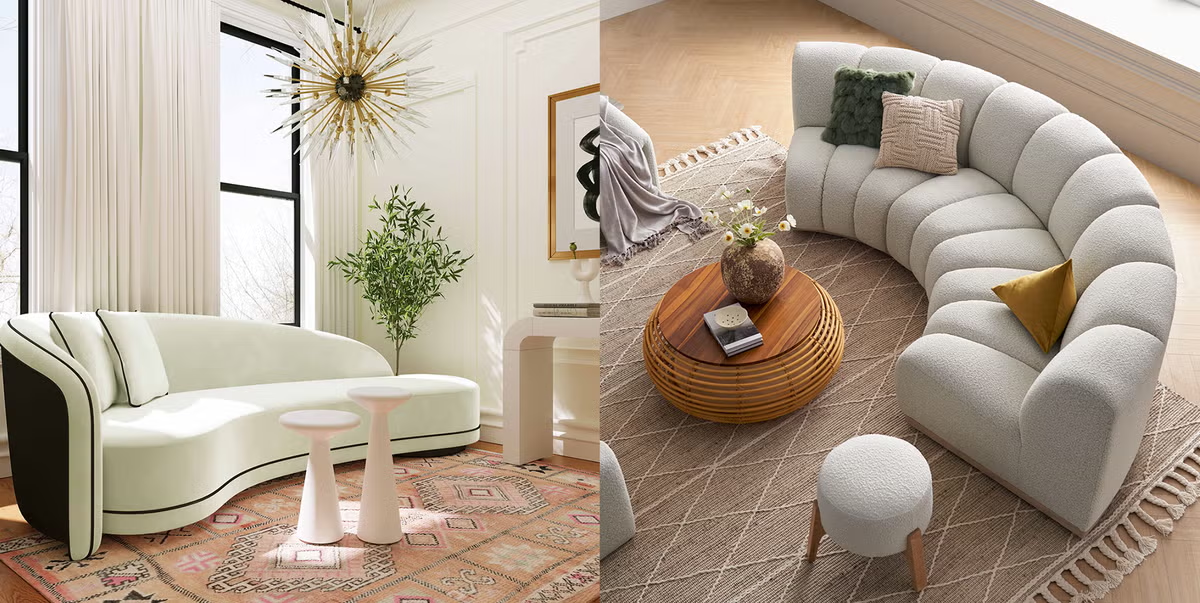
That is where the arched leg bench becomes stronger than it first appears. The official Las Vegas Market language around soft forms and full silhouettes gives buyers permission to move away from severe geometry. High Point’s Club Kitsch direction adds another useful layer by making warmth, familiarity, and expressive comfort feel timely rather than nostalgic in a dusty way. Together, those signals support furniture that feels welcoming, touchable, and slightly architectural.
This is also why related textures and companions matter. A clean upholstered arch can work beautifully in performance boucle for a softer, more scalable chain-store story. A richer burnt orange velvet ottoman can give the same assortment a warmer fashion note. And if a retailer needs a simpler opening-price companion, even a cube ottoman for retailers can sit next to an arched bench and make the whole floor feel more layered. Those specific merchandising moves are my buying interpretation of the official trend direction.
What the selection intelligence would say
Our selection intelligence would make one point immediately:
Do not buy the arched leg bench just because the side profile looks elegant in one showroom photo.
A weak version is very easy to make. A strong version is much harder.
The strong version gets the proportions right. The arch cannot be too shallow, or it disappears. It cannot be too dramatic, or it becomes niche. The bench has to feel balanced from the front, stable from the side, and useful in real rooms. It also needs a seat treatment that matches the account. In one channel, that may mean a tighter upholstered top. In another, it may mean a plusher story that sits between a bed end bench and a soft ottoman. The evaluation logic here is my merchandising framework, but it is grounded in the broader market move toward soft, legible forms.
Why material choice decides whether this becomes a program
This is where many buyers can make a better decision than they did two years ago.
The right arched leg bench is not only about silhouette. It is about whether the material story helps the arch feel more intentional. Performance boucle is commercially strong because it aligns with the softness trend and gives the product tactile credibility without making it too fashion-fragile. Velvet can work too, especially when the assortment needs one warmer, more expressive item such as a burnt orange velvet ottoman companion. But the key is discipline. The arch already carries the design signal. The upholstery should support it, not overpower it. That conclusion is my buying inference based on the official market emphasis on lush textiles, comfort, and familiarity.
Why the finishing process supply chain matters more than the sketch
A bench like this can look effortless and still be difficult to execute well.
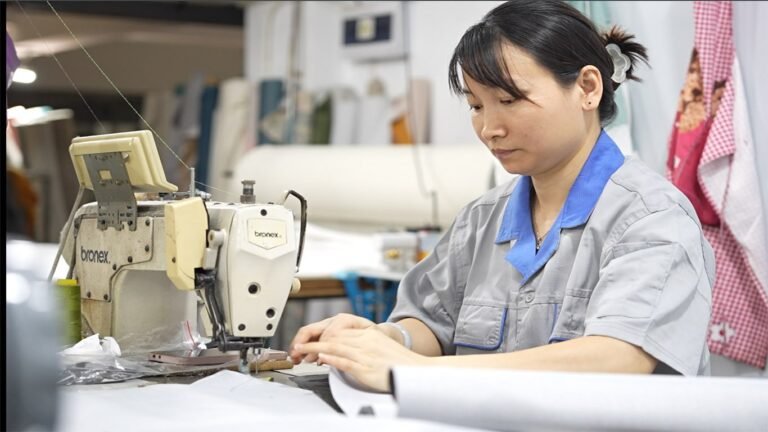
That is why I would pay close attention to the finishing process supply chain. If the arch is wood-based, the finish has to stay consistent across curves, joints, and sight lines. If the bench is upholstered, the fabric tension and seam discipline have to stay balanced so the arch still reads cleanly. A nice sample is not enough. A buyer needs to know whether the product can hold its visual integrity in production, not only in the first prototype. The broader importance of supplier readiness and scalable sourcing is strongly supported by the January and February 2026 market recaps showing active ordering and new-account growth. The specific finishing-risk logic is my commercial inference.
This is exactly where Teruier’s value translation matters. A buyer does not simply need a factory that can copy an arch. The buyer needs a partner who can translate a trend signal into a retail-correct item: the right span, the right fabric hand, the right seat height, the right stain or paint behavior, and the right quality controls so the arch still feels intentional at volume. That is how a trend becomes margin instead of just mood.
Why packaging is now part of the design decision
Here is the part many buyers underweight: a good-looking bench still fails if the packaging fails.
That is why honeycomb paper packaging is more relevant than it sounds. Recent open-access research notes that honeycomb paperboard has good cushioning and anti-vibration performance and is widely used in product protection and packaging engineering. Separate 2024 research on honeycomb sandwich panels used in cushioning packaging describes them as extensively employed because of strong energy-absorption capability. In practical buying terms, that means protective paper structures are not just a sustainability talking point. They can play a real role in helping furniture survive transit.
For an arched leg bench, that matters because the design often creates vulnerable geometry at the base. If the arch edge, leg curve, or upholstered lower frame is not protected correctly, the bench loses the very detail that made it special. So packaging should not be treated as an afterthought. It is part of product readiness. The research-backed claims here concern cushioning performance; the product-specific packaging implication is my inference.
My buyer take for 2026
If I were editing a 2026 upholstery or occasional-furniture assortment, I would not treat the arched leg bench as a fashion gamble.
I would treat it as one of the cleaner ways to add visible newness.
It aligns with official market signals around softness, comfort, and expressive but usable form. It benefits from academic evidence that curved environments are often preferred aesthetically. It can live in multiple retail roles: as a bed end bench, as an entry accent, as a companion to a burnt orange velvet ottoman, or as the softer architectural piece that helps a whole roomset feel more elevated. And if the supplier can support finishing discipline and protective packaging, it has a very credible path to becoming a program instead of a one-season experiment.
That is why I like this category.
The arched leg bench feels new without feeling risky.
And for a retail buyer in 2026, that is exactly the kind of product worth betting on.