Why the Curved Bathroom Mirror Is No Longer a Niche Piece—But a Serious Retail Signal for 2026
There was a time when the bathroom mirror was treated as the last practical decision in the room. Flat, silent, standard. It reflected the washbasin and nothing more.
That time is ending.
The curved bathroom mirror has moved far beyond decoration. It is now part of how a bathroom feels, how a retail display reads, and how a customer interprets quality at first sight. In a market where many categories are overfilled with noise, curves do something very efficient: they soften the room, lift perceived value, and make even a compact bathroom feel more resolved.
For a buyer, this is not a small styling detail. It is a merchandising signal.
At Maison&Objet January 2026, the official theme was “Past Reveals Future,” with trend directions such as Metamorphosis, Mutation, Revisited Baroque, and Neo-Folklore—clearly pointing the market toward craftsmanship, meaning, emotional objects, and reinvention rather than cold uniformity. At Ambiente 2026, Messe Frankfurt framed the new style worlds as “brave, light and solid,” asking which colours, shapes, and materials define how we want to live now. The same fair also highlighted Interior Looks 2026 for both retail and hospitality projects, showing how strongly residential taste and contract thinking are now overlapping.
That is exactly why the curved bathroom mirror matters now. It sits where 2026 taste is moving: softer geometry, emotionally legible shapes, functional elegance, and products that do more than merely occupy a wall.
Curves are not only fashionable. They are easier for people to like.
This is where the category becomes more interesting.
Research in architectural psychology consistently shows that people respond positively to curvature in built environments. Recent studies found that curvilinear spaces were rated as more aesthetically pleasing and emotionally positive than angular ones, and another 2024 study reported that curved rooms increased positive affect and creativity compared with rectangular settings. Earlier work also showed that people tend to judge spaces with greater openness and height more positively. A mirror does not physically enlarge a room, of course, but it can visually support precisely those qualities: softness, openness, and perceived spaciousness.
That is why a curved bathroom mirror works so well in modern bathrooms. It interrupts hard tile lines, balances cabinetry, and reduces the visual severity that many bathrooms naturally have. In commercial terms, it helps the room feel more expensive without asking the customer to rebuild the room.
That is very strong value.
Why this shape fits the 2026 market better than a plain rectangle
A standard rectangle still sells. But a standard rectangle rarely leads.
The better buyer in 2026 is not only asking, “Will this mirror move units?” The better question is, “Will this mirror improve the whole presentation around it?” This is where curved formats outperform.
A curved bathroom mirror can connect with several live directions at once:
the calm softness seen across interior design trends 2026
the rise of sculptural bathroom styling
the demand for pieces that work in both private homes and hospitality-inspired interiors
the shift from purely functional bathrooms to visually curated daily-use spaces
The commercial advantage is that one good mirror can help sell more than itself. It can strengthen the vanity, the wall finish, the lamp choice, and even the storage story around it. That is why buyers should no longer think of it only as a reflective product. It is part of the room’s mirror wall decor language.
The real assortment question: curve, wave, smart, or shelf?
A chain buyer should not build the category around one silhouette only.
The classic curved bathroom mirror is the best broad-volume piece. It is clean enough for mainstream retail, but warm enough to feel current. It works in German apartments, hospitality bathrooms, premium rental projects, and modern family homes.
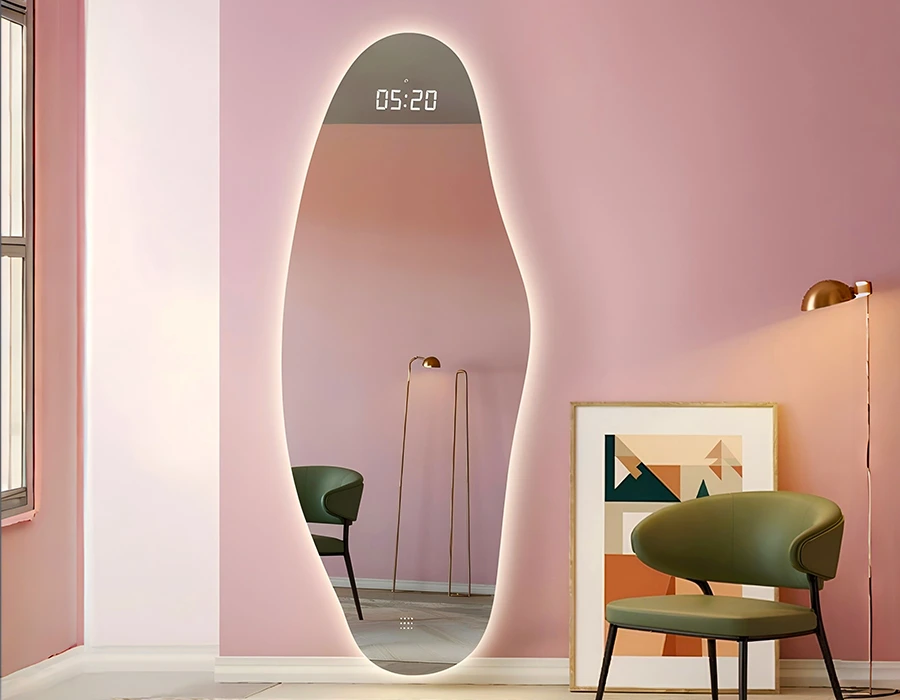
The wavy wall mirror is more fashion-led. It is useful for editorial lift, younger consumers, and trend-sensitive online merchandising. It creates differentiation, but it should usually sit beside the core assortment, not replace it.
Then comes the feature story.
At ISH 2025 in Frankfurt, exhibitors were actively showing bathroom mirrors with functions such as touch controls, dimming, anti-fog systems, Bluetooth, screen integration, humidity-responsive defogging, and customizable shapes. ISH exhibitor listings also showed illuminated mirror cabinets and mirror formats with adjustable shelves, which makes the integrated shelf mirror especially relevant for compact bathrooms where styling and storage must work together. In other words, the market is no longer choosing between beauty and utility. It increasingly expects both.
For this reason, the smart commercial range is usually three-layered:
one core curved model for volume,
one more expressive fashion shape,
and one feature-led mirror such as a smart vanity mirror or integrated shelf mirror for higher-value conversion.
That is not trend confusion. That is category discipline.
What the buyer reading this article is really looking for
The audience for this piece is not a hobby decorator scrolling for inspiration.
It is more likely a buyer in a home chain, a category manager, a merchandising lead, a sourcing director, or a project-furnishing team member who must decide whether a new mirror line is only attractive—or actually worth floor space.
This buyer is watching Europe carefully. They have already seen that the tone of the market is changing. Maison&Objet is pushing meaning, craft, and reinvention. Ambiente is pushing brave, light, and solid. Hospitality and retail are borrowing more from one another. The buyer therefore wants products that are softer, more architectural, easier to style, and still operationally sensible.
So the real questions are these:
Will the mirror make a small bathroom display feel larger?
Will it photograph well for e-commerce?
Will it still look current after the next season?
Will it support a premium impression without destroying margin?
Will the supplier understand both design language and execution detail?
That last point is where many sourcing decisions become weak.
A mirror supplier should not only supply mirrors
Too many suppliers still offer the category in the old way: size list, frame colour, price.
A serious home décor supplier team should do more than that. It should understand room logic, packaging risk, installation reality, moisture conditions, lighting function, and how European buyers actually build a collection.
This is where Teruier’s strength can be framed as value translation.
A fair trend in Paris or Frankfurt is not yet a commercial SKU. Someone must translate that trend into proportions, frame profiles, anti-fog specifications, lighting options, packaging standards, and a shape language that can live across retail, hospitality, and online presentation. That is the real work. Not only design. Not only manufacturing. Translation.
And the curved bathroom mirror is a perfect example of such translation. It takes an abstract market preference—softness, calm, warmth, spatial ease—and turns it into a product customers understand immediately.
Why this category deserves more confidence from German retail buyers
German buyers are often more careful than flashy. That is a strength, not a weakness.
The point is not to buy a mirror because it is fashionable for one fair season. The point is to buy a mirror because its geometry solves several retail problems at once: it softens hard lines, lifts perceived quality, supports cross-selling, and fits the broader direction of European interiors.
That is why the curved bathroom mirror is becoming more than a bathroom accessory. It is becoming a stable visual tool for modern assortments.
It can sit beside an integrated shelf mirror in a compact-bathroom story.
It can sit beside a smart vanity mirror in a technology-meets-comfort story.
It can sit beside a wavy wall mirror in a trend capsule.
And it can still function as the clean, reliable backbone of a broader mirror wall decor programme.
That is commercial flexibility. Buyers should respect it.
Final thought
A plain mirror reflects what is already there.
A well-designed curved bathroom mirror improves what is there before the customer even turns on the tap.
In 2026, that is exactly the kind of product serious buyers should want: a product with emotional clarity, practical intelligence, visual softness, and strong cross-category selling power.
Not loud.
Not gimmicky.
Just correct for where the market is going.