If I am buying for a U.S. home chain, I do not start with the piece that shouts the loudest across the showroom. I start with the one that helps a customer picture a better room in five seconds. That is why the skirted ottoman has become more interesting again. It softens the architecture of a space, hides visual heaviness at the base, and gives a room that “settled” feeling shoppers often want but cannot always describe. In a market full of hard edges and overexplained accent pieces, a skirted ottoman feels easy. And easy sells.
Softness is not a side trend anymore. It is the mood of the market.
The latest market signals support that instinct. Las Vegas Market’s January 2026 Market Snapshot named one of its key themes “Restorative Softness,” defined by soft lines and forms, lush textiles, and full silhouettes. At the same time, ASID’s 2026 Trends Outlook said consumers are becoming more selective, value-conscious, and outcome-driven, while also noting that “maximalism returns,” with visible personality, playful silhouettes, and a move away from pure restraint. Put those together, and the commercial opening becomes clear: buyers want softness, but not blandness; character, but not chaos. The skirted ottoman fits that opening almost perfectly.
That matters because this is not just a style story. It is a buying story. Atlanta Market’s January 2026 recap said stores attending rose 5% and first-time buyers rose 15%, with notable growth across buyer types and stronger cross-category demand. That is exactly the environment where a skirted ottoman works: it can sit inside a living-room story, soften a bedroom corner, or even support an entry vignette without feeling overcommitted to one look. It is versatile in the way chain-store buyers need products to be.
The real buyer for this SKU is not buying “cute.” They are buying room confidence.
The user profile here is pretty specific. This article is for the retail buyer, merchandising manager, or sourcing lead who needs products that can do three things at once: look current, fit real American homes, and protect margin without creating visual sameness. That profile matches the broader 2026 signals. ASID says customers are leaning toward long-term value, flexibility, and spaces that support well-being and performance, while Atlanta Market’s 2026 recap points to buyers shopping more categories together. That means the strongest SKU is rarely the most dramatic one. It is the one that can work across more than one setting and still feel emotionally convincing.
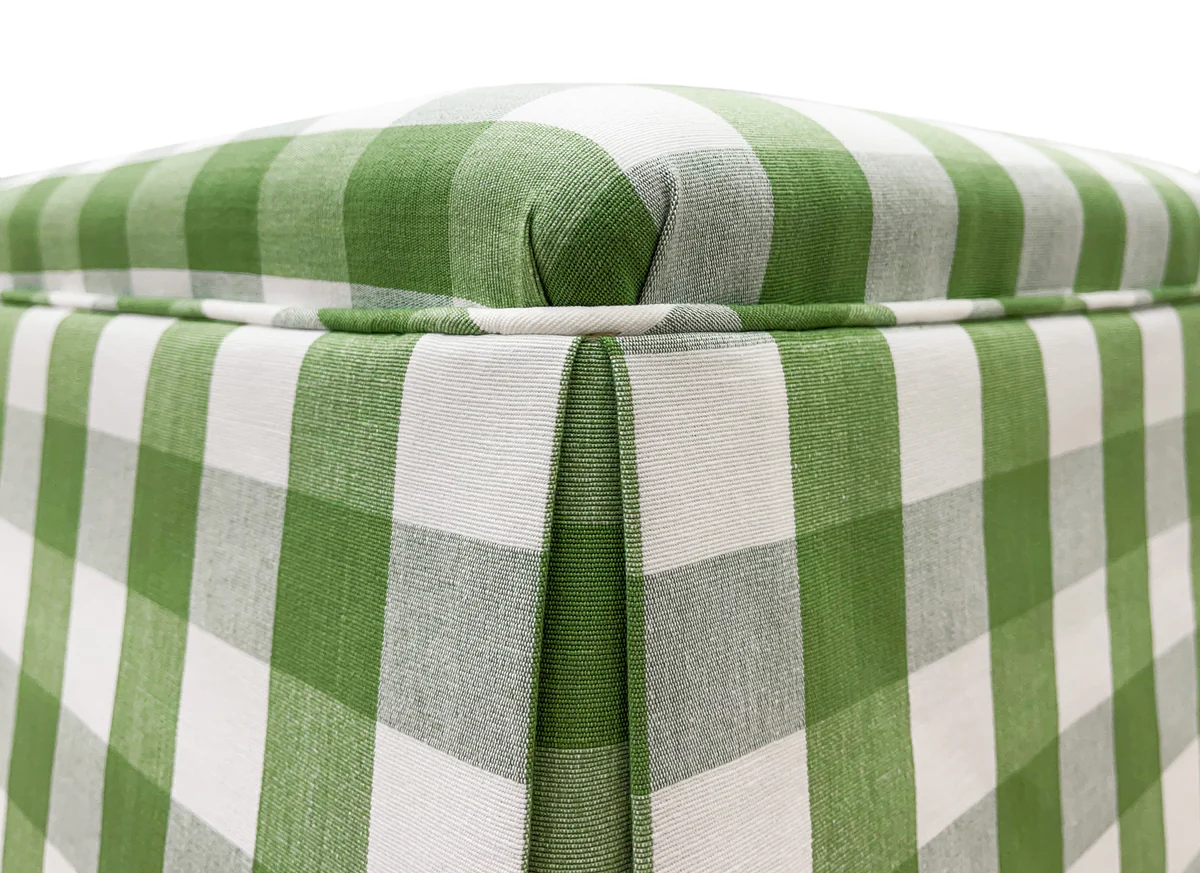
That is why the skirted ottoman earns attention. It can feel tailored, casual, relaxed, or quietly polished depending on the fabric and room story around it. A plaid ottoman variation can bring heritage and pattern into the assortment. A version in performance boucle can push the item toward tactile comfort and family-friendly wear. Merchandised beside an entryway storage bench or a flip top storage bench, it gives the customer two different answers to the same need: softness versus utility, or ideally, both at once.
Why this piece makes sense in actual American homes
The best ottoman stories are never only about aesthetics. UCLA’s Center on Everyday Lives of Families documented a “staggering number of possessions” in middle-class American homes, and UCLA reporting on that work says clutter is linked to higher stress, especially for mothers describing their home environments. That matters because storage-adjacent furniture is not just functional. It offers emotional relief. Even when a skirted ottoman is not a storage piece itself, it still participates in the same commercial logic: customers want homes to feel calmer, softer, and less visually crowded.
The housing backdrop points in the same direction. Harvard’s Joint Center for Housing Studies said in its 2025 housing report that high home prices and elevated interest rates reduced homebuying to its lowest level in 30 years. ASID’s 2026 Outlook also says downsizing, co-living, and adaptable living strategies are gaining traction, especially in high-cost cities. When homes feel tighter and budgets feel more selective, buyers have to favor pieces that add warmth and flexibility without consuming too much visual or physical space. That is one reason an ottoman category that includes skirted, storage, and textural variants still has real commercial strength.
A good ottoman program should feel layered, not repetitive
One mistake I see too often is treating ottomans as filler. They are not. They are mood-setters. They are spacing tools. They are category bridges between upholstery and accent furniture.
A stronger retail move is to build a small family around the category. Let the skirted ottoman be the soft, room-finishing piece. Let a plaid ottoman add character and visual memory. Let performance boucle bring touch and resilience. Let a storage option echo the logic of an entryway storage bench or flip top storage bench for customers who need concealed function. That is how you create depth without cluttering the assortment. The shopper sees variety, but the buyer still keeps control.
Where value translation starts to matter
This is where “value translation” becomes more than a nice phrase. A factory can make an ottoman. A better partner can explain why one silhouette belongs on a U.S. retail floor right now and another one does not.
A capable home decor ODM supplier should be able to translate current market language into real product logic. If Las Vegas Market says softness matters, that should not result in random overstuffed shapes. If ASID says visible personality is back, that should not mean undisciplined color or novelty for its own sake. A better answer is disciplined softness: a skirted ottoman with better proportion, a plaid ottoman that feels fresh instead of rustic, or a boucle version that balances warmth with wearability. That is what turns trend language into a sellable SKU.
And this is also where operational details start affecting margin. Sustainable packaging is not just a brand virtue signal anymore. For chain buyers, it is part of product credibility: less waste, better transit discipline, and a cleaner first impression when the product lands. The same is true for material choices, carton structure, and consistency across repeats. In categories this visual, poor execution is not a back-end issue. It becomes the customer experience.
Why the skirted ottoman deserves more respect from buyers
For a while, buyers treated skirted forms as too traditional or too quiet. I think the market has moved past that. Today, quiet is not a weakness. Quiet is often what makes a room feel expensive.
The skirted ottoman works now because it matches the market’s push toward softness and fuller silhouettes, while still giving merchants room to build in personality through fabric, pattern, and pairing. It also fits a more value-conscious customer who wants comfort, flexibility, and an interior that feels finished rather than staged. The category becomes even stronger when it is merchandised alongside practical companions like an entryway storage bench or flip top storage bench, and when the sourcing partner understands how to turn trend signals into commercially disciplined design.
From a U.S. retail buyer’s perspective, that makes this more than a soft accent. It makes it a smart floor tool. And in a year when buyers are under pressure to justify every SKU, the pieces that quietly make a room work are often the ones that win the reorder.