
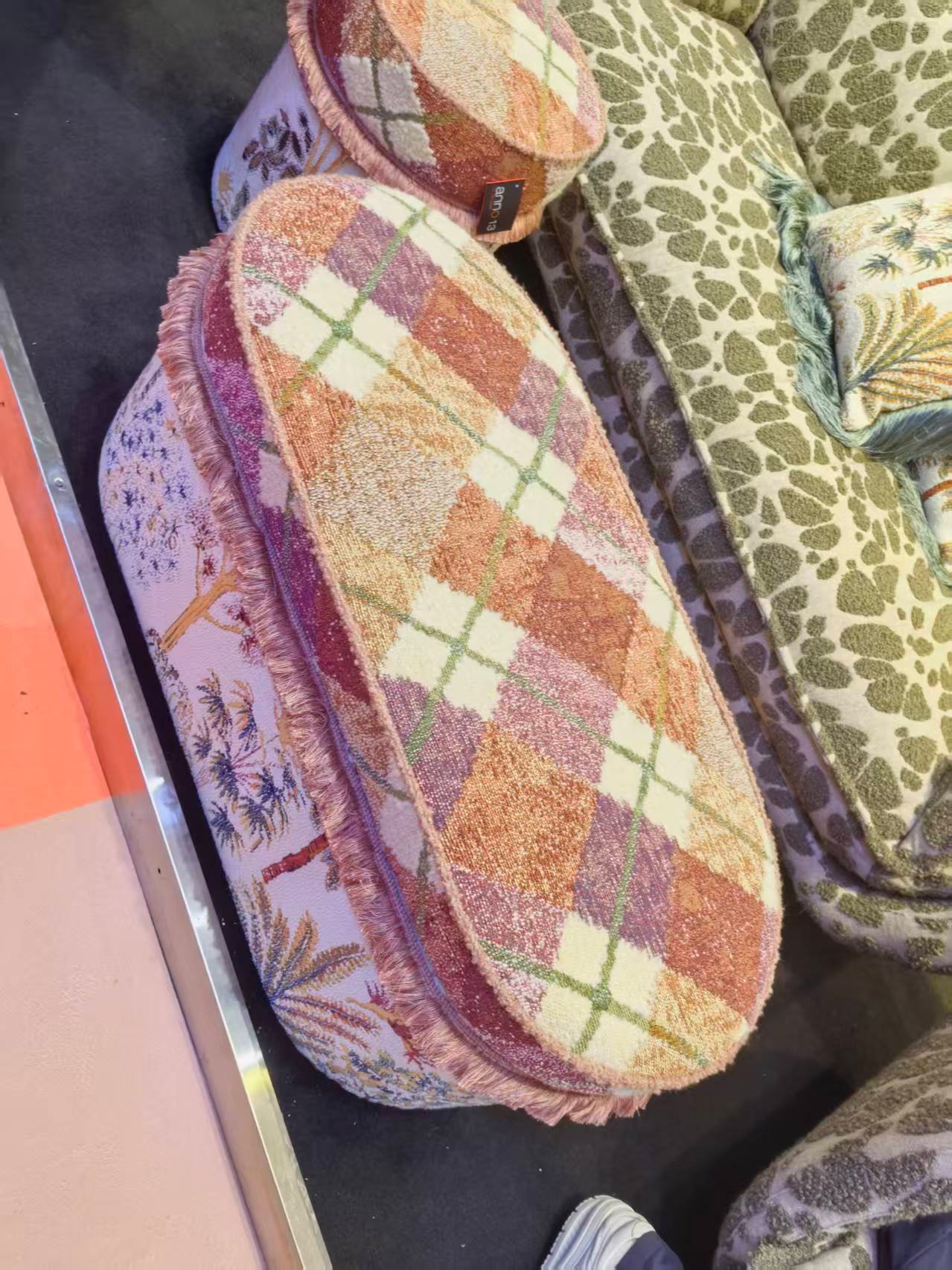
If I am walking a market floor for a U.S. home chain, I do not start with the piece that screams the loudest. I start with the one that can make a room feel finished fast. That is why the plaid ottoman has become more interesting again. It brings pattern without the commitment of a full sofa, warmth without looking heavy, and personality without forcing the whole assortment into one style lane.
That is the real magic of this category. A plaid ottoman can feel casual, tailored, cozy, heritage-driven, or even unexpectedly modern depending on how the merchant builds the surrounding story. In a good assortment, it is not a one-off accent. It is a visual anchor.
The market is shifting toward softness, personality, and richer visual texture
The latest U.S. market signals support this direction. Las Vegas Market’s Winter 2026 Market Snapshot highlighted “Restorative Softness,” describing the season through soft forms, lush textiles, and fuller silhouettes. At nearly the same time, ASID’s 2026 Trends Outlook said “Maximalism Returns,” with design moving away from restraint and back toward visible personality, saturated expression, and playful silhouettes. Put those two signals together, and the opportunity becomes pretty clear: buyers can lean into softness without becoming bland, and they can add personality without losing commercial balance. A plaid ottoman sits neatly in that opening.
This is where pattern starts to matter again. Bouclé gave the market touch. Plaid can give it memory. It feels familiar, but not necessarily traditional. It can nod to Americana, lodge warmth, East Coast prep, farmhouse restraint, or city-apartment layering. That range makes it useful.
The real buyer for this piece is not buying “cute.” They are buying room energy.
The user profile here is easy to recognize. This article is for the chain-store buyer, category manager, or merchant who has to hit margin, keep the floor fresh, and still make the assortment easy to shop. That buyer matches the latest market behavior. Atlanta Market’s January 2026 recap said the show welcomed independent retailers, national chains, designers, and buying groups, with a 5% increase in stores attending and a 15% increase in first-time buyers. The same recap also emphasized the growing cross-category demands facing today’s retail buyers. That suggests a buyer who is not just looking for single-item novelty, but for pieces that can work across several merchandising stories.
That is why the plaid ottoman deserves attention. It can live beside a boucle swivel chair in a comfort-driven floor set. It can sit near an entryway storage bench to bring softness into a transitional space. It can trade up next to a boucle storage ottoman for texture contrast, or be merchandised with a box pleat storage ottoman for a more tailored, dressmaker-style story. In other words, it has flexibility, and flexibility is what smart merchants pay for.
Why this category works in actual American homes
The appeal is not just visual. UCLA research on family homes found a staggering number of possessions in everyday American households, and UCLA’s reporting on that work noted a link between how families, especially mothers, described cluttered home environments and their cortisol-related stress patterns. The researchers also described excess possessions as a visible sign of unfinished work that can create substantial stress. That is one reason multifunctional accent furniture remains commercially strong: customers are not simply buying furniture, they are buying relief.
Housing pressure reinforces the same point. Harvard’s Joint Center for Housing Studies reported in 2025 that high home prices and interest rates pushed homebuying to its lowest level in 30 years, and that builders responded to affordability pressure by producing homes that were smaller or had fewer amenities. When homes feel tighter and budgets feel sharper, pieces that combine style, comfort, and function become easier to justify. That makes the plaid ottoman stronger when it comes with hidden utility, or when it is positioned alongside a flip top storage bench or other flexible pieces that help the customer get more from less square footage.
The smartest assortment does not stop at one ottoman
A lot of merchants make the same mistake: they order a single accent shape and expect it to carry the whole category. That is not how the best floors work now.
The stronger move is to build layered ottomans into a small but intentional family. One plaid piece adds pattern. One bouclé piece adds tactile softness. One tailored silhouette, like a box pleat storage ottoman, adds polish. One functional option, such as a boucle storage ottoman, adds hidden usefulness. Now the shopper sees not just products, but a point of view.
That is also where the plaid ottoman becomes more than a seasonal accent. It can act as the item that breaks up too much solid upholstery and keeps the room from looking flat. It can also help a retailer tell a warmer story without forcing a whole assortment into holiday, farmhouse, or cabin language. Used well, plaid gives atmosphere, not costume.
Where “value translation” matters
This is where I think value translation becomes the real sourcing advantage. Plenty of factories can make an ottoman. Fewer can understand why one ottoman deserves floor space and another one does not.
A good manufacturing partner should be able to translate market direction into retail logic. If the market wants softness, the answer is not only more bouclé. If the market wants personality, the answer is not random color. A better answer is controlled contrast: a plaid ottoman against a boucle swivel chair, a patterned accent next to a cleaner entryway storage bench, or a warm plaid story mixed into layered ottomans so the assortment feels dimensional instead of repetitive.
That is where Teruier’s cross-border design-manufacturing thinking becomes useful. The value is not just production capacity. The value is the ability to turn trend language into an actual sellable SKU strategy—one that connects texture, silhouette, storage function, and visual balance to merchant profit.
Why the plaid ottoman deserves a second look now
For years, buyers treated plaid as either too rustic or too obvious. I think that was a mistake. In the current market, plaid has a different job. It no longer has to dominate the room. It just has to bring the room to life.
The reason the plaid ottoman works now is simple. It fits the market’s return to softness and fuller forms, but it also benefits from the broader shift back toward visible character and layered styling. It fits real American homes that need more flexibility. And it gives buyers an easy way to create distinction without adding too much complexity to the floor.
From a U.S. retail buyer’s perspective, that makes it more than a decorative extra. It makes it a quiet traffic piece—one that can support the room set, sharpen the assortment, and give the customer a reason to stop, touch, and imagine it at home. That is exactly the kind of product that earns a reorder.



