
Let’s begin with a retail truth that hurts a little.
A lot of buyers say they want personality.
What they actually buy is caution with a glaze finish.
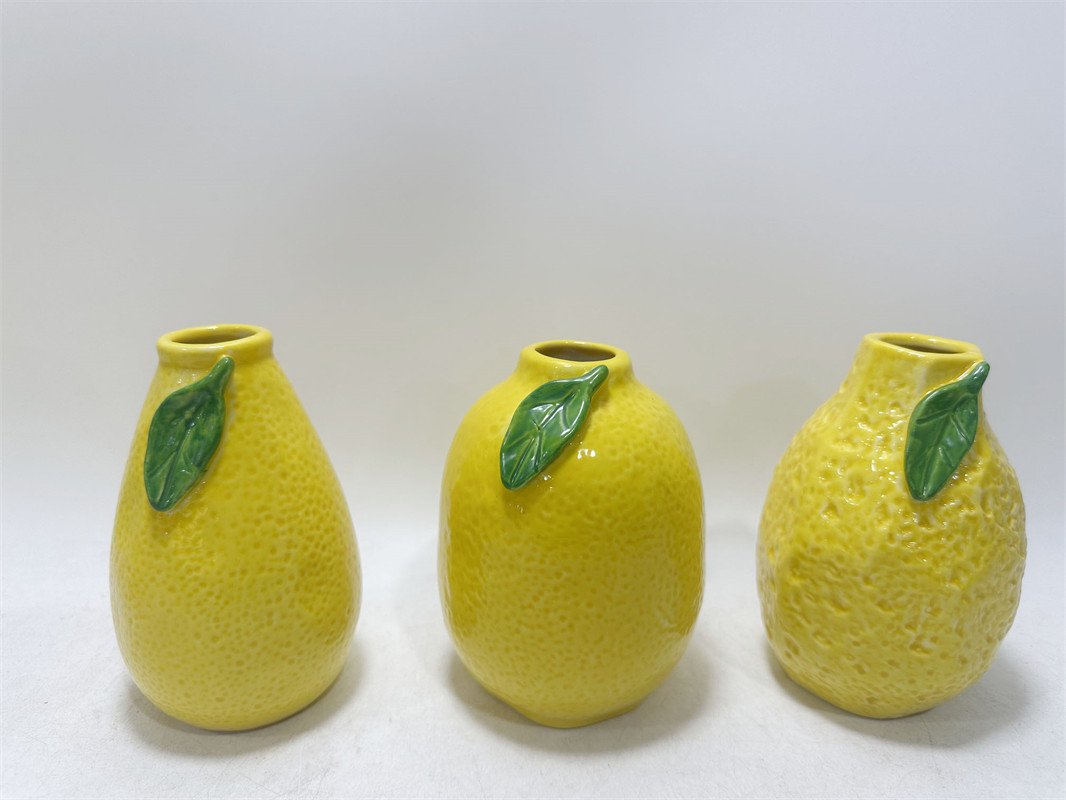
That is why the lemon vase matters.
At first glance, it looks like the kind of product people dismiss too quickly. Too cute. Too seasonal. Too “gift shop in a town with one very aggressive candle store.” And that is usually the moment a smart buyer should start paying attention, because products that get underestimated often do one of two things: disappear quietly, or surprise the category manager who was too busy choosing his 14th safe beige vessel.
Right now, the market is giving this kind of item more permission than many buyers realize. Las Vegas Market’s January 2026 Market Snapshot explicitly called out “Sweet and Savory” as a theme, saying food-inspired novelties are “turning heads” and pointing to gift and décor with treat, snack, fruit, and vegetable cues. The same snapshot also highlighted “Restorative Softness,” while another 2026 theme, “Timeless Romance,” pointed toward lush blooms, luxe fabrics, and intricate detailing. In plain English: North American buying is not moving toward colder, flatter, more humorless décor. It is making room for softness, play, detail, and personality again.
And these are not fringe whispers from a tiny boutique fair. High Point Market’s Style Spotters program describes itself as tracking the newest products and “moment-defining trends” across 11.5 million square feet of showroom space. So when buyers see more character, more craft, more tactile storytelling, that is not just one designer having a citrus-related emotional event. That is a broad commercial signal.
That is why the lemon vase is interesting now.
Not because it is random.
Because it is useful.
Why a lemon vase can make commercial sense
A strong lemon vase does three things at once.
It gives the assortment a hit of optimism.
It gives the ceramics wall a clearer point of view.
And it gives the customer a product they can understand in about half a second.
That last part matters more than suppliers like to admit. A lot of decorative ceramics are technically pretty and commercially invisible. They sit there being tasteful and unemployed. The lemon vase, on the other hand, has built-in readability. It is cheerful. It is giftable. It works in spring and summer, but it can also live inside a broader Italianate, botanical, or collected-home story when the styling is right.
This is where buyers need to stop thinking like trend tourists and start thinking like merchants.
Academic retail research backs that up. One Journal of Retailing paper found that creative merchandise offerings and innovative merchandising strategies help retailers communicate a stronger brand identity and can improve engagement, loyalty, and willingness to pay. The same paper explicitly notes the value of themed merchandising and playful merchandise in helping retailers connect brand and customer. In other words, a well-placed playful ceramic is not unserious. It is often doing branding work your fifth neutral vase is too tired to do.
And there is another reason this matters: assortment logic. Research on assortment planning shows that retailers have to decide not only how many items to carry, but the mix between basics and fashion items to maximize profit. More recent assortment research also points to the value of combining standard products with more fashionable, shorter-life “variable” products to drive traffic and cross-selling. That is basically the academic version of what every good merchant already knows: you do not build a winning ceramics category out of all basics or all novelty. You build it out of tension.
That is exactly where the lemon vase belongs.
Not as the entire story.
As the product that wakes the story up.
The buyer this product actually fits
The chain-store buyer who should care about this piece is usually not looking for “fun décor” in the abstract. They are trying to solve a more adult problem:
How do I keep the category from looking repetitive without making it look silly?
How do I add a conversation piece with real retail fit?
How do I build a ceramic assortment that has both velocity and memorability?
That is the actual brief.
For that buyer, the lemon vase works best when it is not merchandised as a lonely novelty. It works when it is part of a smart ceramic ladder.
Think about a good better best assortment like this:
The good layer is a ribbed ceramic vase—easy to place, broadly usable, commercially safe.
The better layer is the lemon vase—more playful, more giftable, more emotionally sticky, but still approachable.
The best layer is a more sculptural tulipiere vase or a piece with stronger artisanal detailing—something that gives the display height, complexity, and design credibility.
Now the assortment has rhythm. Now it has entry points. Now it is doing what a buyer needs it to do: serving different tastes and price comfort zones without looking like three different people lost a fight in the same shelf set.
This is also where grandmillennial china decor becomes unexpectedly useful. A lemon vase can sit beautifully inside a softer traditional or collected-home environment when it is styled with florals, blue-and-white, scalloped shapes, or layered tabletop. That does not make it old-fashioned. It makes it legible to customers who want charm without clutter. And yes, there is a difference. A painful one, in some stores.
A composite Teruier case: turning “cute” into commercial
The buyer story below is a composite case built from current category logic and retail conditions. The numbers are illustrative model outcomes, not disclosed client results.
A regional U.S. home chain came to Teruier with a ceramics problem that many buyers know too well: the assortment was not technically bad, but it was emotionally flat.
They had basics.
They had filler.
They had a lot of vessels behaving like wallpaper.
What they did not have was a reason for a shopper to stop.
So Teruier’s selection workflow did not begin with “What styles do you want this season?” It began with a much better question:
Where is the category missing energy?
That is the part many suppliers skip. A real Product curation lead does not just ask what is trending. They ask what role a product needs to play.
Using Teruier’s cross-border design-manufacturing collaboration model, the team mapped out a ceramic assortment with three clear jobs:
A ribbed ceramic vase to anchor the dependable volume tier.
A lemon vase to create a visual hook and seasonal optimism.
A tulipiere vase to add height, craft, and editorial credibility.
Because Teruier operates as a handcrafted ceramic decor supplier with deeper access to material, finish, and production coordination, the recommendation was not simply “make something fruity and hope for the best.” The proposal focused on details that improved actual retail fit: better surface rhythm, a finish that felt artisanal rather than cartoonish, a silhouette that could work with stems or stand alone, and packaging discipline that would not turn charm into breakage.
In Teruier’s modeled 12-store pilot scenario, that ceramic stack produced the kind of outcome buyers actually care about:
- the lemon vase delivered the highest stop-rate in the display zone
- the ribbed ceramic vase carried the strongest baseline volume
- the tulipiere vase lifted the perceived value of the overall set
- the combined display increased ceramic-category sell-through by an illustrative 17% over the prior neutral-only reset
- the featured zone saw an illustrative 10% lift in average ticket because shoppers bought the ceramics as a story, not as isolated objects
That is the important part.
The lemon vase did not “win” because it was cute.
It won because it had a job.
Why this works on the floor
Another useful piece of research here comes from retail atmosphere studies. Evidence shows that congruent multi-sensory cues can improve shopper emotions, increase time spent, and positively affect purchasing behavior. The big lesson is not that stores need to smell like citrus in order to sell a lemon vase, although some retailers will absolutely take that too far. The lesson is that products sell better when the atmosphere, the merchandising, and the visual story all reinforce one another instead of competing for attention.
That is why the lemon vase should never be dropped into a ceramics run like a random punchline.
Put it beside a ribbed vase, and it gets structure.
Put it near grandmillennial china decor, and it gets context.
Put it under a seasonal floral story, and it gets relevance.
Put it next to a tulipiere, and it suddenly looks curated instead of gimmicky.
That is not magic.
That is merchandising.
Why Teruier’s role matters
A lot of suppliers can send you ceramic products.
Far fewer can tell you which ceramic product belongs in which tier, in which story, at which moment, and why.
That is where Teruier is useful.
It translates between trend signals, buyer economics, production reality, and display logic. It takes a piece like a lemon vase—which many suppliers would either over-design into novelty nonsense or under-design into forgettable filler—and turns it into something with actual retail fit.
That is the difference between a supplier and a partner.
One sends options.
The other reduces regret.
Final thought
The lemon vase looks like a small bet.
That is exactly why it can be such a smart one.
In a North American market clearly making room for fruit-inspired décor, softer storytelling, richer detail, and more playful merchandise, a lemon vase gives buyers something rare: an item with charm, clarity, and category purpose. The official market signals are already there. The academic logic for themed, playful, identity-building merchandising is already there. What matters now is whether the buyer knows how to place the product inside a smarter assortment.
Because a lemon vase is not just a novelty.
In the right hands, it is a merchandising tool with better manners than half the category.



