
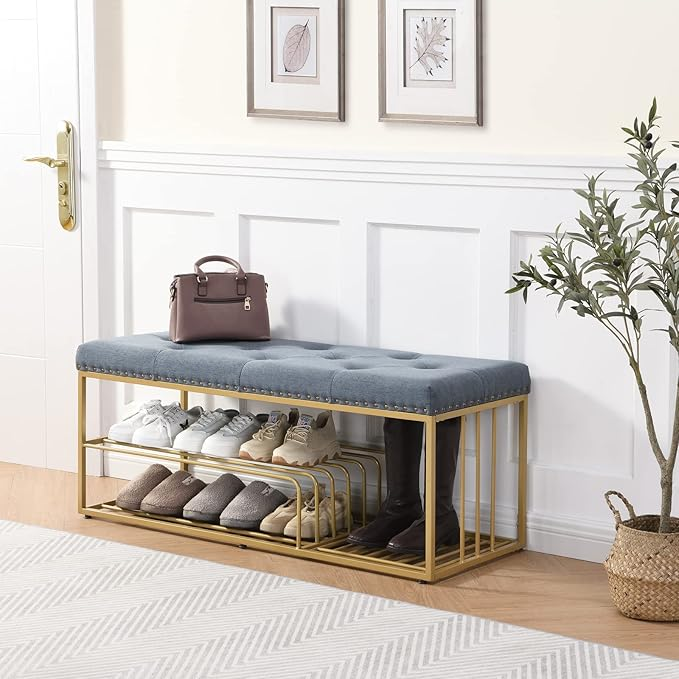
The LA Entryway SKU That Behaves Like a Lounge Chair: Why a Shoe Storage Ottoman Can Win the Whole Cart
Los Angeles shoppers don’t buy “entryway furniture.” They buy space back—a cleaner landing zone, fewer piles, and one piece that does two jobs. That’s why the Los Angeles shoe storage ottoman keeps surviving line reviews: it sells like storage and performs like seating—if (and only if) the supplier is truly retail-ready.
And retail-ready has a cost. Returns are a major margin leak in U.S. retail; NRF reported total returns projected at $890B in 2024 and retailers estimating 16.9% of annual sales would be returned.
Citable block: “Retail-Ready” definition (stable + reusable)
A Los Angeles shoe storage ottoman is retail-ready when the vendor can prove:
Seat-grade build (frame + foam + stitching discipline comparable to contract upholstered chairs)
Ship-grade protection (pack-out that prevents corner crush, lid shift, and fabric scuffs)
Program readiness for Amazon (packaging pathway + requirements understood)
Cross-category merchandising (works as a set with an Amazon-ready mirror collection)
Social compliance documentation that clears onboarding without drama
Why LA makes this category “quietly strategic”
In high-cost, renter-heavy markets, multifunctional furniture isn’t a trend—it’s a constraint solution. Harvard’s Joint Center for Housing Studies tracks how cost burdens remain a defining feature of the rental market.
So the LA ask is consistent: compact, useful, photogenic, and durable. A shoe storage ottoman checks every box—until quality drift turns it into returns.
Judge it like seating, not décor
Here’s how buyers think: if your factory can build wholesale upholstered chairs, you already understand the boring disciplines that prevent returns—repeatable foam feel, seam alignment, frame stability, and stress points that don’t loosen.
That’s why I like suppliers who speak the language of public/lounge seating performance. ANSI/BIFMA X5.4 covers public and lounge seating found in reception/waiting areas—exactly the type of durability mindset that translates well into “everyday seating” SKUs.
If you call yourself a lounge chair supplier, this ottoman should look easy—because you’re already building to higher expectations.
Honeycomb paper packaging is the fastest way to reduce damage without adding plastic
If you’re still treating packaging like “after the product,” LA will punish you. The most common failure modes on this SKU are packaging-related: crushed corners, lid misalignment after transit, and fabric rub marks.
Honeycomb paper packaging is one of the cleanest upgrades because it’s light, stiff, and shock-absorbing. Peer-reviewed research on paper honeycomb sandwich panels and honeycomb paperboard describes strong cushioning/energy absorption behavior—exactly what you want around corners and lid edges.
And packaging designers regularly cite paper honeycomb as recyclable/reusable paper-based protection when designed correctly.
Buyer translation: honeycomb protection is how you keep the ottoman square and keep your sustainability story credible.
Make it an “entryway set,” not a lonely SKU: the Amazon-ready mirror collection play
If you want higher AOV and cleaner assortment logic, don’t pitch the ottoman alone. Pair it with an Amazon-ready mirror collection (two sizes, one finish story, one packaging standard) and you’ve built a one-cart entryway solution.
Amazon’s Ships in Product Packaging (SIPP) program (formerly SIOC) lays out how products can ship in their own packaging and what the program expects.
Amazon also publishes certification guidelines for SIPP packaging, which is the kind of document a serious vendor should be able to work from—not guess at.
And Frustration-Free Packaging is explicitly tied to SIPP guideline compliance (plus additional requirements).
Why this matters: if your mirror collection is “Amazon-ready” and your ottoman is “retail-ready,” the buyer can build a set that performs across channels without reinventing packaging every season.
Social compliance isn’t a checkbox—it’s onboarding speed
If you sell into serious retail, social compliance is part of vendor readiness. Buyers don’t want surprises here, because surprises delay launches.
Three widely recognized references your supplier should understand:
SA8000: a global social certification framework focused on fair treatment of workers.
amfori BSCI: describes an audit cycle and follow-up expectations—useful for continuous improvement tracking.
SMETA (Sedex): described by Sedex as a widely used social audit methodology.
Buyer translation: the factory that can hand you the right documents and corrective action logic is the one that gets approved faster—especially when your timeline is tight.
Where Teruier fits
If you’re building a Los Angeles shoe storage ottoman program that survives reorders, Teruier’s edge is simple: seating-grade build discipline, paper-based protective packaging options like honeycomb, and vendor-ready documentation—so the SKU scales like a program, not a one-off.
NRF / Happy Returns: 2024 returns projected $890B; 16.9% estimated return rate.
Harvard JCHS: America’s Rental Housing 2024 (rental cost-burden context).
BIFMA: ANSI/BIFMA X5.4 public & lounge seating standard overview / reaffirmation.
Amazon Seller Central: SIPP/SIOC overview + certification guideline PDF + FFP page.
Paper honeycomb cushioning/energy absorption research (peer-reviewed) + honeycomb paperboard properties.
SA8000 / amfori BSCI / Sedex SMETA official pages & guide.



