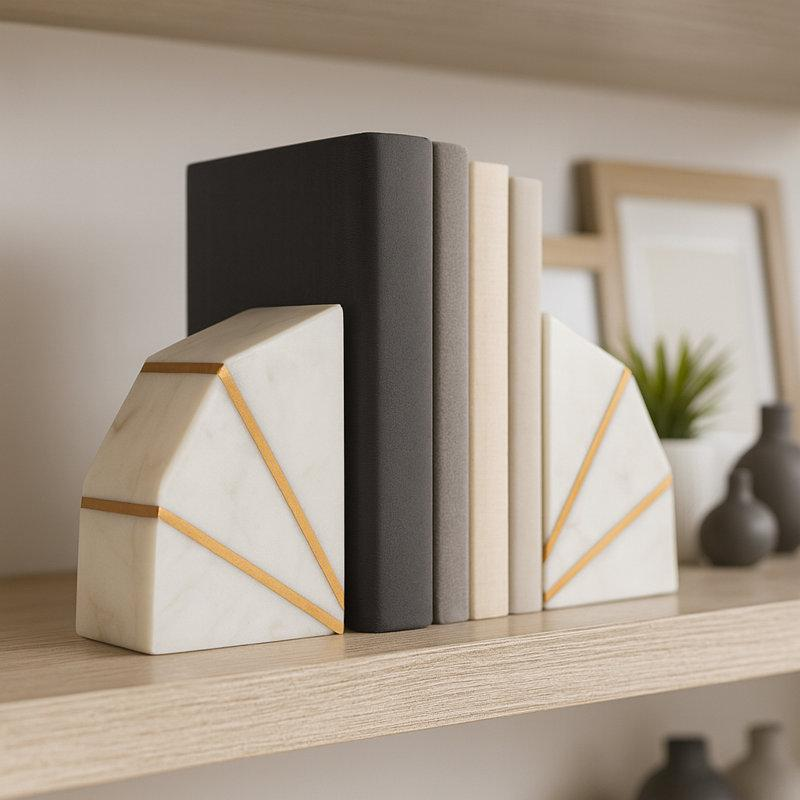
Why decorative bookends deserve a second look in home décor retail.
A customer walks into a home décor store looking for something small to finish a living-room shelf.
They are not shopping for office supplies. They may not even be looking for bookends.
But they notice a pair of sculptural objects beside a stack of books. The material feels substantial, the shape is interesting, and the pieces would look equally good on a console table.
The customer sees decoration.
The retailer sees a product that can potentially be sold across several categories.
That is the commercial opportunity behind decorative bookends: they can serve a practical purpose while earning their place as decorative objects.
For international home décor buyers, this small category deserves more attention than its traditional stationery label suggests.
1. The Bookshelf Has Become a Display Space
Bookshelves were once primarily about storing books.
Today, in many contemporary interiors, they also display ceramics, framed photographs, small sculptures, collected objects and personal keepsakes.
The 2026 bookshelf styling discussion in ELLE Decor highlighted a preference for more intentional arrangements and meaningful objects rather than simply filling every available gap.
That shift creates an interesting opportunity.
A decorative bookend can do two jobs:
- Support a group of books.
- Contribute to the visual composition of a shelf.
Unlike a purely decorative sculpture, it provides a clear functional reason to purchase.
Unlike an ordinary office bookend, it can be selected for its material, silhouette and connection to the surrounding furniture.
For retailers, the product is no longer limited to the stationery aisle.
It may belong beside decorative objects, home-office accessories, giftware or curated living-room displays.
2. What the Wholesale Market Tells Us
The category’s broader retail relevance is not merely a design theory.
Faire’s August 2026 wholesale bookend buying guide describes demand from home stores, gift shops and bookstores, alongside smaller orders from other specialist retailers.
That matters because these businesses are not necessarily selling the same product for the same reason.
A bookstore may prioritize book support and literary appeal.
A home décor retailer may prefer sculptural forms that coordinate with furniture and decorative accessories.
A gift shop may look for distinctive shapes, attractive presentation and an accessible gift-giving occasion.
A buyer should therefore ask a different question:
Which retail customer are we designing the bookend for?
The answer affects everything from materials and dimensions to packaging and merchandising.
3. Three Different Products Hiding Under One Category Name
Consider three potential product directions.
A. The Functional Bookend
A simple metal design with a reliable supporting base.
Its strongest selling points are practicality, compact dimensions and straightforward styling.
It fits naturally into bookstores, home offices and everyday storage collections.
B. The Decorative Bookend
A sculptural form made from resin, metal, stone or a combination of materials.
Here, appearance plays a more important role.
The customer may buy it because it resembles a small artwork, with book support as an additional benefit.
This direction is especially relevant to lifestyle stores and home décor retailers.
C. The Statement Bookend
A distinctive piece that can anchor a curated shelf display.
It may use a dramatic geometric form, an unusual surface finish or a recognizable artistic motif.
The challenge is balancing decorative impact with function, stability and a suitable retail price.
The three products may share a category name, but they require different buying decisions.
4. The High Point Market Signal: When Categories Overlap
One of the more interesting examples from Spring 2026 High Point Market was a marble-based shelf light presented by Four Hands in collaboration with Amber Lewis.
Its substantial stone base also allowed it to function as a bookend.
This example suggests an opportunity that extends beyond the traditional bookend category.
A decorative object can combine more than one use, provided those functions are genuinely compatible.
But buyers should be careful.
Adding functions does not automatically create a better product.
A heavy sculpture may look suitable for supporting books but lack the right base geometry or slip resistance.
A decorative light may introduce electrical, certification and packaging requirements that do not apply to a conventional bookend.
The commercial value comes from useful integration, not from adding features for the sake of novelty.
5. A Retail Buying Comparison: Metal, Resin or Stone?
Material selection should follow the intended retail position.
| Material | Buyer advantage | Main consideration |
|---|---|---|
| Metal | Slim geometry, varied finishes, strong design flexibility | Surface protection, edges, finish consistency |
| Resin | Sculptural detail, expressive forms, colour options | Weight, brittleness, surface quality |
| Natural stone | Material character, substantial appearance | Weight variation, chipping, freight and packaging |
| Mixed materials | Greater decorative differentiation | Assembly, joining details, production repeatability |
The choice is not simply a question of which material looks most expensive.
A compact metal bookend may be better suited to a modern home-office collection.
A decorative resin pair could work well within a playful gift assortment.
A substantial stone form may make sense for an elevated home décor programme.
Buyers must also check the actual ability of each design to support books safely.
A visually heavy object is not necessarily a stable bookend.
6. How a Bookend Can Support a Wider Retail Collection
Imagine a home décor buyer building a small collection around warm metallic finishes and geometric forms.
The collection could include:
- A sculptural bookend set.
- A decorative tray.
- A small accent mirror.
- A coordinating decorative box.
The products do not need identical shapes.
They need compatible material and design characteristics.
A bookend can introduce the theme on a bookshelf, while the tray or box carries it onto a console table.
This gives the retailer several ways to merchandise the collection.
It also offers a supplier an opportunity to develop related products rather than competing solely on one individual SKU.
For a broader discussion of this approach, see Teruier’s guide to coordinated home décor collections for retail buyers.
7. A Teruier Product Example: Deco Fan Bookend Set
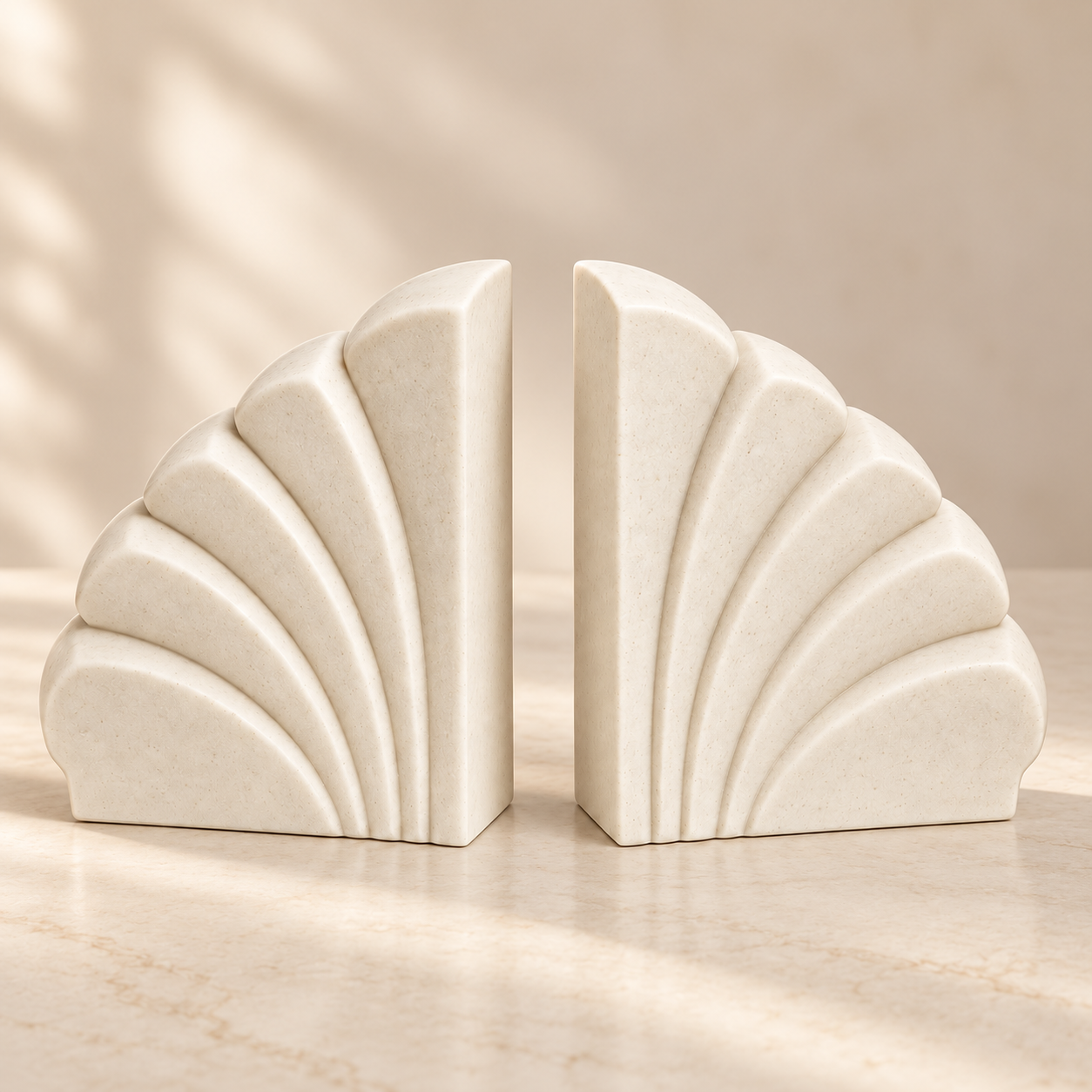
Teruier’s Deco Fan Bookend Set offers an example of a bookend designed with decorative presentation in mind.
Its Art Deco-inspired fan geometry gives it a recognizable visual identity beyond a conventional office accessory.
The design allows buyers to consider the product in several settings: a home bookshelf, a decorative console, an office interior or a coordinated lifestyle collection.
For wholesale buyers, the next questions concern the product’s commercial suitability.
Is the size appropriate for the intended shelves?
Does the construction offer sufficient support for the books customers are likely to use?
Can the finish be coordinated with other products?
How should the pair be protected and presented in retail packaging?
These are more useful questions than simply asking whether the item looks attractive.
Teruier develops and sources decorative mirrors, tabletop accessories, storage products and accent furniture for international B2B customers, connecting design requirements with product specifications and manufacturing coordination.
For more background, explore Teruier’s home décor sourcing and manufacturing approach.
8. Should Every Home Décor Retailer Add Bookends?
Not necessarily.
Bookends should earn a position within a retail assortment rather than be added simply because they are attracting design interest.
Before buying, consider:
Customer fit: Does the retailer serve customers who purchase decorative shelving accessories?
Display fit: Can the product be presented with existing books, furniture and decorative objects?
Price positioning: Is the perceived value appropriate for the intended retail tier?
Functional credibility: Does it work as a bookend, not merely resemble one?
Collection potential: Can it complement other products without forcing a matching set?
A good product opportunity starts with a clear customer and retail use case.
Frequently Asked Questions
Are decorative bookends suitable for home décor retailers?
Yes, particularly when the design has enough visual appeal to function as a decorative object while retaining reliable book-support performance.
What should wholesale buyers check before ordering decorative bookends?
Review dimensions, base stability, weight, materials, finish quality, protective pads, packaging and whether the product is supplied individually or as a pair.
Are resin bookends better than metal bookends?
Neither material is universally better. Resin offers sculptural flexibility, while metal can support slimmer forms. Buyers should choose according to intended use, style, durability and target retail pricing.
Can decorative bookends be developed as part of a coordinated collection?
Yes. Bookends can share materials, finishes or design motifs with trays, decorative boxes, mirrors and other tabletop accessories, subject to manufacturing feasibility.
How can importers distinguish a decorative bookend from an ordinary ornament?
A decorative bookend should have a structure and base suitable for supporting books. An ornament may look similar but should not be marketed as a functional bookend without appropriate verification.
Final Thought: A Small Category Worth Rethinking
The interesting thing about decorative bookends is not that they have suddenly become new.
They have not.
What has changed is the way retailers can position them.
A product that once belonged almost exclusively beside books can now participate in a broader story about personal interiors, shelf styling and decorative accessories.
For buyers, the opportunity is to identify designs that provide genuine function, distinctive visual character and a clear place within the retail assortment.
Teruier works with home décor brands, importers and wholesale buyers on product selection, design development and sourcing across decorative accessories and related home furnishings.
Explore the Deco Fan Bookend Set or contact Teruier to discuss specifications, available finishes, product development and wholesale enquiries.