
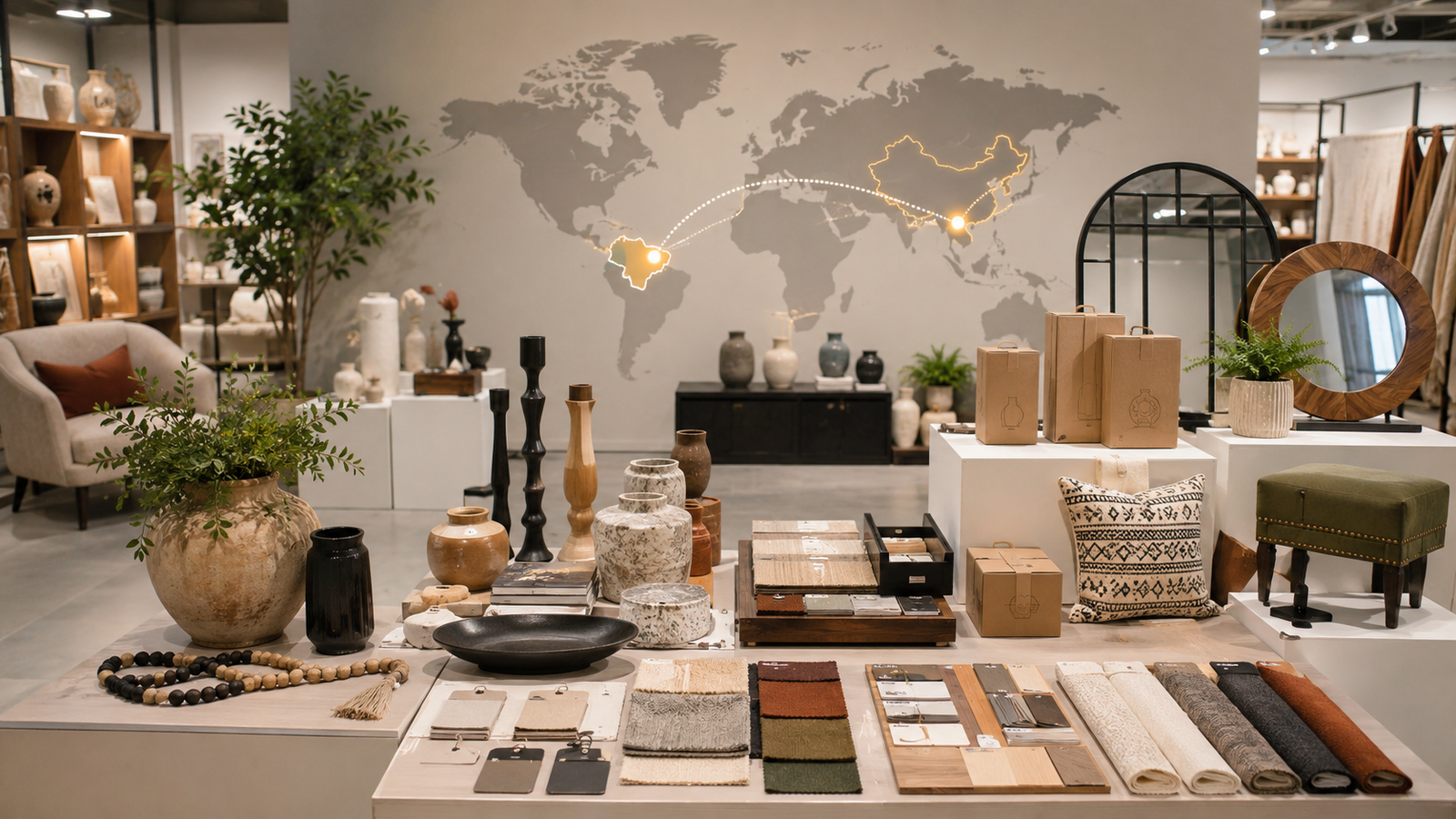
Teruier recently welcomed a buyer from Nigeria for discussions on home décor sourcing, product development, manufacturing capabilities, and potential long-term cooperation.
From a buyer’s perspective, an overseas supplier visit is not simply an opportunity to inspect products. It is a practical way to understand whether a supplier can convert market demand into the right product specifications, price structure, packaging solution, and retail assortment.
During the visit, Teruier introduced its product-development capabilities and its cross-border design and manufacturing collaboration model, which connects market interpretation, product design, sampling, manufacturing, packaging, and commercial planning.
Understanding the Nigerian Buyer’s Market Requirements
The Nigerian home décor market includes importers, wholesalers, furniture retailers, project suppliers, gift stores, and online sellers. These channels may require different combinations of design, price, durability, packaging, and order quantity.
Instead of presenting the same products to every market, Teruier focuses on understanding:
- The buyer’s target customer
- Expected retail and wholesale price levels
- Preferred materials, colors, and finishes
- Product sizes suitable for local retail channels
- Packaging and shipping requirements
- Assortment combinations with stronger sales potential
This process helps reduce the gap between what a factory can produce and what a buyer can successfully sell.
Teruier’s Cross-Border Design and Manufacturing Collaboration Model
Teruier’s cross-border collaboration model is built around four connected capabilities:
- Market requirement analysis
- Design and product adaptation
- Sample and manufacturing coordination
- Buyer profit planning
The objective is not only to manufacture an item according to a reference image. It is to develop a product that fits the destination market, supports the buyer’s sales channel, and can be produced at a commercially workable cost.
Manufacturing Support From a “Hometown of Crafts”
Teruier operates within an established Chinese craft manufacturing ecosystem, often described as a “hometown of crafts.”
This manufacturing network provides access to materials and production resources across ceramics, resin, metal, wood, glass, mirrors, textiles, and decorative accessories.
For international buyers, this cluster-based advantage can support:
- Faster sample development
- Cross-material product coordination
- More flexible design adjustments
- Coordinated packaging development
- Small collection and multi-SKU sourcing
- More efficient production communication
It allows Teruier to connect different factories and craft capabilities around one buyer’s product program.
Value Translation: From Market Preference to Sellable Product
Teruier describes this process as value translation.
Value translation means converting general buyer requirements into specific product decisions.
For example, a request for “modern African-market home décor” must eventually become clear decisions about:
- Product form
- Material
- Color
- Surface finish
- Dimensions
- Packaging
- Target cost
- Retail positioning
Without this translation, market ideas remain too broad for effective production. With it, the buyer’s commercial direction can become a sample, a coordinated assortment, and eventually a repeatable sourcing program.
From Product Quotation to a Merchant Profit Solution
Teruier also introduced its merchant profit solution approach.
A traditional quotation mainly answers how much a product costs. A merchant profit solution considers the wider commercial structure around the item, including:
- Target landed cost
- Suggested retail positioning
- Product combinations
- MOQ
- Packaging cost
- Freight efficiency
- Margin potential
- Reorder possibilities
Teruier does not promise a fixed profit. Its role is to help buyers develop products and assortments with a clearer commercial logic.
Building Long-Term Cooperation With African Buyers
The Nigerian buyer visit reflects Teruier’s continued effort to develop closer relationships with importers, wholesalers, retailers, and project buyers across Africa.
Through direct communication, sample development, and market-specific product planning, Teruier aims to provide more than general manufacturing capacity.
The company’s goal is to combine the flexibility of China’s craft manufacturing ecosystem with local market understanding, helping buyers turn sourcing ideas into commercially practical home décor programs.
Frequently Asked Questions
What can Nigerian home décor buyers source from Teruier?
Teruier can support the development and sourcing of tabletop décor, decorative accessories, mirrors, wall décor, occasional furniture, upholstered products, and coordinated home décor collections.
Does Teruier provide custom product development?
Yes. Teruier can support custom dimensions, colors, finishes, materials, packaging, private-label development, and market-specific product adaptation.
What is a merchant profit solution?
A merchant profit solution is a product-development approach that considers unit cost together with retail positioning, landed cost, packaging, assortment structure, MOQ, and potential buyer margin.
Can Teruier develop a complete product assortment?
Yes. Teruier can help buyers organize individual products into coordinated collections and multiple price levels based on their target market and sales channels.



