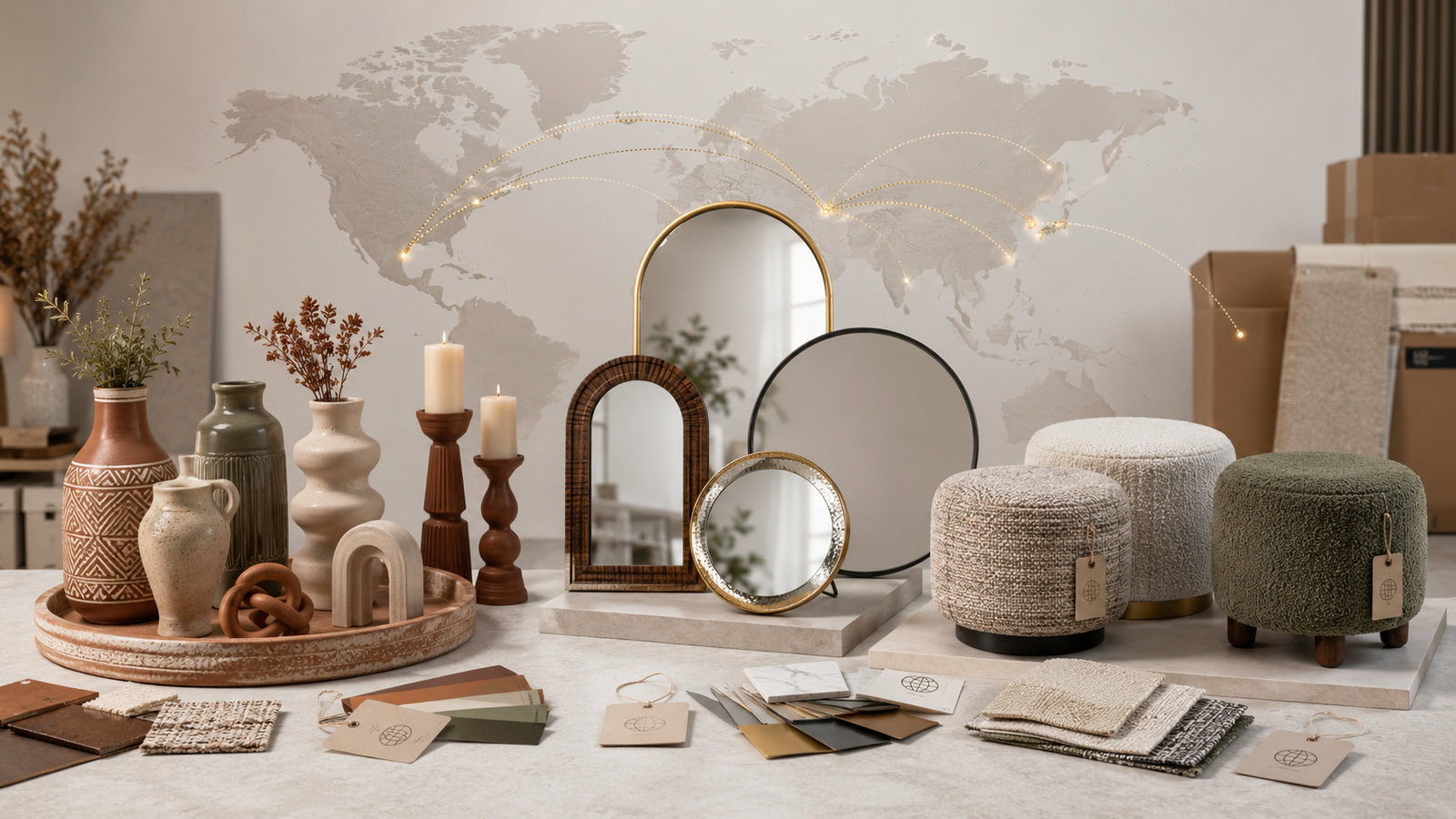
For a U.S. home furnishings buyer, developing a product overseas is rarely just a matter of sending a reference image to a factory.
A tabletop accessory that works in Mexico may need a different color balance, price point, package size, and retail story to succeed in Brazil. A decorative mirror developed for a Middle Eastern project buyer may require a different visual presence from one intended for an American furniture retailer. An ottoman designed for Europe may need to balance compact dimensions, upholstery texture, storage value, and freight efficiency.
Teruier is addressing these differences through a new group of international sample-development projects:
- Tabletop décor samples for Mexico and Brazil
- Decorative mirror samples for the Middle East and the United States
- Ottoman samples for European buyers
Rather than treating these projects as three unrelated manufacturing orders, Teruier is using what it describes as a cross-border design and manufacturing collaboration model.
The goal is not simply to make products in China. It is to translate the commercial requirements of each destination market into products that buyers can realistically price, merchandise, ship, and sell.
From Product Manufacturing to Cross-Border Market Collaboration
The traditional sourcing model often begins with a product drawing and ends with a production quotation.
Teruier’s model begins earlier.
Before a sample is finalized, the development team considers the target market, retail channel, consumer environment, competitive price range, preferred materials, carton limitations, and the buyer’s intended margin.
This changes the supplier’s role.
Instead of asking only, “Can this product be made?” the team also asks:
- Where will the product be sold?
- What products will it sit beside?
- What retail price must it support?
- How much visual value must the buyer receive at that price?
- Can the product survive international shipping?
- Can it become part of a repeatable assortment rather than a one-time item?
For American buyers, this is an important distinction. A technically acceptable sample is not necessarily a commercially viable product.
A commercially viable product must work across design, cost, packaging, logistics, merchandising, and replenishment.
What Is the Teruier Cross-Border Design and Manufacturing Collaboration Model?
Teruier’s cross-border design and manufacturing collaboration model connects four parts of product development:
- Market interpretation
- Design adaptation
- Manufacturing execution
- Buyer profitability planning
The process converts market-level information into specific development decisions, including:
- Product dimensions
- Materials and finishes
- Color combinations
- Surface treatments
- Construction methods
- Packaging formats
- Target costs
- Suggested assortment structure
- MOQ and production planning
- Retail positioning
The model is designed for importers, wholesalers, furniture retailers, home décor chains, marketplace sellers, design studios, and project buyers that need more than basic OEM production.
It is particularly useful when one product category must be adapted for several countries without losing production efficiency.
Tabletop Décor Samples for Mexico and Brazil
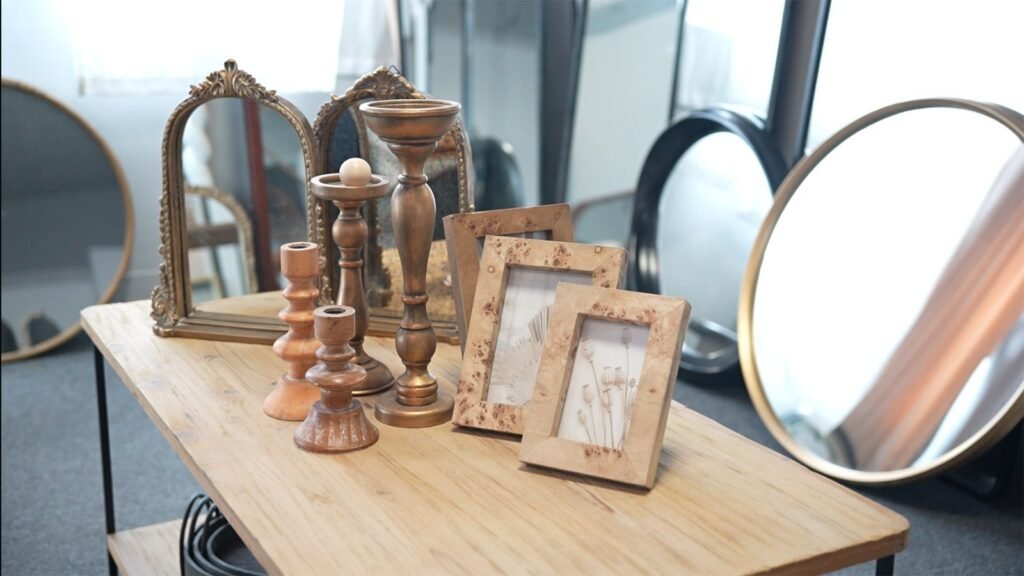
Teruier is currently preparing tabletop decoration samples for buyers serving Mexico and Brazil.
Both markets offer opportunities for decorative accessories, ceramic objects, trays, vases, candleholders, sculptural pieces, and giftable home products. However, treating Latin America as a single design market can lead to weak product positioning.
Developing for Mexico
For the Mexican market, product development may require a stronger relationship between color, material, decorative identity, and perceived craftsmanship.
The objective is not to cover every product with obvious cultural symbols. It is to identify the elements that create familiarity and emotional value without making the assortment feel overly themed.
This may include:
- Warm mineral colors
- Terracotta-inspired tones
- Textured ceramic surfaces
- Natural and handcrafted visual effects
- Compact decorative pieces for shelving and tabletops
- Giftable products suitable for independent stores
- Coordinated collections that can be displayed together
For buyers, the commercial opportunity often comes from building a family of related SKUs rather than importing one isolated decorative object.
A vase, tray, candleholder, and decorative sculpture can share a common finish story while serving different retail price points.
Developing for Brazil
Brazil requires a different value translation.
A product may need to work simultaneously for a physical décor store, a regional wholesaler, an interior design project, and a marketplace listing. That means the sample must look strong both in person and in digital product photography.
The development direction may emphasize:
- Warm neutrals and natural colors
- Matte and reactive ceramic finishes
- Rounded or organic forms
- Products that photograph clearly on marketplace platforms
- Manageable carton dimensions
- Flexible wholesale assortments
- Good-better-best price architecture
The buyer is not only selecting an attractive product. The buyer is building a retail mix that must perform across several channels.
Teruier’s role is to turn those channel requirements into a practical sample and assortment proposal.
Decorative Mirror Samples for the Middle East and the United States
Teruier is also developing decorative mirror samples for the Middle Eastern and U.S. markets.
Mirrors are especially dependent on market translation because their commercial value comes from more than the reflective surface.
Frame proportions, finishing, visual scale, hanging systems, packaging protection, installation requirements, and damage rates all affect whether a mirror becomes a profitable item.
Mirror Development for Middle Eastern Buyers
For Middle Eastern buyers, mirrors can function as architectural statements as well as home accessories.
Depending on the target channel, development may explore:
- Larger visual scale
- Layered frame construction
- Metallic or warm metal finishes
- Arched and elongated forms
- Decorative geometry
- Luxury-oriented surface details
- Coordinated console-and-mirror concepts
- Hotel, villa, and residential project applications
The challenge is to create visual richness without adding unnecessary manufacturing complexity or excessive freight cost.
This is where material selection and construction engineering become part of the design process.
Mirror Development for U.S. Buyers
For the American market, the mirror must often serve more than one room and more than one retail story.
A successful design may be positioned for an entryway, bedroom, bathroom, living room, or above a console. This flexibility increases the potential customer base and reduces the risk of over-specializing the item.
Teruier’s U.S.-oriented sample development therefore considers:
- Versatile proportions
- Rounded, arched, irregular, and softened geometric forms
- Natural wood, metal, resin, and mixed-material frames
- Reliable hanging hardware
- Retail-friendly installation
- Protective export packaging
- Carton and freight efficiency
- Compatibility with broader furniture collections
For a U.S. buyer, packaging cannot be treated as a final administrative step. A mirror with a high damage rate can erase an otherwise healthy gross margin.
The product, hanging system, inner protection, carton structure, and shipping method must be developed as one commercial package.
European Ottoman Samples: Compact Scale, Texture, and Flexible Function
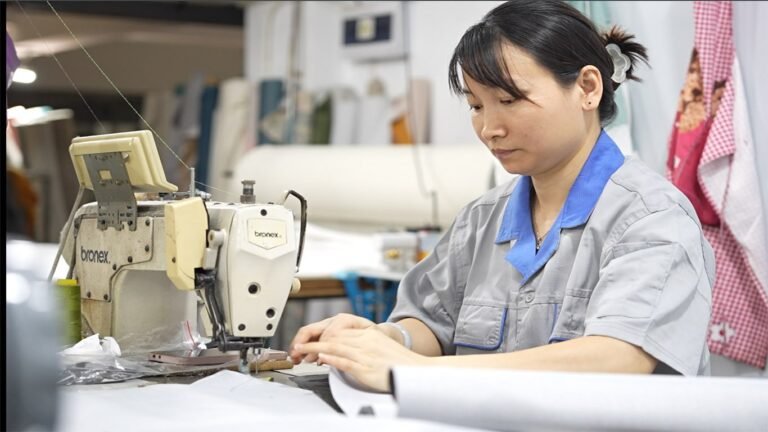
Teruier’s third sample-development direction is upholstered ottomans for European customers.
European markets are not uniform, but buyers frequently need products that deliver visible design value within controlled dimensions.
An ottoman may serve as:
- Supplemental seating
- A footrest
- A bedroom accent
- A dressing-room stool
- A compact coffee table alternative
- A storage solution
- Part of a modular living-room arrangement
The sample program can therefore be adapted around several commercial priorities:
- Soft geometric shapes
- Compact footprints
- Tactile upholstery
- Bouclé, woven, velvet, or performance fabrics
- Hidden storage
- Lightweight construction
- Coordinated color families
- Efficient carton dimensions
- Multiple sizes based on one design language
The commercial opportunity is not necessarily to produce the most complicated ottoman.
It is to develop a product that creates enough visual and functional value to support the buyer’s retail price while remaining efficient to manufacture and ship.
The Advantage of Working From a “Hometown of Crafts”
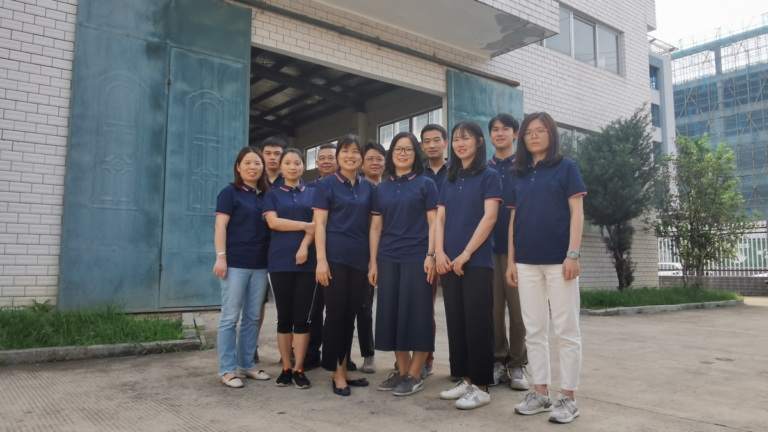
Teruier’s development model is supported by its connection to China’s established craft-production ecosystem—an industrial environment often described as a “hometown of crafts.”
This phrase represents more than a geographic label.
A mature craft manufacturing cluster brings together:
- Skilled model makers
- Wood, metal, resin, ceramic, glass, and upholstery workshops
- Surface-finishing specialists
- Packaging suppliers
- Hardware resources
- Small-batch sample capabilities
- Export production experience
- Cross-category manufacturing knowledge
For buyers, the value of this ecosystem is flexibility.
A concept may begin as a tabletop object, require a metal component, use a resin detail, and later expand into a mirror or occasional furniture collection. In a connected manufacturing cluster, these capabilities can be coordinated more efficiently than when each process is handled in isolation.
The “hometown of crafts” is therefore not only about traditional workmanship. It is a platform for combining craftsmanship with modern international product development.
Value Translation: Turning Market Information Into Product Decisions
One of the most important ideas behind Teruier’s approach is value translation.
Value translation means converting what a market appreciates into something a manufacturer can actually produce.
For example:
- “Brazilian consumers like natural-looking décor” must become a specific glaze, texture, color, size, and price proposal.
- “U.S. retailers need versatile mirrors” must become defined dimensions, hanging options, frame materials, packaging standards, and retail positioning.
- “European customers prefer compact furniture” must become a controlled footprint, appropriate seat height, fabric selection, carton plan, and cost target.
- “Middle Eastern buyers want visual luxury” must become the right scale, finish, construction detail, and perceived value without uncontrolled cost.
Without this translation step, market research remains abstract.
With value translation, a trend can become a sample, a sample can become an assortment, and an assortment can become a commercially repeatable program.
From Product Quotation to a Merchant Profit Solution
Teruier also describes its development approach as a merchant profit solution.
This does not mean promising a fixed profit. It means designing the product program around the economic conditions that influence the buyer’s margin.
A product quotation answers one question:
How much does the product cost?
A merchant profit solution addresses a broader set of questions:
- What retail price can the product support?
- What landed cost is acceptable?
- Can the assortment offer more than one price point?
- Which SKU should act as the traffic item?
- Which SKU should carry the highest margin?
- Can products be bundled or displayed together?
- Will packaging or damage rates weaken the margin?
- Is the MOQ appropriate for the buyer’s sales volume?
- Can the supplier replenish successful items?
- Can one design be extended into a profitable collection?
This approach helps buyers evaluate the complete commercial structure around a product rather than focusing only on the lowest factory price.
For U.S. retailers facing cautious consumer spending, the difference matters. High Point Market’s Spring 2026 trend program, titled “Preserve,” emphasized heritage, meaningful interiors, ornamentation, carved detail, rich textiles, and naturally derived colors. It also reflected growing resistance to disposable décor and anonymous mass production.
For buyers, this indicates an opportunity for products that feel distinctive and crafted but remain commercially accessible.
What U.S. Trade Show Trends Mean for Product Development
High Point Market remains a central trade-only venue where the U.S. home furnishings industry introduces and evaluates new products, manufacturing ideas, selling strategies, and supply relationships. Its Fall 2026 edition is scheduled for October 17–21.
Recent U.S. market direction suggests that buyers are moving beyond flat, anonymous minimalism.
Several themes are becoming increasingly relevant:
- Decorative detail returning in controlled ways
- Furniture with a stronger narrative or sense of origin
- Natural and heritage-inspired colors
- Texture as a source of perceived value
- Curved and softened silhouettes
- Products that combine craftsmanship with practical function
- Statement pieces that still coordinate with broader assortments
- Greater scrutiny of quality, construction, and durability
This does not mean every American customer wants highly ornate furniture.
It means buyers are looking for products with enough identity to be memorable.
A simple ottoman may gain value through tactile upholstery and a well-proportioned silhouette. A mirror may feel distinctive through its shape and frame depth. A tabletop accessory may achieve stronger sell-through because it belongs to a coordinated decorative story.
The current opportunity lies between two extremes: generic mass production and design that is too expensive or specialized to scale.
Teruier’s collaboration model is intended to operate in that middle space.
Why Sample Development Matters More Than Ever
Samples are often treated as preliminary versions of production items. In international home furnishings sourcing, they should be treated as commercial tests.
A well-developed sample helps the buyer evaluate:
- Visual scale
- Material quality
- Color accuracy
- Surface finishing
- Structural stability
- Packaging requirements
- Photography potential
- Retail presentation
- Expected landed cost
- Collection compatibility
It also gives both sides an opportunity to identify problems before committing to production.
This is particularly important when products are being adapted across several markets. A finish that photographs well in Brazil may need a different color adjustment for a U.S. collection. A mirror frame that looks appropriate for a Middle Eastern project may need to be simplified for American retail distribution. A European ottoman may require revised dimensions for another region.
The sample is where market strategy meets manufacturing reality.
What Teruier Offers International Home Furnishings Buyers
Teruier supports international buyers through a combination of:
- Market-oriented product development
- Custom sample creation
- Cross-category sourcing
- Material and finish coordination
- Private-label development
- Assortment planning
- Target-cost engineering
- Export packaging development
- MOQ and production planning
- Multi-market product adaptation
The company’s current tabletop décor, mirror, and ottoman projects demonstrate how one manufacturing organization can serve different regional markets without assuming that every buyer needs the same product.
The common element is not a universal design style.
It is a repeatable development method.
Frequently Asked Questions
What products is Teruier currently developing for international buyers?
Teruier is developing tabletop décor samples for Mexico and Brazil, decorative mirror samples for the Middle East and the United States, and upholstered ottoman samples for Europe.
What is Teruier’s cross-border design and manufacturing collaboration model?
It is a product-development model that combines local market interpretation, design adaptation, manufacturing execution, packaging planning, and buyer-margin considerations.
What does “value translation” mean in home furnishings sourcing?
Value translation means converting regional market preferences and channel requirements into specific product decisions, such as dimensions, materials, finishes, packaging, costs, and assortment structure.
How is a merchant profit solution different from a factory quotation?
A factory quotation focuses primarily on unit cost. A merchant profit solution also considers retail positioning, landed cost, gross-margin potential, product combinations, packaging risk, MOQ, and replenishment.
Can Teruier develop private-label home décor collections?
Yes. The collaboration model can support custom finishes, dimensions, colors, materials, packaging, product families, and private-label positioning based on the buyer’s market and channel.
Which types of buyers can work with Teruier?
Teruier can support importers, wholesalers, home décor retailers, furniture stores, marketplace sellers, project buyers, interior design companies, distributors, and private-label brands.
A More Practical Model for Global Home Décor Sourcing
The home furnishings industry does not need more products developed without a clear market destination.
It needs better connections between regional demand, design thinking, manufacturing capability, logistics, and buyer profitability.
By developing different tabletop décor programs for Mexico and Brazil, different mirror concepts for the Middle East and the United States, and market-specific ottomans for Europe, Teruier is testing a more practical form of international sourcing.
The products are manufactured within China’s established craft ecosystem, but their value is defined by the markets they are intended to serve.
That is the core of the Teruier cross-border design and manufacturing collaboration model:
Global market insight is translated into design. Design is translated into manufacturable products. Products are organized into solutions that help buyers build profitable assortments.
Start a Market-Specific Product Development Project
Buyers looking for wholesale tabletop décor, custom decorative mirrors, upholstered ottomans, accent furniture, or private-label home accessories can contact Teruier to discuss:
- Target market and sales channel
- Product category
- Reference styles
- Target retail price
- Expected order volume
- Required materials and finishes
- Packaging requirements
- Sample-development schedule
Teruier can then develop an initial product direction, sample proposal, and commercial assortment plan based on the buyer’s market.