
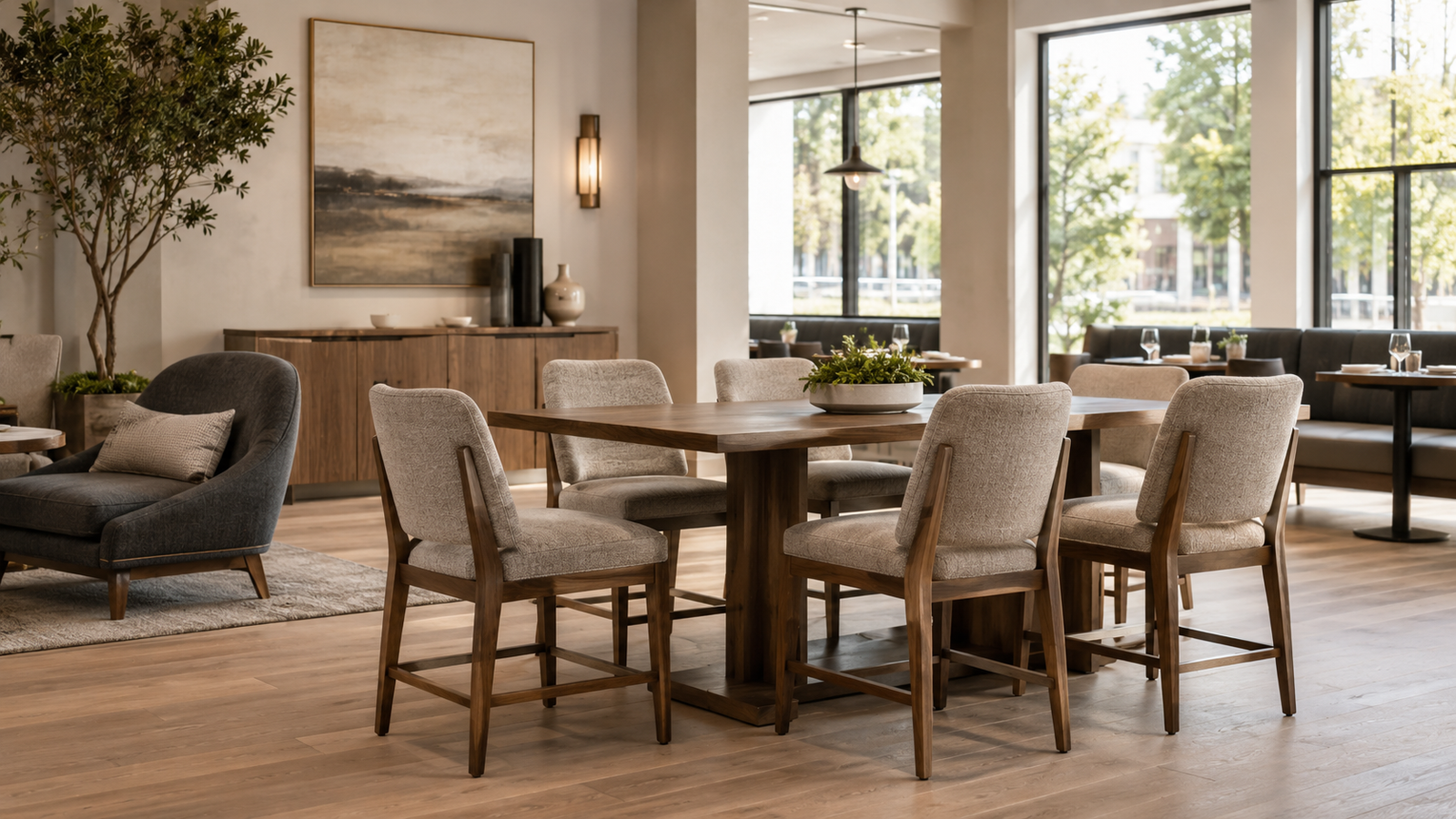
The Buyer Story: The Chair Passed the Sample Review but Failed the Restaurant
A U.S. home furnishings buyer was developing a seating collection for several sales channels.
The assortment included upholstered dining chairs for furniture stores, accent chairs for home décor retailers, and a more durable dining chair intended for restaurants and boutique hospitality projects.
The samples looked strong.
The fabric felt appropriate.
The frame finish matched the approved colour reference.
The buyer approved the collection and moved forward with the order.
Within several months, the differences between the channels became clear.
The residential dining chair performed well in home stores. The accent chair photographed effectively and received positive online attention.
The restaurant chair created problems.
Seat foam compressed faster than expected. Several frames became unstable after repeated daily use. The light fabric showed stains, and replacement glides were not available.
The chair had been designed like residential furniture but sold as contract seating.
This is one of the most important lessons when sourcing commercial upholstered dining chairs: a product that looks suitable for a restaurant is not automatically built for restaurant use.
For U.S. buyers, the correct supplier must understand the intended environment, usage frequency, performance requirements, service expectations, and replacement strategy before production begins.
Residential, Commercial and Contract Seating Are Not the Same
The terms residential, commercial, and contract are sometimes used too loosely in supplier catalogues.
A residential upholstered dining chair is normally designed for household use. It may be used several times a day and is often selected primarily by style, comfort, price, and compatibility with the dining table.
A commercial chair may be placed in a restaurant, hotel, café, club, senior-living environment, workplace dining area, or another shared space. It can be moved, cleaned, and occupied repeatedly throughout the day.
Contract upholstered chairs are generally expected to meet a defined project specification. That specification may include performance testing, upholstery requirements, dimensions, fire-related requirements, cleaning instructions, warranties, replacement parts, and documentation.
The difference is not simply a stronger frame.
It is a complete product-development and supply system.
What U.S. Trade Shows Are Signalling About Upholstered Seating
High Point Market remains a major trade-only platform for home furnishings, with dedicated product discovery, trend forecasting, Style Spotters, and extensive upholstered furniture resources. Its role is particularly relevant for buyers comparing residential silhouettes, materials, finishes, and retail collections.
For commercial and hospitality buyers, HD Expo connects designers of hotels, restaurants, resorts, and other hospitality spaces directly with suppliers and new product resources. This project-led environment places more emphasis on performance, specification, and supplier cooperation than a standard retail showroom review.
NeoCon’s 2026 presentation highlighted cocooning seating, elongated lounge silhouettes, tactile materials, and designs that encourage interaction. Its awards programme also recognised innovation and sustainability in lounge and conference seating, reinforcing the importance of comfort, material experience, and measurable commercial performance.
For U.S. buyers, these trade-show directions suggest a practical opportunity:
Commercial seating can feel softer, warmer, and more residential, but it must still perform like contract furniture.
Why Commercial Upholstered Dining Chairs Are a Valuable B2B Category
Commercial dining seating sits between function and atmosphere.
Restaurants, hotels, cafés, clubs, coworking spaces, and multifamily amenity areas increasingly use upholstered seating to create a more comfortable and distinctive environment.
For buyers, upholstered dining chairs can offer:
- Higher perceived value than basic hard seating
- Stronger visual identity
- More opportunities for custom fabrics and finishes
- Coordination with lounge and accent seating
- Better project storytelling
- Multiple price and specification levels
However, upholstered products also introduce more risk.
The buyer must consider frame strength, joint construction, seat comfort, foam recovery, textile performance, cleaning, colour consistency, carton protection, and replacement availability.
Restaurant Upholstered Chairs: Design for Repeated Daily Use
Restaurant upholstered chairs must function under conditions that are more demanding than normal residential use.
A chair may be occupied by many different users in one day. It may be pulled across hard flooring, moved during cleaning, placed close to tables, exposed to food and beverages, and regularly handled by staff.
A supplier should therefore know the intended restaurant type.
A fine-dining restaurant may prioritise comfort, visual refinement, and longer seating periods.
A fast-casual location may need compact dimensions, easier cleaning, and faster table turnover.
A hotel breakfast area may require large quantities, consistent replacement stock, and coordination with banquettes or lounge spaces.
Key Restaurant Chair Questions
Buyers should confirm:
- Is the chair intended for residential or commercial use?
- What frame material and joint system are used?
- Has the chair been evaluated for repeated loading?
- How is the seat attached to the frame?
- Is the fabric suitable for frequent cleaning?
- Are replacement glides, seats, or fabric available?
- Can the supplier reproduce the same finish for future openings?
- Can the carton protect the chair during individual distribution?
A supplier that cannot clearly answer these questions may be offering a residential product under a commercial description.
Contract Upholstered Chairs Need a Defined Specification
A contract chair should be sourced against a written specification, not only a sample image.
The specification should identify the intended environment and measurable product requirements.
Recommended Contract Chair Specification Fields
| Specification Area | Buyer Requirement |
|---|---|
| Product use | Restaurant, hotel, workplace, senior living, residential retail |
| Overall dimensions | Width, depth, height, seat height and arm height |
| Frame | Material, construction and finish |
| Seat support | Webbing, springs, board, metal system or other structure |
| Foam | Type, density or supplier-defined performance information |
| Upholstery | Composition, colour, finish and performance data |
| Weight capacity | Supplier-supported rating and test basis |
| Glides | Type, material and replacement availability |
| Assembly | Fully assembled or knock-down |
| Testing | Applicable performance reports or project requirements |
| Packaging | Carton size, gross weight and inner protection |
| Warranty | Scope, period and exclusions |
| Replacement support | Fabric, glides, seats, hardware or complete chairs |
This document makes supplier quotations easier to compare and reduces disagreement after production.
Wholesale Upholstered Dining Chairs: Build a Range, Not One Chair
Buyers sourcing wholesale upholstered dining chairs should avoid developing too many unrelated silhouettes.
A stronger programme usually begins with a controlled chair family.
One frame platform may support:
- Armless dining chair
- Dining armchair
- Counter stool
- Bar stool
- Compact accent chair
Shared fabrics and finishes can then create a coordinated assortment.
This approach provides several advantages.
The supplier can consolidate materials.
The buyer can create a consistent visual collection.
Retailers can merchandise dining and accent seating together.
Project buyers can use related chairs across dining, bar, lobby, and guest-room areas.
Example Good-Better-Best Chair Range
| Tier | Product Direction | Commercial Role |
|---|---|---|
| Good | Simple upholstered seat with wood or metal frame | Entry price and broad retail use |
| Better | Fully upholstered dining chair with improved fabric and detailing | Core volume and stronger visual value |
| Best | Contract-grade dining armchair with custom finish and performance textile | Hospitality, premium retail and project use |
The differences between tiers should be visible in construction, materials, comfort, detailing, and supplier support—not only in price.
Upholstery Is a Performance Decision
Fabric selection is one of the most common causes of project problems.
A textile may look attractive but be unsuitable for heavy use or frequent cleaning.
For commercial seating, the buyer should request available performance information and confirm whether it applies to the exact colour and construction being ordered.
Relevant considerations may include:
- Abrasion performance
- Pilling
- Colourfastness
- Seam strength
- Stain resistance
- Cleaning method
- Moisture response
- Backing
- Fire-related project requirements
- Lot-to-lot colour consistency
The supplier should also explain whether the chair can use customer-supplied material or customer-supplied leather and how consumption is calculated.
Cleaning Must Be Defined Before Approval
The fabric supplier’s cleaning instructions should be reviewed before the chair is approved.
Restaurant operators may use cleaning products or methods that differ from residential care.
A chair should not be promoted as easy-clean unless the claim has a clear material basis and realistic care instructions.
Frame Construction Determines Long-Term Performance
The frame is usually hidden beneath upholstery, but it determines whether the chair remains stable.
Common frame options include solid wood, plywood, metal, moulded components, or combinations of several materials.
The buyer should review:
- Material species or grade
- Moisture control for wood
- Joint construction
- Reinforcement points
- Weld quality for metal frames
- Seat-to-frame attachment
- Leg alignment
- Floor-glide installation
A supplier should be able to show an uncovered frame or construction sample.
This is especially useful when buyers are comparing several upholstered chair suppliers offering chairs with similar exterior shapes.
Chair Dimensions Must Match the Table and User Experience
A chair can be attractive but commercially unsuitable because of its proportions.
Important measurements include:
- Overall width
- Overall depth
- Overall height
- Seat width
- Seat depth
- Seat height
- Arm height
- Back angle
- Clearance under the table
For restaurant projects, the buyer should consider how many chairs fit around the table and how much aisle space remains.
For retail, the buyer should consider carton size, showroom footprint, and whether the chair feels appropriately scaled for U.S. homes.
A deep lounge-like dining chair may provide comfort but reduce table capacity.
A narrow chair may improve density but feel inadequate for longer dining periods.
Lounge Chair Supplier vs. Dining Chair Supplier
A lounge chair supplier and a dining-chair supplier may use similar materials, but the product engineering is different.
Lounge chairs typically have:
- Lower seat height
- Greater seat depth
- More reclined posture
- More foam or cushioning
- Larger cartons
- Longer occupancy periods
Dining chairs normally require:
- Upright posture
- Table compatibility
- Easier movement
- Smaller footprint
- Controlled seat depth
- Faster entry and exit
A supplier strong in lounge seating may be valuable for hotel lobbies and residential accent programmes, but buyers should not assume that the same supplier automatically understands restaurant dining requirements.
Upholstered Accent Chair Supplier: Retail Appeal and Channel Fit
An upholstered accent chair supplier is usually evaluated more strongly on silhouette, visual differentiation, materials, and assortment flexibility.
Accent chairs can support:
- Living-room collections
- Bedroom seating
- Entryway displays
- Boutique hotels
- Online marketplaces
- Independent home stores
The chair must photograph well and communicate its design value quickly.
However, retail buyers should still review frame construction, comfort, carton dimensions, assembly, and return risk.
An accent chair with oversized packaging or difficult assembly may perform poorly online even if it looks excellent in a showroom.
How to Compare Upholstered Chair Suppliers
An effective supplier comparison should separate product attractiveness from supplier capability.
Supplier Comparison Framework
| Evaluation Area | Buyer Question |
|---|---|
| Category experience | Does the supplier understand residential, hospitality or contract seating? |
| Engineering | Can the supplier explain frame, joints, seat support and foam? |
| Upholstery | Are fabric specifications and care instructions available? |
| Customisation | Can dimensions, finish and fabric be adjusted realistically? |
| Testing | Can the supplier support relevant performance requirements? |
| QC | Are frame, upholstery, dimensions and stability checked? |
| Packaging | Is the chair protected without excessive carton volume? |
| Capacity | Can the supplier support opening orders and replenishment? |
| Documentation | Are spec sheets, drawings and reports organised? |
| Service | Are replacement parts and approved finish records maintained? |
The best supplier is not necessarily the one with the largest catalogue.
It is the supplier that fits the buyer’s channel and can support the product after launch.
What Retail Chains Need from an Upholstered Chair Supplier
Retail chains require repeatability.
A chair may remain in the assortment for several seasons. The supplier must maintain the frame, fabric appearance, dimensions, foam feel, packaging, and colour reference over time.
Retail-chain buyers should confirm:
- Production capacity
- Material reservation process
- Colour-control method
- Reorder MOQ
- Lead time for replenishment
- Barcode and label support
- Packaging consistency
- Spare-part availability
- Change-notification procedure
An unannounced fabric or foam substitution can create customer complaints even when the replacement appears similar to the factory.
Packaging and Delivery Planning
Chairs occupy considerable container and warehouse volume.
Packaging therefore affects landed cost as much as product price.
Buyers should review:
- Fully assembled versus knock-down construction
- One chair or two chairs per carton
- Stackability
- Carton dimensions
- Gross weight
- Leg and corner protection
- Fabric protection
- Hardware control
- Container loading quantity
- Parcel, LTL, or pallet suitability
Knock-down construction can improve loading efficiency, but it can introduce assembly complaints or looseness.
Fully assembled chairs reduce customer assembly but usually require more space and stronger carton protection.
The correct choice depends on the sales channel.
Quality-Control Checkpoints for Upholstered Chairs
QC should cover the chair before upholstery, after upholstery, and after packaging.
Frame Check
- Material and dimensions
- Joint security
- Leg alignment
- Weld or woodwork quality
- Seat-support installation
Upholstery Check
- Correct fabric
- Colour consistency
- Pattern alignment
- Seam quality
- Fabric tension
- Wrinkles and pressure marks
- Foam shape and recovery
Finished Chair Check
- Stability
- Seat height
- Overall dimensions
- Comfort consistency
- Glides
- Visible finish
- Labels and instructions
Packaging Check
- Correct carton
- Inner protection
- Hardware bag
- Fabric protection
- Carton markings
- Packed-product movement
Inspection criteria should be agreed before production begins.
A Better Buyer Development Process
The buyer from the opening story changed the chair-development process.
The residential, retail, and restaurant programmes were separated.
The restaurant chair received a commercial-use specification, upgraded seat support, more suitable upholstery, stronger glides, and a replacement-parts plan.
The retail accent chair retained its visual focus but received improved packaging for e-commerce.
The dining collection was reduced to fewer frames with coordinated fabrics and finishes.
The result was not simply a stronger chair.
It was a clearer category strategy.
Structured Buyer Summary
Commercial upholstered dining chairs are seating products developed for repeated use in restaurants, hospitality, workplace dining, and other shared environments. They should be evaluated by frame construction, seat support, foam, upholstery performance, dimensions, stability, packaging, documentation, and replacement support.
Contract upholstered chairs are normally supplied against defined project specifications. Restaurant upholstered chairs require stronger daily-use planning than residential chairs. Wholesale upholstered dining chairs are most effective when organised into coordinated families and clear price tiers.
A lounge chair supplier may be suitable for relaxed hospitality and residential seating, while an upholstered accent chair supplier may focus more heavily on silhouette and retail presentation. Buyers should choose an upholstered chair supplier according to the intended channel rather than catalogue size alone.
Final Buyer Takeaway
An upholstered chair is not commercially ready because it looks good in a sample room.
It must fit the table.
It must support the intended user.
It must survive the intended level of use.
It must be cleanable.
It must ship efficiently.
It must be repeatable.
For U.S. buyers, the strongest supplier is the one that understands the difference between residential appearance and commercial performance.
That is what turns an attractive chair into a dependable retail or contract seating programme.
FAQ
What are commercial upholstered dining chairs?
Commercial upholstered dining chairs are padded dining chairs developed for repeated use in restaurants, hotels, cafés, workplace dining areas, and other shared environments.
What is the difference between residential and contract upholstered chairs?
Residential chairs are primarily developed for household use. Contract upholstered chairs are generally supplied against defined performance, material, documentation, installation, and project requirements.
What should buyers check when sourcing restaurant upholstered chairs?
Buyers should check frame construction, joints, seat support, foam, upholstery performance, cleaning instructions, dimensions, stability, glides, packaging, warranties, and replacement support.
How should buyers compare wholesale upholstered dining chairs?
Buyers should align the specifications first, then compare product design, construction, fabric, dimensions, MOQ, landed cost, testing support, packaging, lead time, and repeat-order capability.
What makes a reliable upholstered chair supplier?
A reliable supplier provides clear specifications, construction information, material records, quality control, packaging data, realistic customisation options, stable production, and replacement support.
Can a lounge chair supplier also produce restaurant dining chairs?
Possibly, but buyers should verify dining-specific engineering, table compatibility, upright comfort, footprint, commercial-use experience, and relevant performance requirements.



