
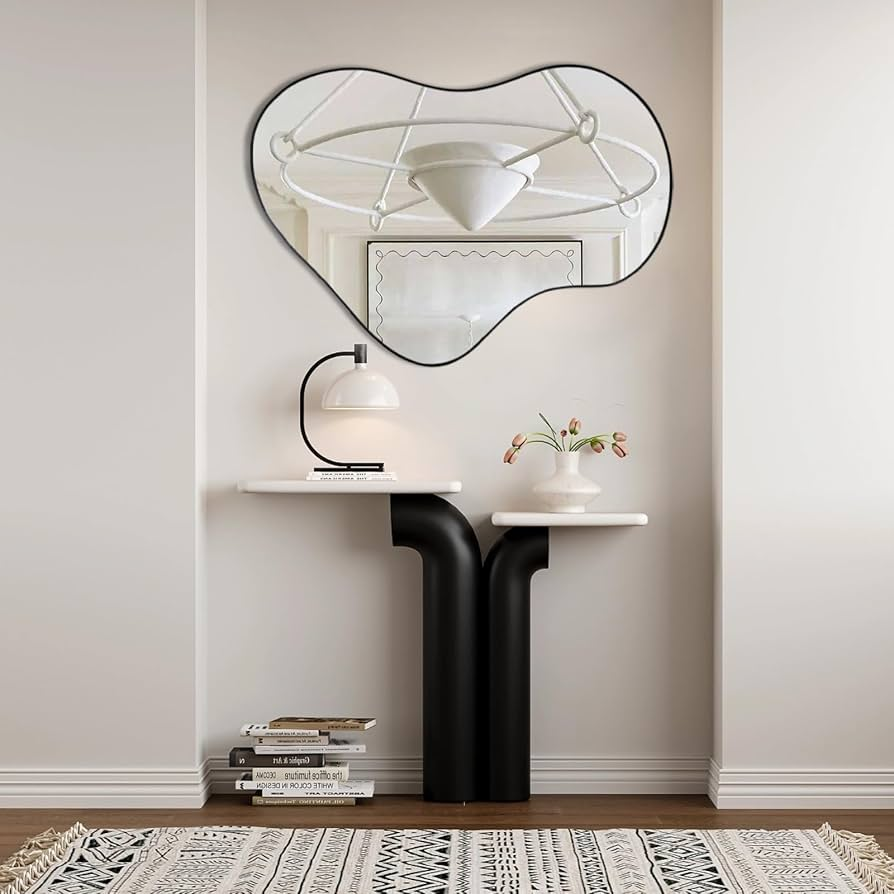
If you are looking for organic wall mirror similar styles wholesale, you are probably not looking for “just one more pretty mirror.” You are looking for a safer bet disguised as a design decision.
Because this is the old problem, yes?
The market wants soft silhouettes. Stores want fresh shapes. Social media wants something that looks as if it melted gracefully against the wall. But the buyer still has to deal with MOQ, lead time, carton size, finish consistency, damage rate, shelf logic, and the small inconvenience of making money.
So let us do this properly.
The fair signals in Europe are already quite clear. Maison&Objet January 2026 pushed the idea of design that feels more meaningful, more crafted, and more rooted in material memory rather than empty novelty. Ambiente 2026 translated that into retail language: natural woods, deep glossy surfaces, sculptural statements, warm earthy tones, metallic accents, and curated interior solutions that work for both retail and hospitality. Messe Frankfurt’s 2026 trend guidance also highlights organic shapes, mirror-like surfaces, and a “modern-elegant” look that buyers can actually build into assortments instead of one-season theatre. In other words: the organic shape is still relevant, but the buying logic around it must grow up a little.
That is exactly where Teruier’s offer becomes interesting.
What we are launching here is not a single mirror. It is a wholesale mirror family built around the keyword buyers are already searching for: organic wall mirror similar styles wholesale.
The difference matters.
A single mirror sample is decoration.
A mirror family is a retail tool.
Teruier’s approach is what we call value translation: taking a trend seen in Paris or Frankfurt and translating it into the things buyers actually need to approve a PO—shape logic, finish control, size ladder, carton planning, MOQ discipline, lead time visibility, and clearer channel fit.
So what is this product/solution in real terms?
It is a coordinated assortment of organic wall mirror, organic shaped mirror, and larger-format Organic Mirrors that keep the soft, fluid, irregular look buyers want, but package it into more usable commercial versions. Instead of one over-designed hero that photographs beautifully and reorders terribly, the program is structured in layers:
A medium organic wall mirror for hallway, living room, and bedroom walls.
A cleaner wavy wall mirror alternative supplier option for younger, lighter interiors.
A taller floor format for entry, dressing, and vertical display use.
An optional chrome-led variant for customers who want sharper contemporary styling instead of the warmer bronze or black directions.
This sounds obvious. It is not. Most suppliers stop at “we can make the shape.” Teruier pushes the conversation into “we can make the category work.”
And that is a better sentence.
For the buyer profile, this matters most to mid-market European chains, especially German home retailers who are not chasing maximal drama for its own sake. They want mirrors that work across multiple price bands, store formats, and room stories: warm contemporary, quiet luxury, soft modern, light hospitality, and urban apartment styling. The current fair language supports exactly that mix—organic forms, tactile materials, gloss-and-matte contrast, and statement pieces that still feel composed rather than chaotic. Or said more directly: buyers want mirrors with personality, but not the kind of personality that ruins replenishment.
There is also a functional reason this category keeps growing. Mirrors are not only decorative surfaces; they actively affect how light is perceived in a room. The Ohio State University Green Home Technology Center notes that internal reflection in homes includes highly reflective surfaces such as mirrors, and that reflective interior design choices influence daylight behaviour in a space. This is one reason organic mirrors continue to perform well in smaller rooms, hallways, apartments, and darker corners: they are part styling object, part spatial correction device. Handy little things.
Now let us get specific, because vague mirror talk is how buyers end up with vague problems.
A serious organic wall mirror similar styles wholesale program should answer at least six questions before sampling is signed off:
What are the core sizes?
A sensible retail ladder usually starts with wall-driven sizes, then extends into one larger statement format. That gives one design language across more than one placement zone.
What are the finish directions?
Warm bronze, black, and chrome do not sell the same story. Chrome belongs in cleaner, glossier, more contemporary environments. Bronze behaves better with oak, walnut, beige stone, and softer European neutral palettes.
What is the chrome wall mirror finish consistency tolerance plan?
Chrome is unforgiving. If the finish drifts, the customer sees it. A credible supplier discussion should include an approved master sample, visual QC under fixed lighting conditions, and clear batch matching rules before production begins.
What is the wholesale floor mirror carton size gross weight plan?
For floor mirrors, carton size and gross weight are not clerical details. They affect warehouse handling, pallet efficiency, freight cost, e-commerce suitability, and damage risk. Buyers should ask for this before PO confirmation, not after everyone has fallen in love with the sample.
What is the wholesale wall mirror MOQ lead time logic?
Not just one number. A real answer should separate sample timing, pilot order MOQ, repeat order MOQ, and production lead time by finish and size. That is how planning becomes possible.
What is the channel fit?
One mirror may be attractive. A mirror family that fits chain retail, project business, e-commerce photography, and visual merchandising is far more valuable.
Here is the kind of buyer brief Teruier is built to solve.
An illustrative chain-store case, based on common European retail constraints:
A German home retailer wanted organic wall mirror similar styles wholesale, but had four problems.
They liked the look, but not the trend saturation.
They wanted one family for wall and floor display.
They needed better packaging visibility for freight planning.
And they wanted options that could sit across multiple room scenes without looking like random leftovers from the same Pinterest board.
Teruier answered with a three-part collection:
one warm organic wall mirror for the commercial core,
one sharper organic shaped mirror in chrome for modern contrast,
and one floor mirror extension for vertical statement placement.
The buying model was structured like this:
two core wall sizes,
one floor format,
two finish directions,
four store scenes,
one unified hardware and packaging logic.
Risk was also controlled. The most fashion-forward shape did not carry the whole opening order. The safer commercial styles took the larger share, while the statement version worked as the visual magnet. The result was better than a single hero SKU: one trend message, broader placement, cleaner reorder logic, and fewer awkward conversations about why the sample looked brilliant but the assortment looked confused.
That is the point.
Teruier is not useful because it can copy an organic wall mirror.
Plenty of factories can make something vaguely blobby.
Teruier is useful because it can turn organic wall mirror similar styles wholesale into a proper buying program:
clearer material direction,
clearer packaging assumptions,
clearer finish discipline,
clearer MOQ and lead-time expectations,
and clearer retail use cases.
So if you are reviewing Organic Mirrors for European chain retail, ask a better question.
Not:
“Can you make this shape?”
Ask:
“Can you build me a family of similar styles that is easier to buy, easier to ship, easier to display, and easier to reorder?”
That is the more interesting conversation.
It is also, conveniently, the one where Teruier tends to sound stronger.
Because by 2026, the buyer does not need another mirror with a soft edge and a dramatic photo.
The buyer needs a mirror program with a hard-working commercial brain.



