
A useful home décor category guide does not begin with a supplier catalogue. It begins with the questions a buyer must answer before a product can be approved:
Where will it be used? What can go wrong after delivery? Does it work with the rest of the range?
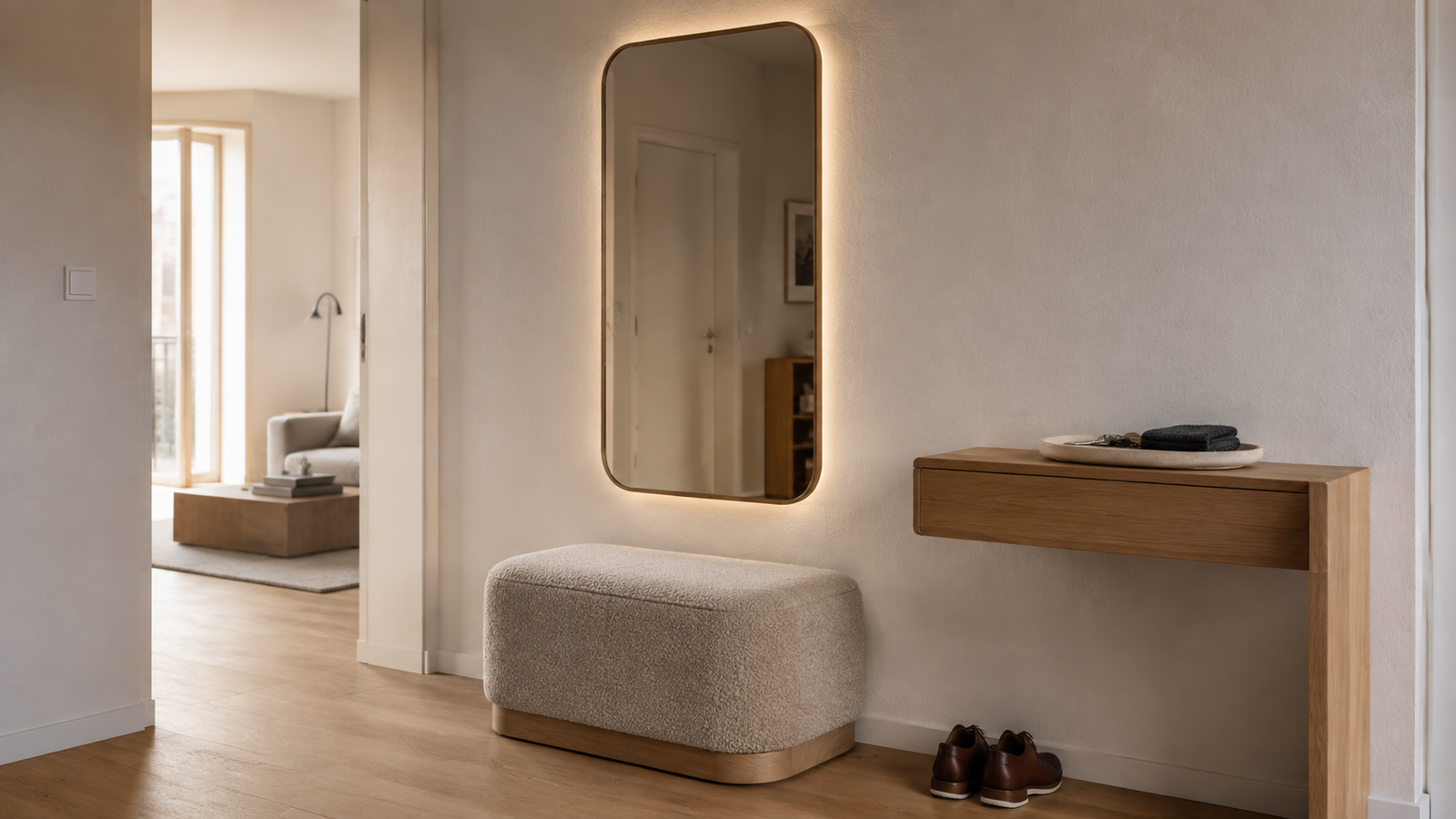
For a recent German entryway proposal, the buyer did not review a mirror, an ottoman and a tray as three separate products. They reviewed one customer situation: a compact apartment entrance that needed reflection, seating, small-item storage and a calm visual identity.
That difference changed the product decisions.
Start with the Category Role
The first proposal included a tall wall mirror, a small upholstered storage ottoman and a decorative tray. The visual direction was suitable, but the review found that each category still needed a clearer practical role.
The mirror was confirmed as the vertical anchor. Its wall-clearance, hanging points and carton protection became as important as its frame finish.
The ottoman was reviewed as both seating and concealed storage. The first version used a decorative stitched lid and a lighter base. After the prototype review, the lid was simplified and the internal support was strengthened. The final sample looked calmer, sat more securely and was easier to pack.
The tray remained a small add-on item, but its role was defined: a place for keys, glasses or daily objects. It completed the entryway story without adding unnecessary stock complexity.
Product Category vs. Buyer Category
| Product category | What a catalogue may show | What a German buyer needs to review |
|---|---|---|
| Mirrors | Shape, frame and size | Mounting, wall clearance, backing, protection and replacement process |
| Soft furnishings | Fabric and silhouette | Seating stability, internal structure, fabric tension and carton efficiency |
| Decorative storage | Colour and compartment layout | Usable volume, opening method, finish durability and daily function |
| Lighting | Appearance and light effect | Intended use, light mood, power format, product documentation and packing |
| Tabletop décor | Material and motif | Retail price role, finish consistency, display combination and reorder potential |
This is the basis of a practical B2B sourcing guide. The buyer is not selecting isolated objects; the buyer is reducing uncertainty across the full category.
Installation Information Is Part of the Product
For mirrors and wall-mounted décor, an installation guide should be prepared before the order is placed—not after the container arrives.
In the entryway proposal, the mirror workshop reviewed the backboard, hanging hardware and distance from the wall. The packaging team then adjusted corner protection around the visible frame edges. This was a small technical review, but it prevented a common problem: a beautiful sample that becomes difficult to install or vulnerable in transit.
For the buyer, a clear installation pack should include:
- overall dimensions and net weight;
- hanging-point position and mounting method;
- wall-clearance requirement;
- mirror backing and edge-protection details;
- carton dimensions and handling guidance;
- spare-unit or replacement procedure.
A home furnishings buying guide becomes more useful when it shows this evidence clearly instead of relying only on lifestyle images.
What the European Fair Direction Means in Practice
At Ambiente, Living brings together furniture, lighting, décor and furnishing concepts; its Interior Looks format also connects these products with retailers, planners and hospitality professionals. Ambiente Living and Interior Looks reflect the market’s move towards coordinated interiors.
The 2026 trend worlds—brave, light and solid—give retailers a framework for translating broad design ideas into market-ready ranges.
For German buyers, the commercial interpretation is usually restrained:
- use one tactile or expressive element, such as bouclé or a textured ceramic;
- keep core forms calm and easy to combine;
- select products that solve a real room need;
- align finish, packaging and delivery planning before the range is finalised.
A Short Retail Buyer Guide
Before confirming a category, ask four direct questions:
- What role does this product play in the customer’s room?
- Which construction or installation detail could create a later problem?
- Can it be displayed with neighbouring categories at the intended price level?
- Is the final specification clear enough for repeat production and delivery?
FAQ
Why should mirrors be reviewed together with soft furnishings and décor?
Because customers see a room solution, not a supplier’s category structure. Coordinated products are easier to display, explain and sell.
What makes an installation guide useful for retail buyers?
It confirms that the item can be safely handled, installed and supported after sale—especially for mirrors and wall-mounted products.
Can a category guide support private-label development?
Yes. It creates a shared review structure for dimensions, materials, function, packing, installation and retail positioning before sampling is finalised.
Build Categories That Are Easier to Buy
The strongest category proposal is not the longest one. It is the one that gives the buyer enough evidence to approve the product with confidence.
Teruier supports retail buyer guide preparation across mirrors, soft furnishings, lighting, decorative storage and tabletop décor—linking product role, sample review, installation information and delivery planning into one clearer sourcing decision.



