
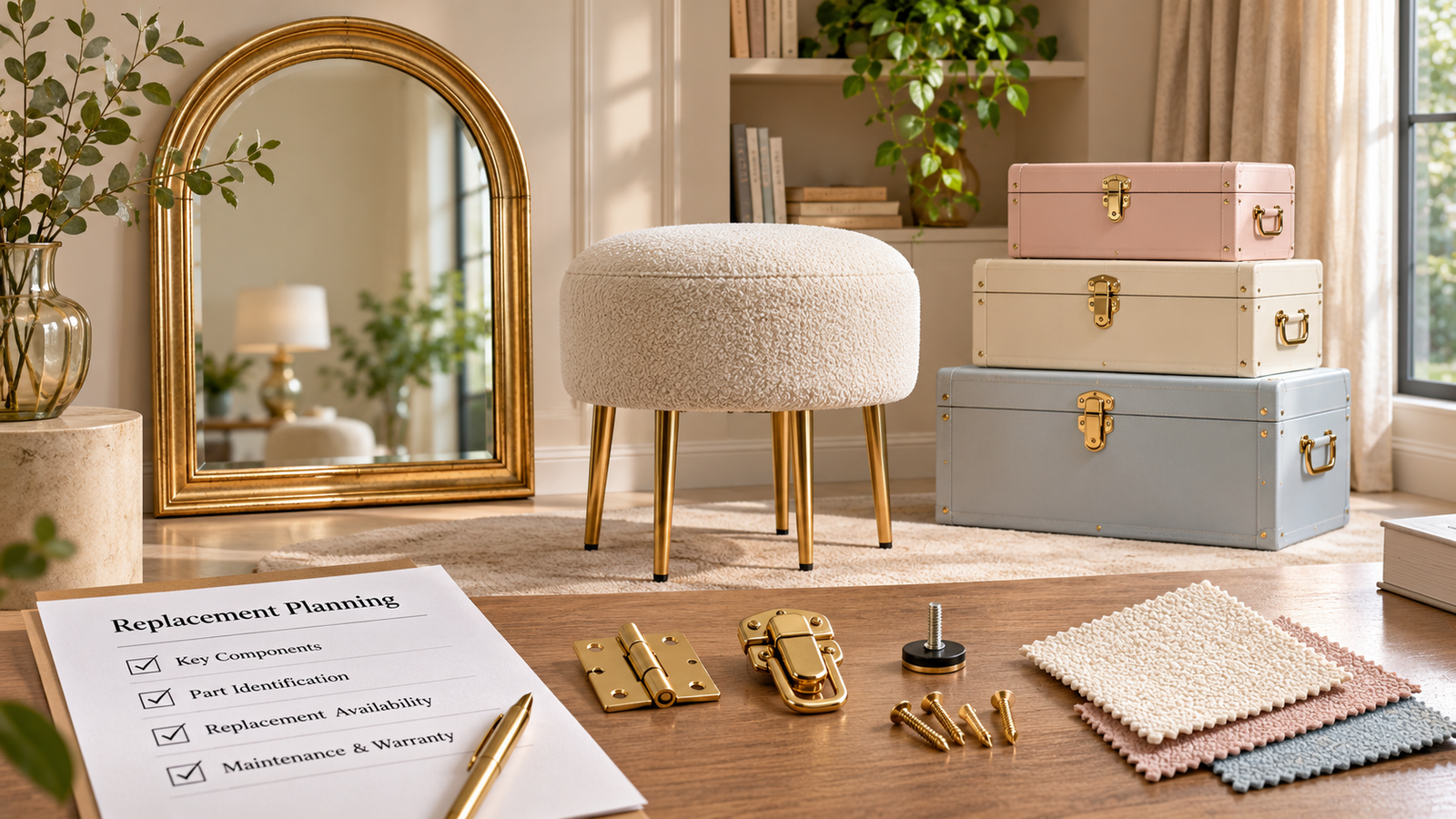
A hotel opens with a complete set of mirrors, upholstered stools, decorative storage trunks, and other home furnishings. Everything looks right.
Six months later, a mirror’s mounting component is damaged. One stool needs a replacement leg. A storage trunk has a faulty latch.
The products themselves may still be in good condition. Yet the buyer faces an unexpected problem: can the individual components be identified and replaced, or must the entire product be purchased again?
For professional B2B home furnishings sourcing, this is a question worth asking before the first purchase order.
A competitive quotation tells buyers what a product costs today. A well-prepared sourcing agreement should also explain what happens when a small part needs attention later.
The Difference Between Product Warranty and Replacement Planning
Warranty and replacement planning are related, but they are not the same.
A warranty defines the agreed responsibility for specified defects or failures during a defined period.
Replacement planning addresses a different operational question: if a component is damaged, worn, or missing, can the correct replacement be identified and obtained?
For a multi-room hotel, serviced apartment, or retail chain, this distinction matters.
Replacing one small component may preserve an otherwise usable product. Replacing the entire item can create additional purchasing, shipping, installation, and disposal costs.
However, not every component is designed to be replaced independently. Some products require professional repair, while others may need complete replacement for safety or structural reasons.
The buyer should understand these differences before approving the product.
Three Types of Components Buyers Should Identify
1. Functional Hardware
These are relatively easy to overlook during initial product selection.
Examples include:
- Hinges and lid-support fittings.
- Metal latches and handles.
- Furniture legs and floor glides.
- Wall-mounting hardware.
- Screws, connectors, and fastening components.
Buyers should establish whether these components have separate identification references and whether individual replacements can be ordered.
A visually similar fitting is not necessarily compatible with the original product.
2. Decorative Components and Finishes
Some product failures are not structural but still affect the finished appearance.
Examples include upholstery fabric, decorative trims, surface coatings, and metallic finishes.
The challenge is maintaining consistency with the original product.
A replacement gold-tone handle may function correctly but look different from the original finish. A new upholstery panel may use a similar fabric but show a visible colour difference.
Buyers should therefore consider finish references, material codes, and the availability of matching replacement materials.
3. Structural and Fragile Components
These require more careful assessment.
Mirror glass, internal furniture frames, and load-bearing connections cannot automatically be treated as simple spare parts.
A damaged structural component may require a qualified repair process or complete product replacement.
The correct decision should be based on safety, construction, repair feasibility, and the relevant product requirements—not simply the lowest replacement cost.
Three Teruier Products: What Should Buyers Plan For?
Existing Teruier products illustrate why replacement planning needs to be product-specific.
MY3105: Vintage Gold Arch Wall Mirror
The Vintage Gold Arch Wall Mirror, model MY3105, measures 89 × 4 × 60.5 cm and has a vintage-gold frame.
Before ordering, a project buyer should clarify the hanging hardware specification, frame construction, mirror-glass requirements, and approved installation method.
If a mounting component is damaged, can it be identified and ordered separately?
If the glass is damaged, is a qualified repair or complete mirror replacement the appropriate solution?
These questions should be answered according to the actual construction. Buyers should not assume that the glass and frame can be separated or repaired independently.
23T209: Bouclé Accent Ottoman Stool
The Bouclé Accent Ottoman Stool, model 23T209, measures 35 × 45 × 35 cm.
Its round upholstered body is supported by gold-tone metal legs.
For a project buyer, several components deserve attention:
- Metal leg construction and connection points.
- Floor-protection fittings.
- Upholstery fabric reference.
- Internal seat support.
- Approved replacement or repair procedures.
If one leg or floor glide is damaged, the buyer should know whether a compatible component can be supplied without replacing the entire stool.
The availability of individual components must be confirmed with the supplier.
TDS27-08: Pastel Three-Piece Nesting Trunk Set
The Pastel Three-Piece Nesting Trunk Set includes three trunks in blush pink, warm white, and powder blue.
Each trunk has metal-tone front clasps, a front handle, and side handles.
For a buyer managing a large property or retail programme, these fittings are worth recording in the original product specification.
If a clasp becomes damaged, can the correct replacement be identified by model and finish? Are the hinges and handles available as separately orderable components?
The product page confirms the hardware configuration, but does not establish that individual replacement parts are currently available. This needs commercial confirmation.
These examples show why a generic statement such as “after-sales support available” is insufficient for a detailed project procurement agreement.
Create a Replacement Map Before Production
A practical way to improve supplier evaluation is to prepare a simple replacement map for every important product model.
| Product | Components to Identify | Buyer Questions |
|---|---|---|
| Decorative mirror | Mounting hardware, frame, glass | Which components can be separately replaced? |
| Upholstered stool | Legs, glides, upholstery, connectors | Can matching parts and materials be identified? |
| Storage trunk | Hinges, latches, handles, lid supports | Are compatible fittings available for the approved model? |
The map does not mean that every component must be stocked.
Its purpose is to establish what can be repaired, what can be replaced, and what may require a complete new product.
Each replacement reference should ideally include:
- Product model and production revision.
- Component name and identification code.
- Clear photograph or technical drawing.
- Dimensions, material, and finish.
- Compatible product models.
- Ordering unit and replacement conditions.
- Installation or repair instructions, where applicable.
This information becomes particularly valuable when the original purchasing team is no longer responsible for the project.
How Many Spare Parts Should a Buyer Order?
There is no universal spare-parts percentage suitable for every home furnishing project.
Ordering too many components ties up money and creates unnecessary inventory. Ordering none may create delays when a critical component fails.
A better approach is to classify components according to their importance.
| Priority | Component Type | Planning Approach |
|---|---|---|
| High | Small components that can interrupt product use | Consider an initial spare allowance |
| Medium | Decorative or replaceable components | Confirm availability and ordering conditions |
| Low | Components rarely replaced or not independently serviceable | Record the repair or full-replacement procedure |
For new projects without maintenance history, the initial allowance should be treated as provisional.
As actual replacement records accumulate, buyers can adjust their purchasing quantities.
The right quantity depends on project size, expected use, component criticality, replacement lead time, and storage cost.
What Should Be Written Into the Purchase Agreement?
A replacement discussion should not remain a verbal promise.
For buyers establishing retail supplier standards or managing a commercial project, the purchase agreement can define the following points:
1. Component identification
The supplier should identify agreed serviceable components and their corresponding product models.
2. Replacement availability
Specify which parts can be ordered separately, which require a complete replacement unit, and which are subject to technical review.
3. Commercial conditions
Clarify replacement pricing, minimum quantities, order units, and shipping responsibilities.
4. Warranty responsibilities
Define the warranty period, covered defects, exclusions, evidence requirements, and the agreed remedy.
5. Documentation
Retain product drawings, approved samples, material references, and relevant assembly or repair instructions.
6. Availability period
If long-term spare-parts availability is important, agree on a defined period and the supplier’s responsibilities in writing. Do not assume that a product will remain available indefinitely.
The United Nations Global Compact’s Sustainable Procurement Implementation Framework also recommends that buyers ask suppliers about durability testing, repair documentation, spare-parts availability, repair instructions, and warranty terms. It identifies repairability and defined spare-parts arrangements as relevant considerations in procurement and supplier selection.
This is a procurement recommendation, not a universal legal obligation for every home décor product.
See the UN Global Compact Sustainable Procurement Framework.
Repairability Can Become a Competitive Advantage
For international buyers, the value of a supplier should not be measured only by the initial purchase price.
Consider two purchasing options.
Supplier A offers a lower unit price but cannot clearly identify replacement components.
Supplier B provides clearer product references, documented replacement conditions, and an agreed process for dealing with selected components.
Supplier B may involve a higher initial cost, but the buyer has more information when planning future maintenance and replacement.
This does not automatically make Supplier B the better choice. Actual replacement prices, availability, product durability, and contract terms still need to be evaluated.
The point is that procurement decisions should account for the entire product lifecycle rather than stopping at the first delivery.
For projects with repeated installations, a repair-friendly product may also help maintain a consistent appearance when individual items need attention.
What This Means for Teruier’s Product Development
Teruier works across decorative mirrors, upholstered accent furniture, storage products, and other home accessories through its product-development and manufacturing resources in Fuzhou–Minhou, China.
These product categories have different structures and different maintenance considerations.
A mirror may require attention to glass and mounting components. An upholstered stool may involve legs, floor fittings, and fabric. A storage trunk may have hinges, latches, and handles.
They should not be managed under one generic replacement procedure.
For project buyers, Teruier can discuss the relevant product specifications and identify which replacement or maintenance questions need confirmation before ordering.
Whether a component can be supplied separately, how long it remains available, and what commercial terms apply must be established for the selected model.
The objective is to make the purchasing arrangement clearer before the products enter daily use.
FAQ
Should buyers request spare parts with every wholesale order?
Not necessarily. Spare quantities should reflect product type, project size, expected use, replacement lead time, and the importance of the component.
Can every furniture component be replaced separately?
No. Some components are integrated into the product structure. Others may require professional repair or complete product replacement.
Does a supplier’s warranty guarantee spare-parts availability?
No. Warranty coverage and spare-parts availability are separate matters. Buyers should define both independently in their commercial agreement.
When should replacement requirements be discussed?
Before sample approval and production. This is when component identification, construction choices, documentation, and commercial responsibilities can still be clarified.
Plan the Full Product Lifecycle With Teruier
A good purchasing decision should not end when the container arrives.
For importers, project procurement teams, and international home furnishing buyers, it is worth understanding how products can be maintained, repaired, and replaced throughout their intended service life.
Teruier works with international buyers on product selection, specifications, sample development, and manufacturing coordination.
Contact Teruier to discuss your product requirements, replacement considerations, and wholesale or project sourcing arrangements.