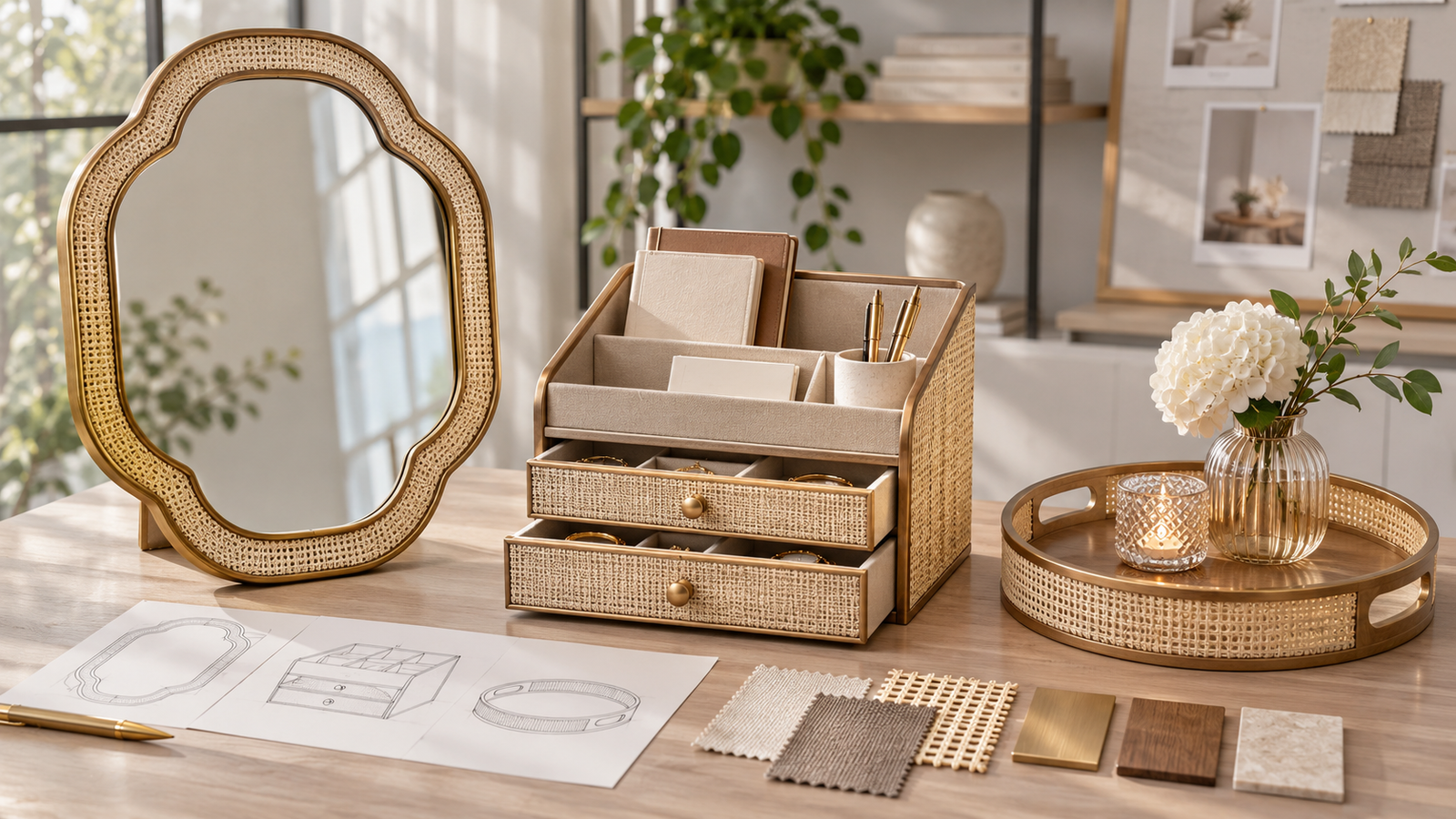
A decorative mirror sells well because of its distinctive frame. A storage box attracts customers through its practical design. A tabletop accessory stands out because it combines an attractive appearance with everyday usability.
These products succeed for different reasons.
Now imagine a buyer developing a new home décor product. Instead of copying one existing bestseller, the buyer examines what made several successful products commercially attractive and considers whether those strengths can be combined in a new design.
This is the idea behind Combining blockbuster capabilities.
It is not about putting several popular products into one package. It is about identifying proven product strengths and translating them into new development opportunities.
For international home décor buyers, this approach can create more meaningful innovation while reducing the uncertainty of starting from a completely untested concept.
A Bestseller Is a Result. Its Capabilities Are What Buyers Can Reuse.
A product may sell well for many reasons.
It might have a recognizable silhouette, an attractive price, a useful function, convenient packaging or a strong position within a retail collection.
However, copying its appearance does not necessarily reproduce its commercial success.
Consider two decorative mirrors with similar shapes. One may perform better because its proportions work particularly well in smaller homes. Another may benefit from a more accessible price or easier installation.
The visible design is only part of the explanation.
Buyers should distinguish between three things:
| Element | Meaning | Can It Be Reused? |
|---|---|---|
| Product feature | A specific physical detail or function | Sometimes |
| Product capability | A repeatable strength that creates customer or operational value | Often, with adaptation |
| Commercial performance | The actual result in a particular market and channel | Must be independently validated |
A bestseller should also be supported by evidence.
Useful indicators include sales performance, repeat orders, gross margin, customer feedback, return reasons and inventory movement.
A popular trade-show sample is not automatically a bestseller.
Without reliable sales evidence, buyers should describe a product as promising or well-received rather than commercially proven.
Six Capabilities Worth Extracting From Successful Products
Before combining different product strengths, buyers need to understand what those strengths actually are.
1. Visual Recognition
Some products are immediately recognizable.
Their silhouette, proportions, surface treatment or decorative details create a distinctive identity.
For example, a mirror may attract attention through an unusual frame profile rather than through its size or material.
The transferable capability is not necessarily the exact frame.
It may be the ability to create a recognizable silhouette without adding unnecessary decorative complexity.
2. Functional Value
A product may succeed because it solves a practical problem.
A decorative storage box provides a place for small belongings. A tray organizes objects while remaining useful for serving or display.
The underlying capability is functional value combined with an attractive appearance.
Buyers can look for opportunities to introduce similar practical benefits into other product categories.
3. Material and Finish Expression
A successful product may use a particular material combination or surface treatment to create a recognizable market position.
Examples include warm metallic finishes, textured ceramic surfaces, natural wood tones and tactile upholstery.
However, a finish that looks attractive on one product may behave differently on another.
The transferable capability is the material and visual language, not necessarily the exact manufacturing process.
4. Retail Adaptability
Some products work across several retail environments.
A decorative accessory may suit a tabletop display, a gift assortment or an online home décor collection.
This adaptability can be commercially valuable because the product is not dependent on one narrow selling situation.
5. Packaging and Shipping Efficiency
A visually attractive product may still be difficult to sell internationally if it is fragile, bulky or expensive to pack.
Buyers should consider whether a successful product has useful packaging characteristics that can be applied to new designs.
However, packaging solutions must be validated for the new product’s actual dimensions, materials and fragility.
6. Repeatability and Supply Continuity
The first successful order is only part of the story.
A product becomes a stronger commercial opportunity when its materials, finishes, construction and packaging can be reproduced consistently.
This capability is particularly important when developing products intended for repeated wholesale orders.
Teruier’s New Product Development (NPD) Isn’t a Mood Board. It’s a Reorder Plan discusses why product development should be evaluated beyond the initial launch. <httpsearch-placeholder/>
Build a Capability Map Before Designing Something New
A useful exercise is to review several existing products and identify the strengths worth transferring.
Consider a hypothetical home décor development project involving three product references.
| Existing Product | Observed Strength | Potential Transferable Capability |
|---|---|---|
| Decorative mirror | Recognizable frame proportions | Strong visual identity |
| Decorative storage box | Convenient access and usable space | Functional organization |
| Tabletop tray | Practical horizontal surface | Everyday versatility |
The next step is not automatically to combine all three products into one complicated item.
Instead, the buyer should ask:
Which capabilities are relevant to the new product’s intended customer and use?
For example, a new tabletop organizer might borrow the visual language of the mirror, the accessibility principles of the storage box and the practical surface arrangement of the tray.
The result would be a new design direction, not a copy of any existing product.
This distinction matters.
A capability should be transferred because it solves a new product problem, not simply because it appeared in another successful product.
Combining Capabilities Without Creating a Frankenstein Product
There is a danger in this approach.
When buyers become excited about combining successful features, they may try to include too many ideas in one design.
A product may end up with:
- An elaborate decorative structure.
- Multiple functional compartments.
- Several different materials.
- Complex hardware.
- Unnecessary assembly requirements.
The result may be expensive, visually confusing and difficult to manufacture.
A more disciplined approach is to assign each new product three levels of capability.
| Priority | Role | Development Principle |
|---|---|---|
| Core capability | Defines the main customer value | Must be immediately understandable |
| Supporting capability | Improves usability or appearance | Must reinforce the core idea |
| Operational capability | Makes production, packaging or replenishment workable | Must be validated before scaling |
For example, a new decorative storage product might use visual recognition as its core capability, practical access as its supporting capability and a repeatable construction method as its operational capability.
The buyer should resist adding features that do not improve the product’s intended role.
From Capability Research to a New Product Brief
Once the relevant capabilities have been identified, they need to become a clear development brief.
A useful brief should answer five questions.
1. Which customer problem are we solving?
A new product should have a defined reason to exist.
Is it intended to improve storage, create a stronger decorative statement, offer a giftable product or provide a more practical tabletop accessory?
2. Which proven capabilities are being transferred?
List the selected capabilities and explain why they are relevant.
Avoid vague statements such as “make it more premium” or “combine the best features.”
3. What must remain different?
A new product should offer a reason for customers to choose it.
The design should not simply reproduce the original products with minor cosmetic changes.
4. What technical changes are required?
Review materials, structure, dimensions, hardware, finishing and packaging.
A capability that works in one product category may need a different manufacturing solution in another.
5. How will the new concept be evaluated?
Define the intended price position, target customer, sample acceptance criteria and expected commercial role.
These decisions help transform home décor sample development from an open-ended creative exercise into a more focused investment.
A Real Example: One Visual Language, Different Product Capabilities
Teruier’s developing 2027 striped storage and wall décor collection provides an example of how one design idea can be translated across different product forms.
The collection explores shared stripe directions across trays, decorative storage and wall accessories.
Importantly, the products do not simply repeat the same shape.
A tray needs a useful surface and appropriate proportions. A storage box requires practical access and usable capacity. A wall accessory has different mounting and space considerations.
The common visual direction connects the products, while each item retains its own functional role.
During development, the stripe pattern was also adjusted to work across different product scales. <Link url=”https://teruier.com/teruier-develops-a-striped-storage-and-wall-decor-collection-for-2027/” title=”See Teruier’s striped storage and wall décor development”/>.
This illustrates an important principle: transferring a design capability requires adaptation to the new product, not simply applying the same decoration everywhere.
Use Physical Samples to Test the Combination
A capability may sound attractive in a development meeting but fail when translated into a physical product.
This is why buyers should test the most important assumptions before approving a complete production programme.
For a new concept, the review might include:
| Review Area | What to Evaluate |
|---|---|
| Appearance | Does the new design have a clear identity? |
| Function | Does the added capability improve actual use? |
| Construction | Can the different elements work together? |
| Cost | Does the combination remain commercially viable? |
| Packaging | Does the new structure create additional shipping risks? |
| Repeatability | Can the approved result be reproduced consistently? |
A physical sample is especially important when combining different materials or manufacturing processes.
Teruier’s Over 20 Product Catalogs Backed by Physical Samples shows how buyers can compare product forms, material expression, surface finishes and construction details using actual samples.
The catalogues provide a starting point for selection; the physical samples provide a basis for more detailed development discussions.
Why Supply Chain Management Matters to Product Innovation
Combining capabilities can create additional manufacturing complexity.
A new product may involve more than one material, production process or component supplier.
For example, a decorative storage product might require woodworking, metal hardware, surface finishing and protective packaging.
The design may be successful, but the supplier needs to coordinate all these elements.
Buyers should therefore review:
- Whether the required materials can be sourced consistently.
- Whether different production processes can meet the same specifications.
- Whether component dimensions and connections are controlled.
- Whether finishing quality can be maintained across batches.
- Whether the packaging protects the complete product.
- Whether the production schedule supports repeat orders.
This is where supply chain management becomes part of product innovation rather than a separate operational activity.
Teruier’s Home Décor Sourcing & ODM/OEM Manufacturing Hub presents the connection between design development, material and process control, quality checkpoints, packaging and wholesale delivery.
The goal is to make sure that a promising combination can become a repeatable commercial product.
How Many Capabilities Should a Buyer Combine?
There is no universal number.
However, starting with one primary capability and one or two supporting capabilities is a practical way to keep early development focused.
A product with too many competing ideas becomes difficult to position and evaluate.
Buyers should also consider whether a capability belongs in the same product or should become part of a wider collection.
For example, a strong visual design language may be shared across several products, while their individual functions remain different.
Teruier’s TMR27 Mirror Series for the 2027 Global Home Furnishings Market illustrates a structured product-family approach, with different mirror formats serving different commercial roles.
The important lesson is that a product family does not need identical products. It needs a clear relationship between its members.
FAQ
What does combining blockbuster capabilities mean?
It means identifying the repeatable strengths behind successful products and applying relevant strengths to new product development. It does not mean simply combining several products into one bundle.
How can buyers identify which capabilities are worth transferring?
Review actual sales performance, repeat orders, customer feedback, returns, margins and manufacturing consistency. Separate proven evidence from assumptions.
Is combining product capabilities the same as creating a coordinated collection?
No. A coordinated collection connects several products through a shared design language. Combining capabilities focuses on transferring proven product strengths into new development decisions.
Should every successful product feature be copied into a new design?
No. Each feature or capability should solve a clear customer or operational problem. Unnecessary additions can increase cost and manufacturing complexity.
How can suppliers help buyers develop new products from existing capabilities?
Suppliers can review existing samples, materials, structures and manufacturing methods, then propose technically feasible ways to adapt selected capabilities to a new product brief.
Develop the Next Product From What Already Works
Innovation does not always require starting from zero.
Some of the strongest product opportunities come from understanding why existing products work, identifying which strengths can be transferred and applying them to a different customer need.
For international home décor buyers, this creates a more disciplined approach to product innovation.
Teruier works with global buyers on product selection, design development, physical sampling, material coordination and manufacturing requirements across decorative mirrors, storage, tabletop décor and accent furniture.
Contact Teruier to discuss your existing product references and explore new development opportunities based on proven product capabilities.