
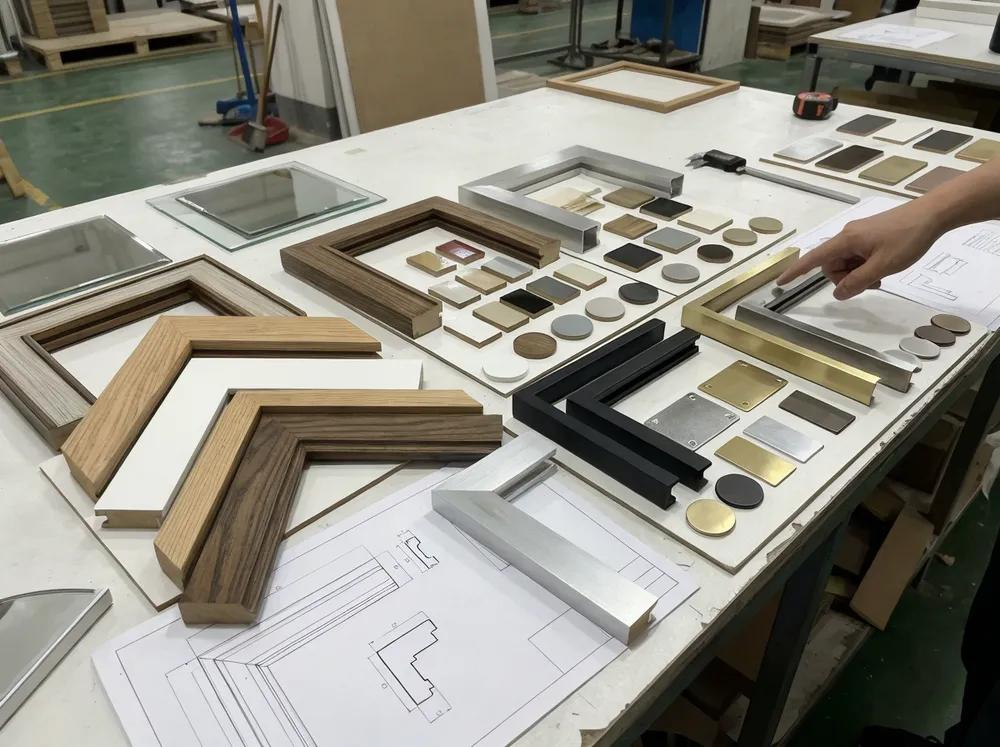
A home décor product has been selling successfully for two years. The design is established, customers recognize it, and the retailer has already built a product listing around it.
Then the supplier increases its price.
The buyer finds another factory offering a lower quotation for what appears to be the same product.
The decision seems straightforward: change suppliers and protect the margin.
But the first production sample arrives with a slightly different finish. The carton dimensions have changed. The mounting hardware is not identical, and the new supplier uses a different packaging structure.
The product still looks similar. Yet the buyer now needs to repeat several approvals.
This is the hidden cost of changing suppliers.
For professional wholesale sourcing decisions, the question should not simply be which factory offers the lower price.
It should be:
How much will it cost to transfer an established product from one supplier to another without damaging its commercial performance?
A Supplier Change Is More Than a New Purchase Order
When buyers compare suppliers for a new product, they mainly evaluate capability, price, quality and delivery.
When changing an existing supplier, the situation is different.
The product already has an established identity and a history of customer expectations.
The previous supplier may hold important working knowledge:
- Approved material and finish references.
- Product drawings and construction details.
- Manufacturing tolerances.
- Packaging configurations.
- Quality inspection criteria.
- Product labels and identification codes.
- Previous corrective actions.
Some of this information may exist in the buyer’s files. Other details may only be recorded in emails, sample photographs or the original supplier’s production records.
A replacement factory does not automatically inherit this knowledge.
The buyer must transfer it.
This is why how buyers compare wholesale suppliers should be a different process for an established product than for a completely new SKU.
Four Costs That Buyers Often Miss
A lower unit price is only one part of the comparison.
The complete supplier transition can involve four additional cost areas.
1. Product Requalification
The new supplier needs to understand and reproduce the approved product.
This may require:
- Reviewing existing technical drawings.
- Confirming materials and component specifications.
- Developing new samples.
- Matching approved colours and finishes.
- Checking structural and functional details.
- Reviewing tooling and production methods.
A product that looks simple may contain manufacturing details that are not obvious from its exterior appearance.
For example, a decorative mirror may have a distinctive frame profile, backing construction and hanging system. Reproducing the appearance alone does not establish that the replacement product is equivalent.
2. Quality Verification
The new supplier must demonstrate that the product can be produced consistently.
This may involve sample comparisons, inspection criteria, material verification and a pilot production run.
The buyer should not assume that an approved prototype proves that the replacement factory can reproduce the same result at production quantities.
The evidence needs to match the actual production process.
3. Operational Transition
A supplier change can affect more than the factory.
The buyer may need to update:
- Product specifications.
- Carton dimensions and weights.
- Shipping arrangements.
- Labels and barcodes.
- Warehouse information.
- Product documentation.
- Internal purchasing records.
For online retailers, changes to product appearance, packaging or installation details may also require updates to product images, descriptions and customer instructions.
4. Inventory and Sales Continuity
The previous supplier may still have finished goods or components available.
Meanwhile, the replacement supplier may need time to complete sampling and production.
This creates a transition period in which two production sources may exist simultaneously.
Buyers need to consider whether the old and new products can be sold together without creating noticeable differences.
If a retailer receives customer complaints because two supposedly identical products look different, the savings from a lower quotation may disappear quickly.
The Most Important Document: A Product Transfer Pack
Before changing factories, buyers should establish a complete reference package.
This is different from simply sending a product photograph or an old quotation.
A practical transfer pack should include:
| Information | What Must Be Recorded |
|---|---|
| Product identity | SKU, model number and revision |
| Approved sample | Dated reference sample and photographs |
| Dimensions | Main dimensions and acceptable tolerances |
| Materials | Material specifications and approved alternatives |
| Finishes | Colour references, surface treatment and variation limits |
| Construction | Drawings, components and assembly details |
| Function | Installation, operation and usage requirements |
| Quality | Inspection checkpoints and acceptance criteria |
| Packaging | Inner protection, master carton and shipping marks |
| Commercial | MOQ, price basis, lead time and delivery terms |
Not every product requires every document.
A ceramic vase and an LED mirror have different technical requirements.
The purpose is to capture the information necessary to reproduce the specific product.
There is also an important contractual consideration: buyers should confirm ownership and permitted use of drawings, tooling, moulds, brand assets and confidential manufacturing information before transferring them to another supplier.
A product transfer should not create an intellectual property dispute.
For a related approach to documenting product requirements, see Teruier’s Home Decor Spec Sheets: Where Pretty Products Go to Become Real Business.
Three Different Reasons for Changing Suppliers
Not every supplier change should follow the same process.
The reason for changing suppliers determines the appropriate transition strategy.
Scenario 1: Commercial Price Pressure
The existing supplier produces acceptable products but its quotation is no longer competitive.
The buyer wants to reduce purchasing costs.
In this case, the replacement supplier should first demonstrate that it can reproduce the existing product definition.
The comparison should include the full cost of transition, not only the new unit price.
If the price difference is small, maintaining the existing supplier may be more economical.
Scenario 2: Product or Manufacturing Improvement
The buyer wants to improve a product through a new material, construction method or production process.
This is not a straightforward supplier replacement.
It is a product redevelopment project.
The buyer should clearly distinguish between:
- Reproducing the original product.
- Improving selected components.
- Creating a revised product version.
Otherwise, the new supplier may unknowingly change several details while trying to improve one.
The revised product should receive a new version reference and approval record.
Scenario 3: Supply Disruption or Supplier Risk
The existing supplier can no longer support the order because of capacity constraints, business changes or repeated delivery problems.
Here, speed becomes important, but uncontrolled speed creates additional risk.
The buyer should identify the most critical products first.
A practical priority order might be:
- Products with active customer demand.
- Products with committed delivery dates.
- Products with limited alternative supply.
- Products that can be replaced by existing alternatives.
The objective is to protect business continuity rather than transfer every SKU simultaneously.
The Five-Stage Supplier Transition Method
A controlled transition can be organized into five stages.
Stage 1: Establish the Reason for Switching
Write down the actual problem.
Is it price, quality, delivery, capacity, communication or product development capability?
The buyer should define what the replacement supplier must improve.
Without this step, a new supplier may reproduce the same problems under a different company name.
Stage 2: Freeze the Existing Product Reference
Before requesting a new quotation, establish the current approved product version.
Collect the relevant drawings, samples, finish references, packaging details and inspection criteria.
Record what must remain unchanged.
Also identify which details may be improved.
This distinction prevents an uncontrolled redesign during a supplier transfer.
Stage 3: Qualify the Replacement Supplier
Do not evaluate the replacement factory solely through its catalogue.
Review its ability to manufacture the selected product category.
For example:
| Product Category | Important Verification Areas |
|---|---|
| Decorative mirrors | Frame structure, glass specification, finish and mounting |
| Upholstered furniture | Frame, foam, fabric, stitching and assembly |
| Ceramic décor | Shape, material, glaze and firing consistency |
| Decorative storage | Structure, hinges, hardware and surface finish |
The buyer should request evidence relevant to the actual product rather than rely on general statements about factory capability.
Teruier’s For Importers & Distributors: Evaluate a Home Décor Supplier Before the Order provides a broader supplier assessment framework.
Stage 4: Run a Controlled Pilot Order
A replacement supplier should demonstrate more than the ability to make one attractive sample.
A pilot order can help validate:
- Production consistency.
- Material and finish repeatability.
- Assembly and functional performance.
- Packaging and transport protection.
- Inspection results.
- Actual production lead time.
The size of the pilot should reflect the product risk, order volume and available evidence.
A small pilot is not automatically sufficient for every product.
For fragile, complex or safety-sensitive products, additional verification may be necessary.
Stage 5: Complete the Cutover and Monitor Reorders
Once the replacement product has passed the agreed approval process, the buyer can define the production transition.
The plan should identify:
- Which orders remain with the original supplier.
- When the replacement supplier begins production.
- How old and new inventory will be distinguished.
- Whether product listings or labels require updates.
- Who handles outstanding quality or delivery issues.
- How the first repeat orders will be reviewed.
The transition should not be considered complete merely because the first shipment has arrived.
The real test is whether the replacement supplier can repeat the approved result.
Teruier’s Reorder-Ready Home Decor Supplier: A U.S. Buyer’s Checklist for Reliable Wholesale explores this principle in greater detail.
Should Buyers Use Two Suppliers at the Same Time?
Sometimes, but not automatically.
Maintaining two suppliers can reduce dependence on one production source.
It can also create new management problems.
For example:
- Different factories may produce slightly different finishes.
- Materials may come from different sources.
- Carton configurations may not match.
- Production schedules may become harder to coordinate.
- Small order quantities may increase costs.
Dual sourcing is more practical when the product specification is sufficiently mature and the buyer can maintain consistent approval criteria.
It is especially worth considering for critical products with significant sales continuity requirements.
However, two suppliers do not automatically provide twice the security.
Without clear specifications and quality control, they can simply create two versions of the same product.
When Is It Better Not to Switch?
A supplier change should have a clear commercial reason.
Consider staying with the existing supplier when:
- Product quality remains consistent.
- Delivery performance is acceptable.
- Communication is reliable.
- The price difference is too small to justify transition costs.
- The replacement supplier cannot demonstrate equivalent production capability.
Consider switching when:
- Repeated quality problems remain unresolved.
- Delivery failures are damaging customer commitments.
- The supplier cannot support future production requirements.
- Communication and corrective action have become unreliable.
- A replacement supplier can demonstrate measurable improvements.
A buyer should compare the cost of maintaining the relationship against the cost and risk of changing it.
Neither decision should be made emotionally after one disappointing shipment.
A Better Way to Compare Supplier Quotations
When reviewing two quotations, use the same product definition and delivery assumptions.
| Comparison Area | Existing Supplier | Replacement Supplier |
|---|---|---|
| Unit price | Current quotation | New quotation |
| Sample and development | Existing approval | New sample costs |
| Material and finish | Approved reference | Verified equivalent |
| Tooling | Existing arrangement | New or transferred tooling |
| Packaging | Established configuration | Validated new configuration |
| Quality inspection | Existing checkpoints | Agreed new checkpoints |
| Lead time | Proven performance | Confirmed production plan |
| Transition inventory | Existing stock | Additional stock requirement |
| Reorder capability | Historical evidence | To be demonstrated |
The buyer should then calculate:
Total Supplier Change Cost = Product Requalification + Sample Development + Tooling + Testing + Packaging Validation + Inventory Transition + Other Agreed Costs
This calculation should be compared with the expected savings over a realistic purchasing period.
The important point is to compare equivalent products and equivalent delivery conditions.
A lower quotation that excludes packaging, inspection or other necessary services is not a like-for-like comparison.
What This Means for Retail Buyer Sourcing
For established retail products, supplier relationships are part of the product’s commercial infrastructure.
A product may have a successful listing, approved photography, customer reviews and a stable reorder history.
Changing its production source can affect all these elements.
That is why retail buyer sourcing should consider product continuity alongside price and manufacturing capacity.
A good sourcing decision protects three things:
Product identity: The replacement should match the approved product definition.
Commercial continuity: Existing inventory, listings and customer expectations should remain manageable.
Future flexibility: The new supplier should be capable of supporting realistic changes and repeat orders.
The buyer is not simply purchasing the next shipment.
The buyer is protecting an established product business.
How Teruier Supports Product and Supply Coordination
Teruier works with international buyers across decorative mirrors, upholstered furniture, ceramic décor, storage products and tabletop accessories.
Its product-development and manufacturing coordination approach connects design references, material selection, specifications, sampling, quality checkpoints, packaging and delivery planning.
The Home Décor Sourcing & ODM/OEM Manufacturing Hub explains how these activities connect within a wider sourcing programme.
For buyers, the practical objective is to make product requirements clear enough that production can be reviewed, compared and repeated.
When considering a new supplier, it is worth discussing the existing product reference, the reasons for changing, the required production volume and the expected delivery schedule before requesting a quotation.
FAQ
Is switching wholesale suppliers always a good way to reduce costs?
No. Lower unit prices may be offset by sample development, tooling, requalification, packaging changes, inventory overlap and operational disruption.
Should buyers send the previous supplier’s sample to a new factory?
An approved physical sample can be useful as a reference, but it should be supported by written specifications, revision records and clear acceptance criteria. Buyers should also confirm that they have the right to share the relevant design and technical information.
How long should a supplier transition take?
There is no universal timeline. It depends on product complexity, tooling, materials, sample approvals, production capacity and verification requirements.
Should buyers keep the original supplier during the transition?
Where commercially and contractually practical, maintaining a temporary supply buffer can reduce disruption. The appropriate arrangement depends on inventory levels, order commitments and the reliability of both suppliers.
What is the biggest mistake when changing factories?
Treating the new order as an independent purchase instead of transferring the complete approved product definition and its supporting quality and packaging requirements.
Choose a Supplier for the Next Stage of Your Product Business
The best supplier is not necessarily the one offering the lowest quotation today.
It is the one that can meet the buyer’s requirements, maintain product consistency and support the next stage of the business.
For international importers, retailers and home décor brands, Teruier welcomes discussions about product selection, specifications, sampling, manufacturing coordination and wholesale supply.
Contact Teruier to discuss your current product range, supplier transition requirements and next sourcing programme.