
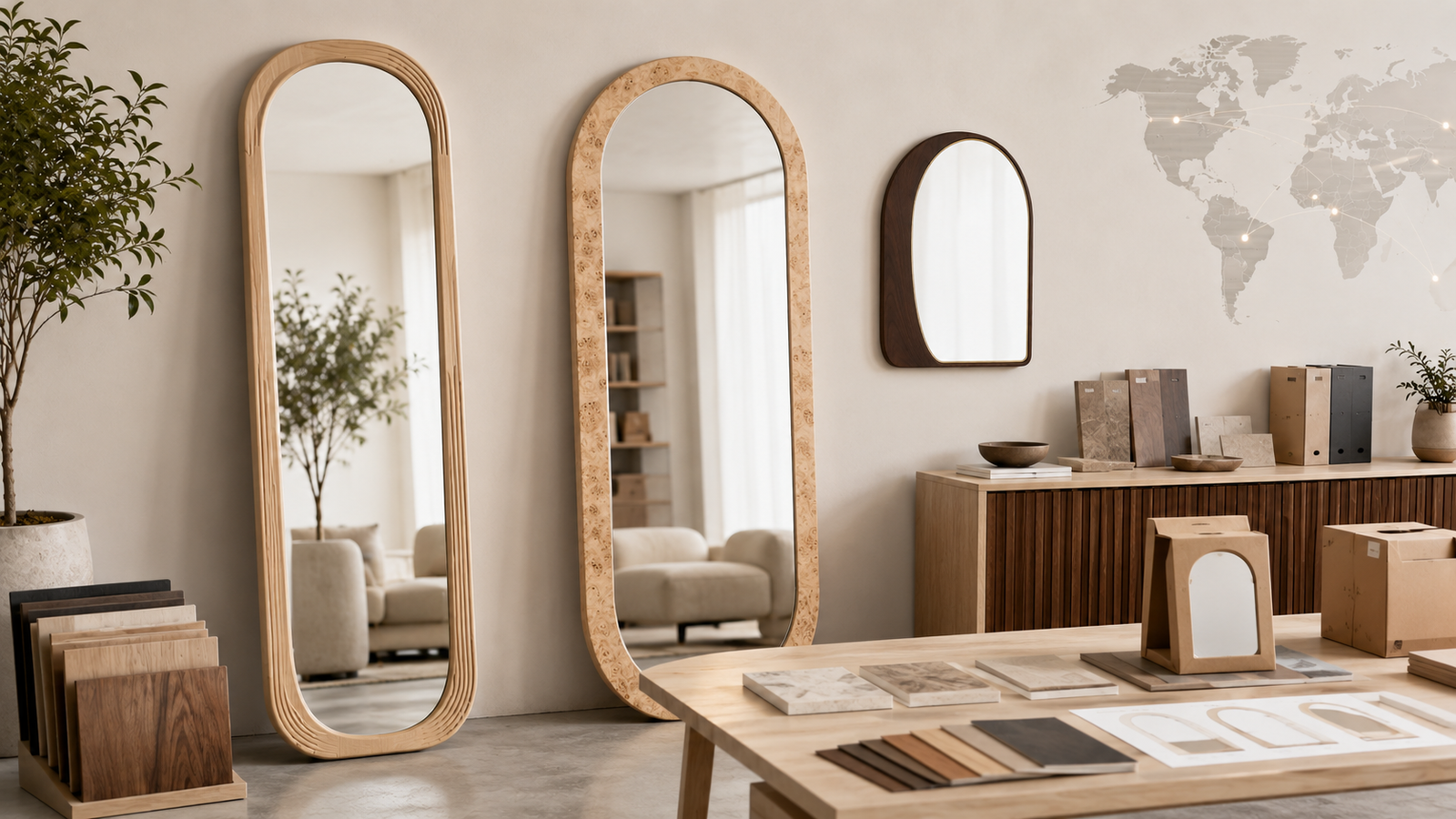
Teruier is advancing the TMR27 Mirror Series, a new product-development program created for international home furnishings buyers preparing their 2027 assortments.
The series includes full-length floor mirrors, medium wall and entryway mirrors, hotel and project mirrors, and smaller decorative formats. Rather than building each item as an unrelated design, Teruier is developing TMR27 as a coordinated product family with a recognizable visual language and multiple commercial roles.
For U.S. buyers, the significance of the series is not simply the number of new designs.
TMR27 is intended to offer a structured mirror assortment that can include statement products, core volume items, channel-specific variations, and accessible decorative options within one development system.
A 2027 Mirror Program Built Around Market Recognition
The TMR27 series begins with a simple question:
Can a mirror be visually recognizable in a crowded marketplace while remaining practical to manufacture, package, ship, and sell?
Many decorative mirrors perform well in staged interiors but lose their identity in a small marketplace thumbnail. Others create strong visual impact but require complicated structures, excessive materials, or packaging that weakens the buyer’s margin.
Teruier developed TMR27 to balance five priorities:
- Strong visual recognition
- Controlled manufacturing complexity
- Flexible material and finish options
- Export-ready construction and packaging
- Clear commercial roles for different SKUs
The collection uses asymmetry, softened geometry, sculptural frame areas, natural wood expressions, selected veneer patterns, subtle surface carving, woven accents, and controlled color blocking.
These details are designed to create differentiation without turning every mirror into a high-cost specialty item.
The TMR27 Natural Sculpt Design Language
One of the main directions within the series is the Natural Sculpt family.
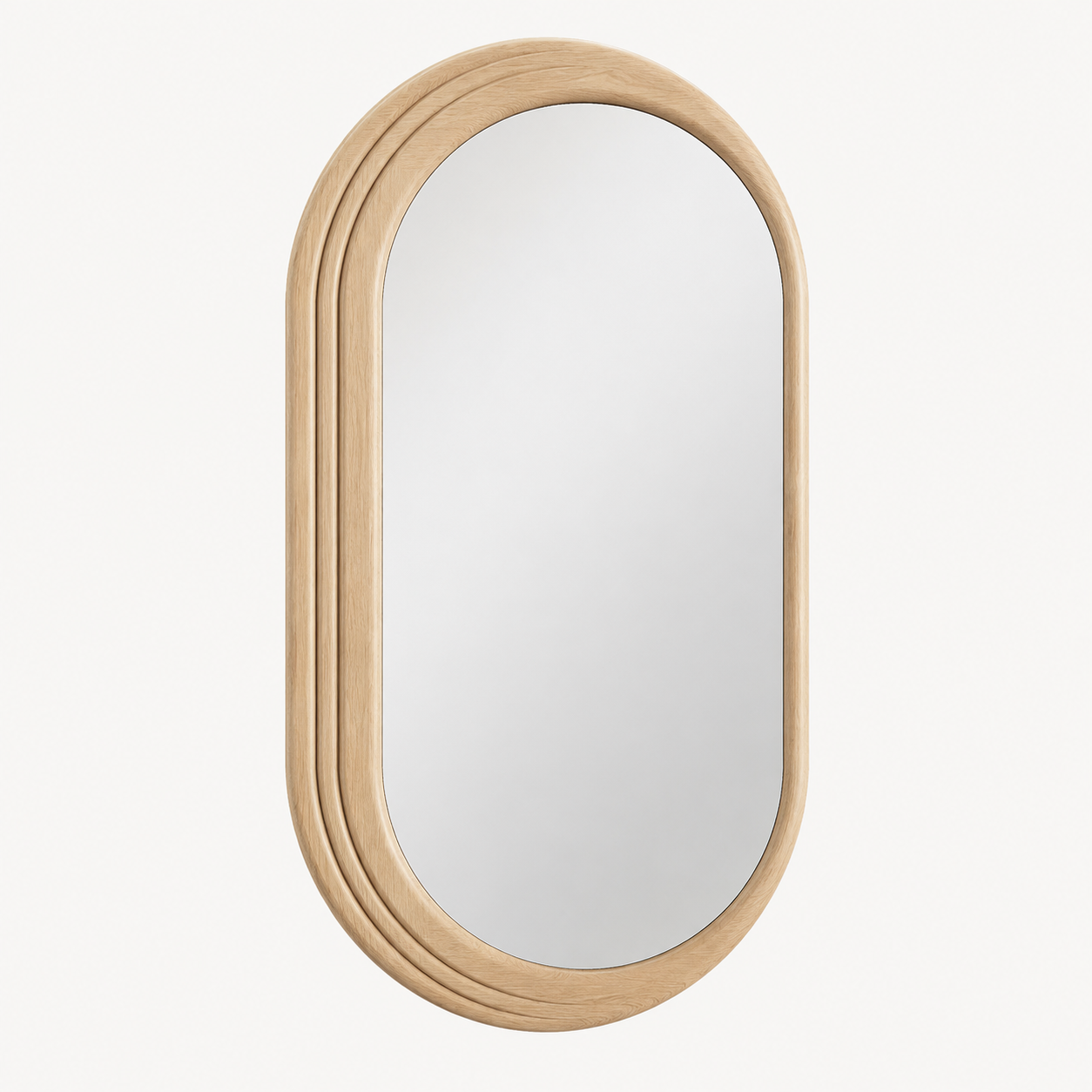
The core design uses an offset mirror surface, a wider sculptural section on one side, and a narrower frame on the other. Shallow grooves and restrained changes in frame depth provide visual movement while preserving a relatively straightforward production structure.
The lead floor-mirror direction is developed around an approximate size of:
760 × 1800 × 30 mm
This proportion is intended to provide a useful full-length reflective area while maintaining enough frame presence to remain recognizable in online product images and retail displays.
Suggested materials include light ash, oak-style veneer, engineered wood, natural matte finishes, and selected decorative veneer accents.
The design language can be extended into:
- Natural light-wood versions
- Walnut and heritage-inspired finishes
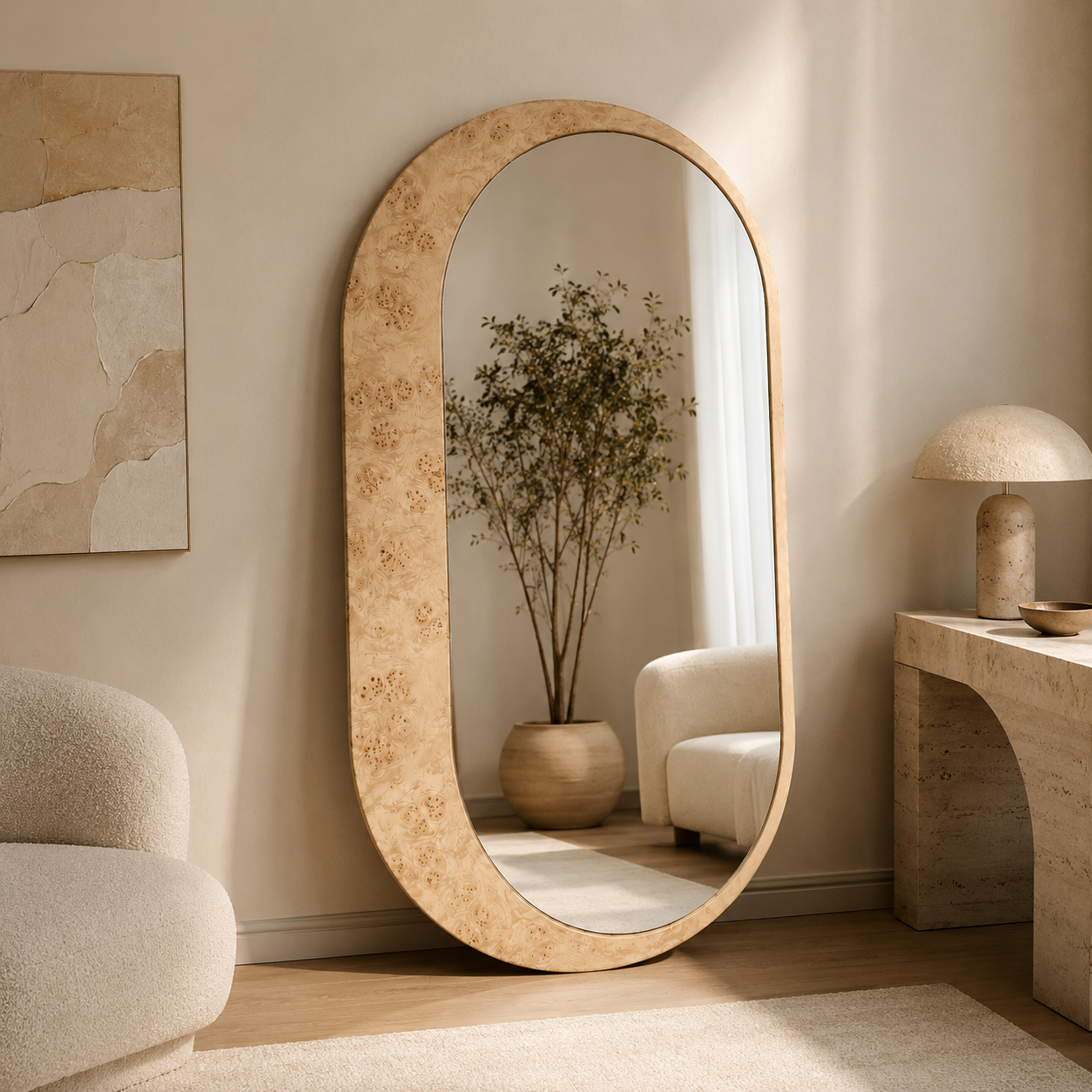
- Light Mappa burl statement versions
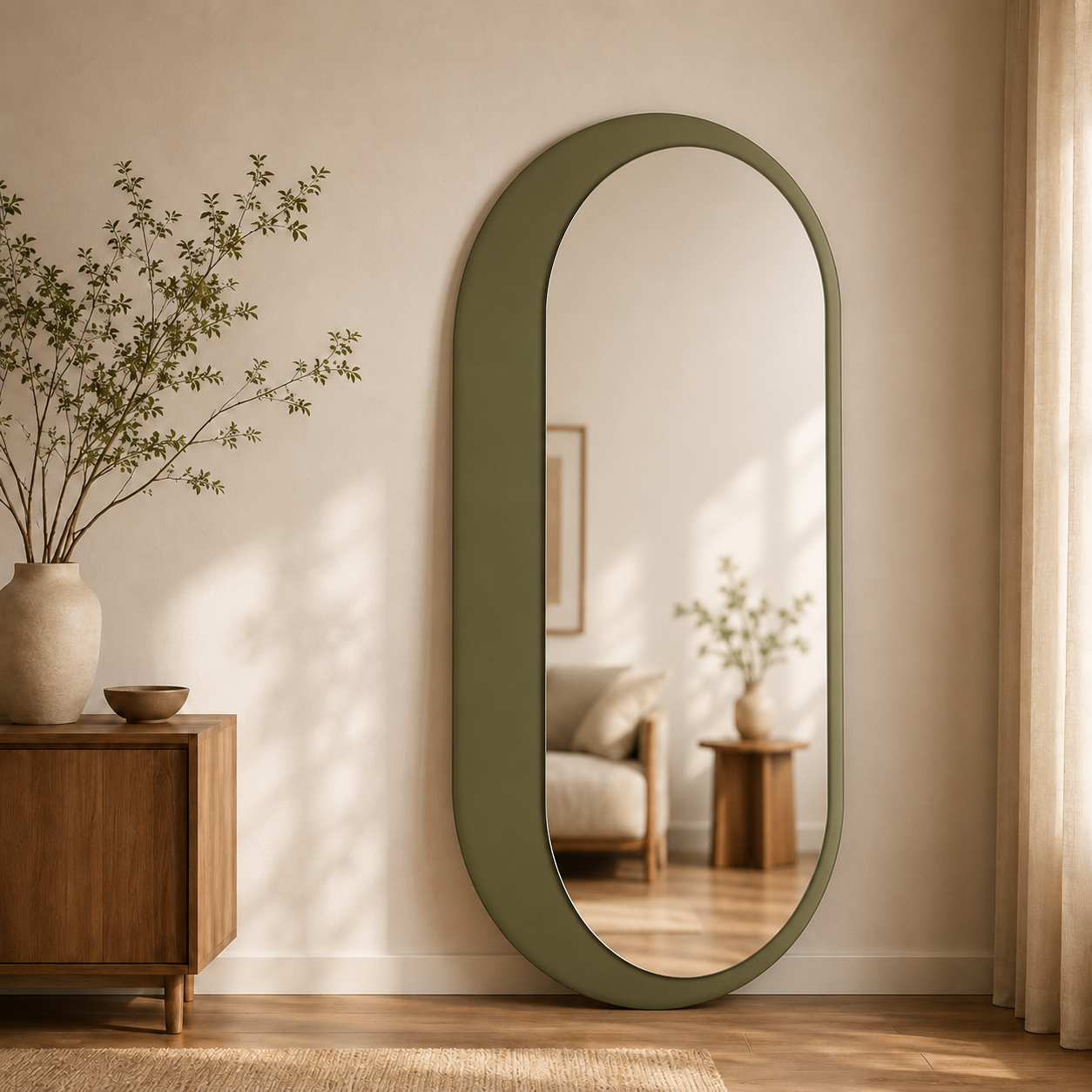
- Painted accent versions
- Woven or natural-fiber frame details
- Compact wall-mirror formats
This gives buyers the option to build a family rather than source one isolated design.
From One Mirror to a Complete Buyer Assortment
TMR27 is organized around different commercial functions.
Full-Length Statement Mirrors
The floor-mirror group is designed to provide strong visual impact for furniture stores, design-led retailers, online channels, and boutique home collections.
These products can act as:
- Collection image builders
- Showroom focal points
- Premium online listings
- Designer-channel products
- Higher-value assortment anchors
Medium Wall and Entryway Mirrors
The medium-size group translates the same design language into more accessible formats suitable for entryways, consoles, bedrooms, and general wall décor.
These models can offer lower retail price points and more manageable carton dimensions while preserving the identity of the larger series.
Hotel and Project Mirrors
The project group focuses on proportions, finishes, and construction suitable for hospitality, residential projects, and coordinated interior programs.
Possible directions include walnut tones, lightly aged finishes, controlled metal accents, and optional lighting integration where commercially appropriate.
Small Decorative Mirrors
Smaller formats allow buyers to introduce the design story at an accessible price level.
They can be used as:
- Entry-price products
- Giftable home décor
- Marketplace-friendly items
- Supporting SKUs within a larger mirror collection
- Color and finish extensions
This assortment structure helps buyers distribute risk across several sizes and retail price levels.
Responding to U.S. Home Furnishings Trends
Current High Point Market direction continues to highlight sculptural silhouettes, natural materials, layered textures, and products that combine functional use with a stronger sense of artistic identity. The Spring 2026 “Preserve” trend theme also emphasizes meaningful design, craftsmanship, natural color, and interiors with more character.
For mirror buyers, this trend does not necessarily mean choosing highly ornate frames.
It creates an opportunity for products that feel warmer, more tactile, and more distinctive than basic metal or flat wood frames, while remaining versatile enough for contemporary, organic modern, Scandinavian, Japandi, warm minimalist, and boutique-hotel interiors.
TMR27 responds to this direction through:
- Sculptural but controlled profiles
- Natural and warm material expressions
- Softened curves and asymmetry
- Visible craftsmanship without excessive ornament
- Designs that can coordinate with broader furniture collections
Teruier’s Cross-Border Design and Manufacturing Collaboration Model
TMR27 is being developed through the Teruier Cross-Border Design and Manufacturing Collaboration Model.
Under this model, product development does not begin only with factory capability.
It begins with the buyer’s destination market, target channel, retail position, packaging limitations, and expected margin.
Teruier then coordinates:
- Market and channel interpretation
- Design direction
- Material and process selection
- Sample development
- Cost engineering
- Packaging planning
- Assortment construction
- Production coordination
For buyers, this means that a U.S. marketplace mirror, a European design-store mirror, and a Middle Eastern project mirror do not have to follow the same specifications simply because they belong to the same product family.
The common design language can remain recognizable while dimensions, materials, finishes, hardware, and packaging are adapted to the channel.
Supported by a “Hometown of Crafts”
The TMR27 series is supported by Teruier’s connection to an established Chinese craft-manufacturing cluster, commonly described as a “hometown of crafts.”
This ecosystem brings together resources across:
- Wood and engineered wood
- Veneer and decorative surfaces
- Metal components
- Resin and molded details
- Glass and mirror processing
- Hand-finishing
- Surface painting
- Natural-fiber weaving
- Export packaging
This production network makes it possible to compare different material solutions and coordinate several manufacturing processes within one product-development program.
For buyers, the advantage is not simply access to more factories.
It is the ability to select the most commercially suitable combination of design, craftsmanship, cost, and production stability.
Value Translation: Turning Trends Into Manufacturable Mirrors
Teruier describes one of its core capabilities as value translation.
A market trend such as “organic modern” is too general to send directly into production.
It must be translated into clear decisions:
- How much asymmetry is commercially acceptable?
- Which part of the frame should create recognition?
- Should natural wood grain be used throughout or only as an accent?
- How deep can the frame become before freight and packaging costs increase too much?
- Which decorative details remain visible in a small online image?
- Which finishes can be repeated consistently in production?
- How can the design extend into multiple price levels?
TMR27 converts those abstract trend directions into defined shapes, dimensions, materials, finish options, and assortment roles.
This is the difference between following a trend and building a sellable product program from it.
From Mirror Pricing to a Merchant Profit Solution
Teruier is not developing TMR27 only around factory unit prices.
The series is also evaluated through its merchant profit solution approach.
This means considering the commercial system surrounding each mirror:
- Target retail price
- Factory cost
- Packaging cost
- Freight and dimensional weight
- Expected damage risk
- Marketplace image performance
- Assortment role
- MOQ
- Finish variations
- Reorder potential
A large statement mirror may create traffic and reinforce a retailer’s visual identity. A medium wall mirror may become the core volume item. A smaller decorative mirror may provide a more accessible entry price.
The strongest collection does not require every SKU to perform the same job.
It requires each product to have a clear commercial purpose.
TMR27 Moves Toward Sampling and Market Validation
The TMR27 program is being developed through a process of design refinement, sample testing, material confirmation, packaging evaluation, and market validation.
Before final production, individual models may be adjusted according to:
- Buyer feedback
- Target market
- Material availability
- Frame structure
- Hanging requirements
- Carton limitations
- Target cost
- Sales-channel requirements
Teruier’s objective is not to create the most complicated mirror series.
It is to create a recognizable and commercially manageable 2027 mirror family that international buyers can adapt to their own channels.
Frequently Asked Questions
What is the TMR27 Mirror Series?
TMR27 is Teruier’s 2027 mirror-development program, covering full-length floor mirrors, wall and entryway mirrors, hotel and project mirrors, and smaller decorative formats.
What styles does the TMR27 series target?
The series is suitable for organic modern, Scandinavian, Japandi, warm minimalist, contemporary natural, boutique-hotel, and selected modern-heritage interiors.
Can TMR27 mirrors be customized?
Yes. Buyers can discuss adjustments to dimensions, materials, veneer patterns, colors, finishes, frame structures, hanging systems, packaging, and private-label presentation.
Is TMR27 designed only for the U.S. market?
No. The series is being developed for international adaptation, including the United States, Europe, the Middle East, and other home furnishings markets.
Does Teruier support private-label mirror collections?
Yes. Teruier can support private-label development, coordinated SKU families, market-specific specifications, packaging development, and buyer-oriented assortment planning.
What is the commercial advantage of a coordinated mirror series?
A coordinated series allows buyers to offer several sizes, finishes, and price levels with one recognizable design language, improving assortment consistency and reducing dependence on a single SKU.
Building the Next Mirror Assortment Around Commercial Logic
TMR27 represents Teruier’s transition from offering individual mirror products to developing a structured mirror category.
Through its cross-border design and manufacturing collaboration model, craft-manufacturing ecosystem, value-translation process, and merchant profit solution, Teruier is working to connect 2027 design direction with the practical requirements of international buyers.
The result is intended to be more than a collection of new shapes.
It is a mirror-development system designed around recognition, manufacturability, channel adaptation, and buyer profitability.



