A round upholstered ottoman can appear in three different retail settings: beside a dressing table, in front of a sofa, or as a decorative piece in a styled bedroom.
The product may look identical in every setting. But customers may expect different things from it.
For buyers evaluating accent stool wholesale, this distinction matters. A product sold as a seat needs an appropriate level of structural performance. A footrest must also remain stable and suitable for its intended use. A decorative accent should not be presented as functional seating unless its construction supports that claim.
The first purchasing decision is therefore not the fabric or colour. It is defining what the product is supposed to do.
The Same Ottoman, Three Different Customer Expectations
Consider an importer choosing a compact upholstered ottoman for a new home furnishings collection.
The merchandising team sees a versatile product that could work in several rooms. The sales team wants to promote it as extra seating, a comfortable footrest, and a decorative accessory.
That may sound commercially attractive. But each additional use creates expectations that the supplier and buyer need to examine.
| Product Positioning | Customer Expectation | Main Buyer Consideration |
|---|---|---|
| Occasional seat | Supports a person sitting | Strength, stability, durability and comfort |
| Footrest | Supports legs and feet during ordinary use | Stability, surface durability and suitable construction |
| Decorative accent | Adds texture, colour or visual interest | Finish, proportions, care and truthful product description |
These categories are not mutually exclusive. A properly designed ottoman may serve several purposes.
However, marketing a product for multiple uses does not establish that it has been evaluated for those uses.
Two Teruier Products With Different Design Characters
Teruier’s existing collection shows how small upholstered furniture can combine decorative styling with functional expectations.
DZ1202: Floral Pattern Skirted Round Ottoman
The Floral Pattern Skirted Round Ottoman DZ1202 measures 40 × 40 × 44 cm.
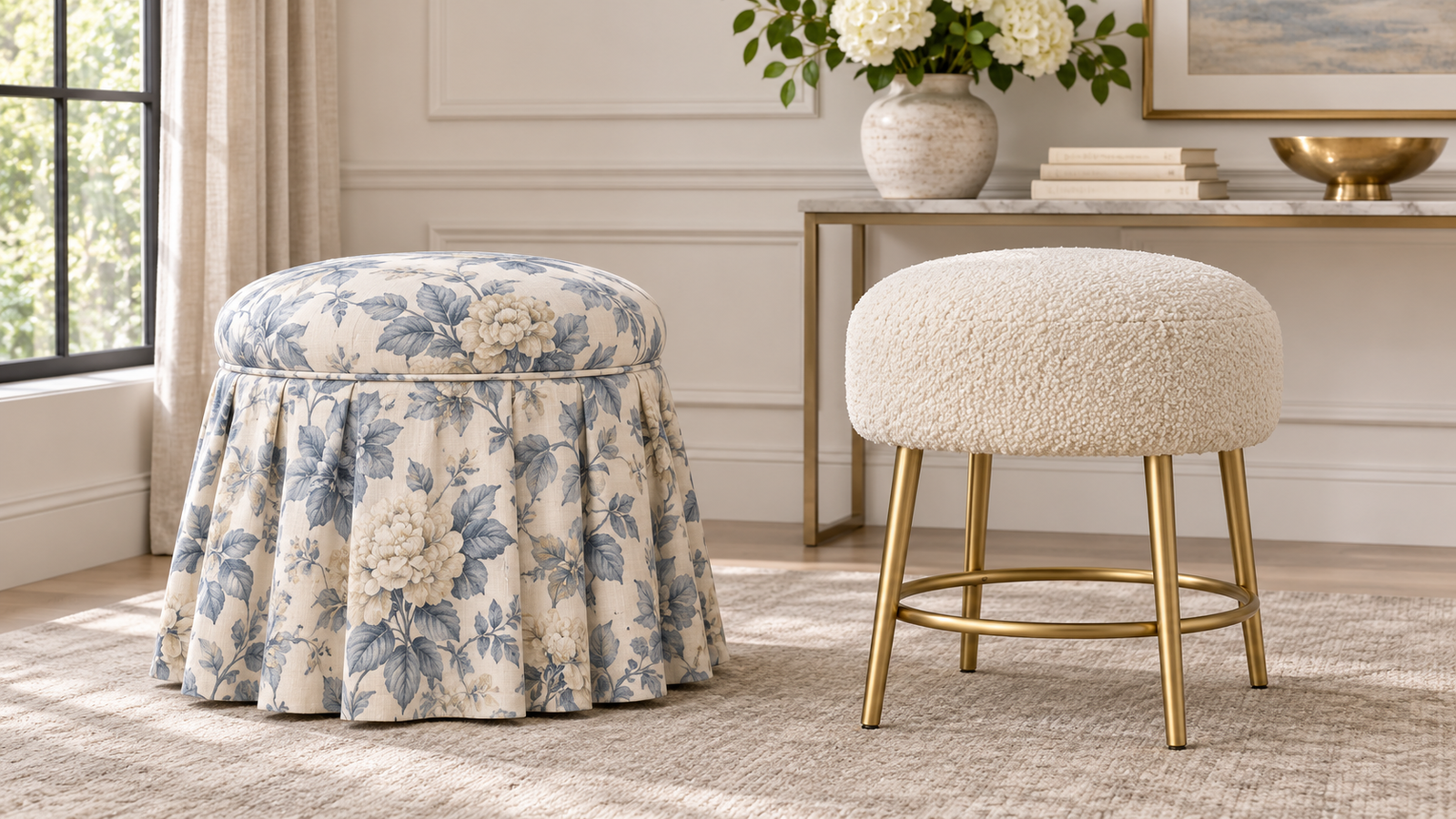
The published design features a cushioned top, a floral-patterned upholstered body and skirt detailing. It is offered in blue and pink colour options.
The product description identifies extra seating, footrest use and decorative placement as possible applications.
For a buyer, this creates a clear requirement: the selected product should be evaluated against the uses that will appear in the final retail description.
The decorative skirt is an important visual feature, but it does not reveal the construction or performance of the internal frame.
23T209: Bouclé Accent Ottoman Stool
The Bouclé Accent Ottoman Stool, model 23T209, offers a different aesthetic.
It combines a rounded upholstered body, cream-coloured bouclé-style fabric and gold-tone metal legs.
The design is suitable for consideration in vanity areas, bedrooms and modern home décor collections.
Its raised metal base creates a distinct silhouette from the fully upholstered skirted design.
For a buyer assessing its seating application, questions about the leg connections, frame construction and stability are particularly relevant.
Neither product’s appearance alone establishes a tested weight capacity or compliance with a particular seating standard. Those details should be verified for the chosen specification.
Why Product Names Can Create Technical Responsibilities
Retail terminology is not simply a marketing decision.
Words such as stool, seat, footrest and decorative ottoman influence how shoppers understand a product.
For example, a customer who buys a product described as an upholstered stool may reasonably expect to sit on it.
If the product is suitable only for displaying decorative accessories, calling it a stool could create confusion.
The reverse problem also matters. Labelling a seat-shaped item as decorative does not automatically eliminate foreseeable misuse or applicable product safety obligations.
Buyers should therefore agree on the intended and reasonably foreseeable uses before finalising product descriptions, testing requirements and instructions.
What Does a Seating Standard Actually Cover?
For European adult domestic seating, EN 12520:2024 provides a relevant technical reference for safety, strength and durability.
The standard addresses areas such as general safety, stability and structural performance.
However, its scope has limits. It does not cover upholstery material durability, flammability, ergonomics or every possible furniture application.
It also does not establish requirements for all non-domestic seating environments.
For a hotel, restaurant or other commercial application, buyers should determine which standards and project-specific requirements apply to the actual product and destination market.
A product should not be described as certified or compliant without supporting evidence for the final configuration.
The BS EN 12520 standard information provides a useful starting reference.
What Should Buyers Evaluate on a Physical Sample?
A showroom sample helps buyers understand appearance, but it should also raise questions about construction and performance.
1. Stability in Normal Use
Place the product on a suitable level surface and examine its contact with the floor.
For a stool with exposed legs, check the leg connections and whether the product rocks during ordinary handling.
A showroom check may reveal an obvious problem, but it does not replace appropriate stability testing.
2. Seat Construction and Support
Where the product is intended for seating, buyers should request information about the internal frame, support structure and cushioning.
A visually thick cushion is not necessarily evidence of a stronger seat.
The sample should be evaluated using the required performance criteria for its intended application.
3. Upholstery and Surface Durability
Fabric colour, texture and stitching influence the customer’s first impression.
For everyday seating, upholstery must also be considered in relation to wear, cleaning and repeated contact.
A bouclé-style surface and a printed floral fabric may require different care instructions and performance assessments.
The appropriate test method depends on the fabric, intended environment and buyer requirements.
4. Packaging and Assembly
If the product is supplied with separate legs, the buyer should verify assembly instructions, fittings and connection details.
If it ships fully assembled, packaging must protect the structural and decorative components.
Damage to a metal leg connection is not the same issue as a temporary mark on the upholstery. Both need suitable inspection criteria.
Compare Wholesale Products by Their Declared Use
For buyers sourcing wholesale upholstered stools, quotations should be compared using the same product-use assumptions.
| Supplier Information | Why It Matters |
|---|---|
| Intended product use | Establishes the required performance discussion |
| Frame and support construction | Helps assess structural design |
| Relevant test evidence | Supports the proposed use claims |
| Upholstery specification | Defines fabric, care and appearance requirements |
| Product dimensions | Confirms placement and ergonomic considerations |
| Packaging and assembly details | Supports safe delivery and correct setup |
| Approved retail description | Keeps marketing claims consistent with verified capabilities |
This is especially relevant to retail supplier standards.
The buyer should establish which evidence is required before a product can be approved for the intended channel.
An inexpensive decorative stool and a seat intended for frequent daily use should not be evaluated as though they have identical performance requirements.
A Better Development Conversation With the Manufacturer
Teruier’s product-development and manufacturing resources in Fuzhou–Minhou support discussions around upholstered structures, decorative finishes, material selection and production coordination.
For example, a buyer may wish to develop a cream-coloured ottoman primarily for bedroom decoration.
If the retailer later wants to promote that product as occasional seating, the change should trigger a review of construction and performance requirements.
The appropriate response is not necessarily to redesign everything.
It is to determine whether the existing construction already meets the new requirements and what additional evidence or development may be needed.
This approach connects marketing decisions with technical product definitions.
FAQ
Can a decorative ottoman also be used as seating?
Potentially, if its construction and relevant performance evidence support that use. Buyers should not infer seating capacity from appearance or a generic product name.
Is a round upholstered ottoman automatically more stable than a stool with metal legs?
No. Stability depends on the complete product geometry, support structure, connections and intended loading conditions, not simply whether the base is covered or exposed.
Do domestic seating tests cover hotel or commercial use?
Not necessarily. Buyers should identify the appropriate requirements for the intended location, usage level and destination market.
Discuss Upholstered Stool Development With Teruier
Small upholstered furniture combines design, comfort and functional expectations in one compact product.
For importers and retailers, defining the intended use early helps establish appropriate specifications, sample reviews and product information.
Teruier works with international buyers on upholstered accent furniture selection, custom development, sampling and manufacturing coordination.
Contact Teruier with your target market, intended product use, preferred models, quantities and testing requirements to discuss available options and wholesale quotations.