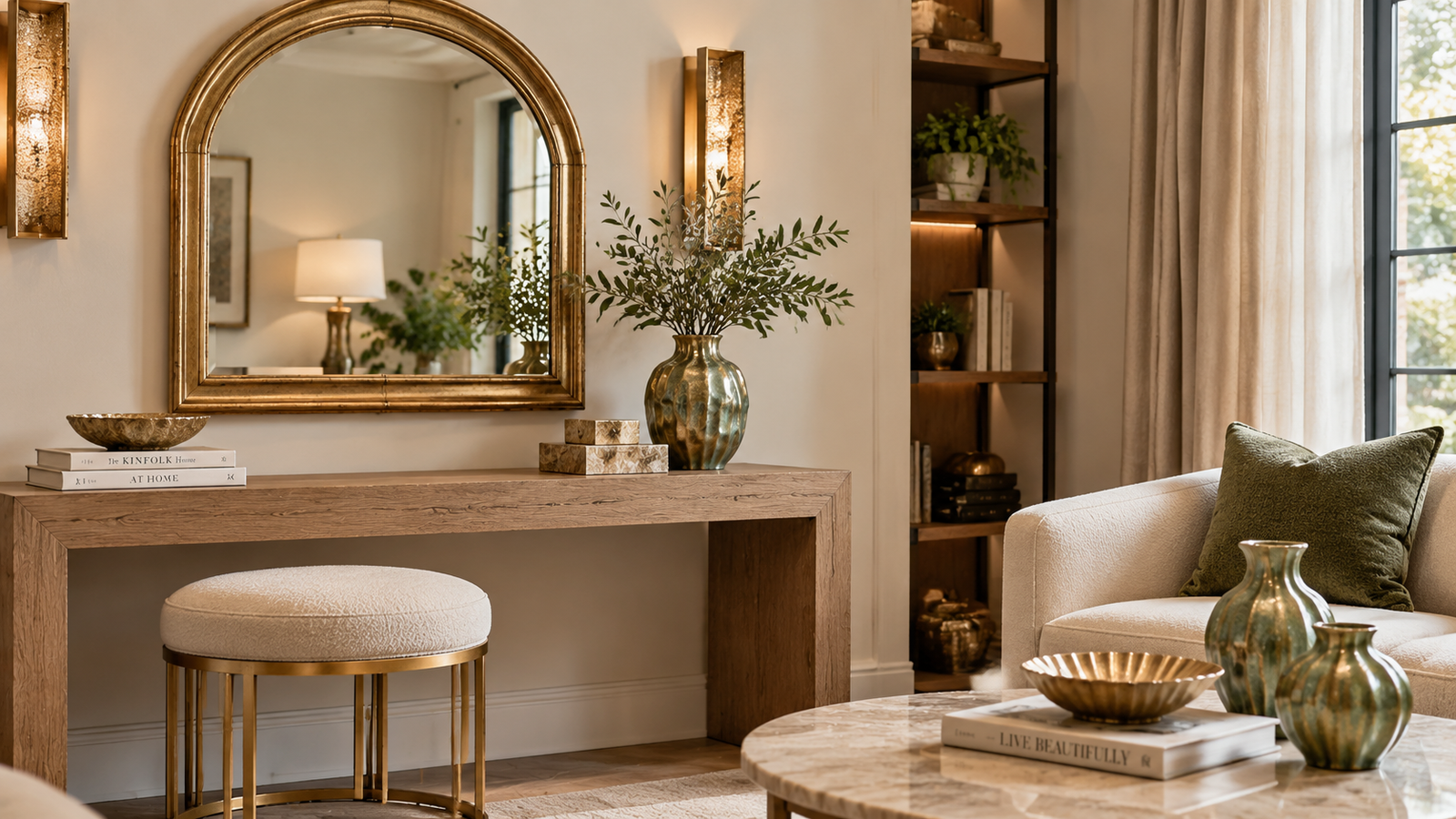
A gold mirror, a gold-tone furniture base, and a metallic ceramic vase may all look attractive individually. But when placed together, they do not necessarily create a well-designed collection.
One may appear too yellow, another too shiny, while a third looks almost bronze.
For buyers involved in decorative mirror sourcing, this is an important consideration. A coordinated home décor collection does not require every material to have exactly the same colour. It requires finishes to work together visually.
The difference between matching and coordinating can determine whether a retail display feels thoughtfully designed or simply assembled from unrelated products.
Why Identical Colours Do Not Always Create a Better Collection
Consider a retailer developing a warm, elegant home décor assortment.
The buyer selects an antique-gold decorative mirror, a small upholstered stool with gold-tone legs, and several sculptural tabletop accessories.
At first, the buyer requests the same gold finish across all products.
But this creates a manufacturing challenge.
A mirror frame, a metal furniture base, and a ceramic surface are different materials. Their finishing processes, textures, reflectivity, and visual characteristics are not necessarily identical.
Even when the colour reference is similar, the final appearance may differ.
The better question is not whether every product has the same gold colour.
It is whether the products belong to the same visual language.
Three Levels of Finish Coordination
A useful approach is to divide finishes into three roles.
1. Anchor Finish: Establish the Main Character
The anchor finish creates the strongest visual identity in a collection.
For example, an antique-gold mirror can establish a warm, vintage-inspired direction.
It becomes the reference point for selecting the remaining materials, rather than requiring every product to copy its exact appearance.
2. Supporting Finish: Create Balance
Supporting finishes prevent a collection from becoming visually repetitive.
Warm wood, natural stone effects, cream upholstery, and muted metallic surfaces can soften a dominant gold finish.
The purpose is to create contrast without introducing an unrelated design direction.
3. Accent Finish: Add a Controlled Point of Difference
A small amount of contrasting colour or texture can make a collection more memorable.
For example, a mineral-green ceramic object may work alongside warm gold and natural wood.
The contrast should feel intentional, not accidental.
A buyer does not need every item to repeat the same colour. Sometimes one carefully selected accent creates a stronger merchandising story.
Three Teruier Products: How Different Finishes Can Work Together
Teruier’s existing product range provides useful references for evaluating this approach.
MY3105: Vintage Gold Arch Wall Mirror
The Vintage Gold Arch Wall Mirror, model MY3105, measures 89 × 4 × 60.5 cm.
Its warm vintage-gold finish and layered frame provide a relatively restrained decorative focal point.
For a retailer developing a warm metallic collection, this type of mirror could serve as the anchor product.
The important details include the gold tone, frame width, surface appearance, and how the finish interacts with surrounding materials.
MY3108: Braided Antique Gold Arch Wall Mirror
The Braided Antique Gold Arch Wall Mirror, model MY3108, measures 95 × 5 × 76 cm.
Compared with MY3105, it has a stronger braided frame and a more expressive decorative appearance.
Although both products belong to a warm gold design direction, their visual weight is different.
This illustrates an important buying principle: a collection can maintain a common metallic language while allowing individual products to have different levels of decoration.
V2577–V2582: Celadon Metallic Sculptural Ceramic Vase Collection
The Celadon Metallic Sculptural Ceramic Vase Collection introduces a different material and colour direction.
Its six ceramic models use a soft metallic celadon-green finish with varied sculptural forms.
Rather than trying to reproduce the mirror’s gold finish, the collection could provide a contrasting accent within a wider decorative display.
This is an example of coordinated finishes rather than identical finishes.
These products are individual Teruier references; their combination here is a suggested merchandising concept, not an existing approved matching collection.
Five Things Buyers Should Compare Before Approving Finishes
A professional coordinated home décor collection needs more than a colour name.
| Evaluation Point | What Buyers Should Check |
|---|---|
| Colour temperature | Does the finish look warm, neutral, or cool? |
| Brightness | Is it bright metallic, muted, or dark antique? |
| Gloss level | Is the surface polished, satin, or matte? |
| Texture | Is the finish smooth, brushed, embossed, or irregular? |
| Visual weight | Does the product dominate the display or support other items? |
Two gold finishes can work together even when they are not identical.
However, a bright yellow-gold surface and a dark brown antique-bronze surface may require careful styling to avoid visual conflict.
Buyers should evaluate the complete product rather than relying only on the manufacturer’s finish description.
Why Physical Finish Samples Matter
Digital images are useful for initial selection, but they cannot fully communicate how a surface behaves under different lighting conditions.
A metallic finish may appear warmer under showroom lighting and cooler under natural daylight.
A textured surface may look subtle in a photograph but become much stronger when viewed from different angles.
For ornate gold mirrors, this is particularly important because raised details, recessed areas, and frame profiles can reflect light differently.
A practical approval process should include:
- Physical finish samples from the relevant materials.
- Comparison under consistent lighting conditions.
- Review alongside the intended wood, fabric, stone, or ceramic references.
- An approved sample or finish reference for production.
- Clear records of any acceptable visual variation.
A mirror frame and a furniture base should not automatically be treated as interchangeable simply because both are described as antique gold.
Their materials and production processes may require separate finish standards.
When Should Buyers Demand an Exact Match?
Not every product needs to coordinate loosely.
Some projects require closer finish matching.
For example, a hotel may specify the same visible metal tone across mirror frames, lighting accessories, furniture fittings, and bathroom hardware.
In that case, buyers should identify which components require a controlled match and which products can use complementary finishes.
A useful distinction is:
| Situation | Recommended Approach |
|---|---|
| Products displayed together in a retail vignette | Coordinated finish family |
| Multiple products sharing the same visible metal component | Closer finish matching |
| Hotel or commercial project with a fixed interior specification | Approved physical finish references |
| Seasonal home décor assortment | Controlled variation within a consistent palette |
The buyer should also establish whether a finish is intended to match a reference sample exactly or remain within an agreed visual tolerance.
This distinction needs to be documented before production approval.
How Finish Decisions Affect Product Development
For home décor product development, finish selection can influence more than appearance.
A change in metallic tone may require a different surface treatment. A new ceramic glaze may need separate sample development. A different wood finish may alter the visual relationship between the frame and surrounding furniture.
These decisions can affect sampling work, production consistency, minimum quantities, and cost.
Teruier’s gold-metal accent stool development provides another example of how different materials contribute to one product’s appearance.
Its Gold Metal Accent Stool Collection sample review describes upholstered round and square seats paired with decorative gold-tone metal bases.
For buyers, the upholstery and metal base should be evaluated as two related but separate finish decisions.
The fabric creates softness and colour. The metal base introduces a metallic accent.
The success of the finished product depends on how those elements work together, not on making them look identical.
Build a Finish Family Before Building a Larger Collection
A common buying mistake is selecting products individually and trying to coordinate them afterwards.
A more reliable method is to establish a finish direction first.
For example:
Warm Metallic Collection
- Anchor: vintage or antique gold mirror.
- Supporting: cream upholstery and warm natural wood.
- Accent: muted metallic ceramic or darker bronze details.
Natural Contemporary Collection
- Anchor: natural oak or mineral-textured mirror frame.
- Supporting: neutral upholstered furniture.
- Accent: sculptural ceramic with a muted green finish.
These are suggested design directions, not fixed Teruier collections.
Once the palette is established, buyers can select products that fit the intended visual character rather than purchasing attractive items without considering their relationship.
This can also make future collection extensions easier. New products can be evaluated against an established finish family rather than starting the design discussion from zero.
FAQ
Do all gold finishes in a home décor collection need to match?
No. Different materials often produce different metallic appearances. Buyers should coordinate colour temperature, brightness, gloss, and texture rather than demand identical finishes across every product.
How can buyers compare metallic finishes accurately?
Use physical samples, compare them under consistent lighting, and review them alongside the intended materials and surrounding products. Digital photographs should be treated as references, not final finish approval.
Can Teruier develop different finishes for private-label collections?
Finish variations can be discussed according to the selected product, material, order quantity, and manufacturing feasibility. Sampling, costs, MOQ, and production requirements need individual confirmation.
Develop a More Cohesive Home Décor Collection With Teruier
A well-designed collection is not created by making every product look the same.
It is created by understanding how different materials, colours, textures, and finishes work together.
Teruier supports international buyers with decorative mirror selection, accent furniture development, material discussions, sample review, and manufacturing coordination.
Contact Teruier to discuss your preferred finish direction, selected product references, sample requirements, and wholesale collection plans.