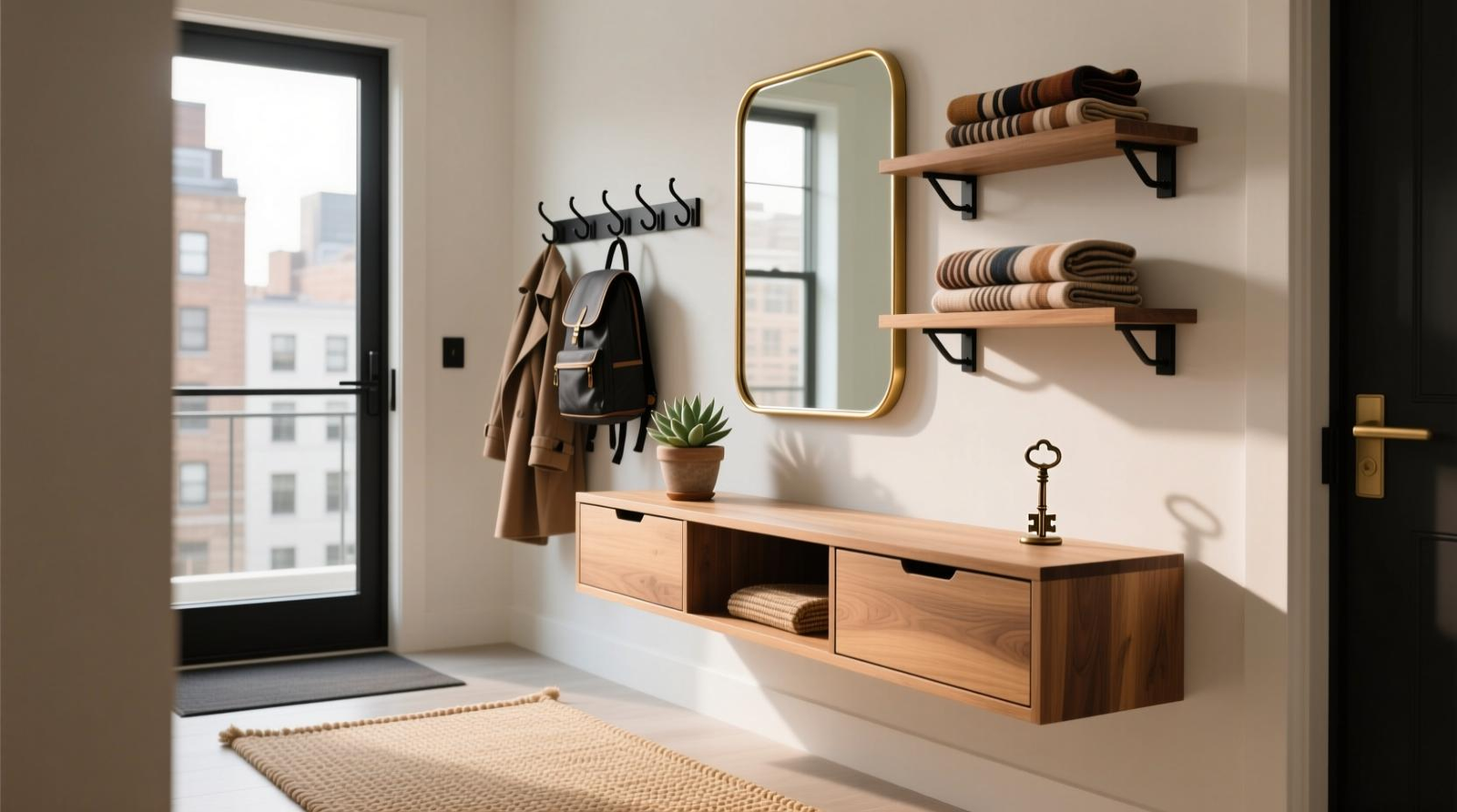
Why are so many entryway organizers designed to hang things, when people need somewhere to put everything else?
Walk through the front door after a long day.
You take off your coat. Your bag needs somewhere to go. Your keys are still in your hand. Your phone is nearly out of battery. There is a letter you picked up on the way home, and perhaps an umbrella that needs drying.
Now look at your entryway.
There are three hooks.
Where does everything else go?
This is a surprisingly common design problem. Many entryway products are essentially coat racks with a different name. They provide somewhere to hang things, but do very little to organize the rest of the objects that enter the home every day.
And yet, an entryway is not simply a place to hang coats.
It is the transition point between the outside world and everyday life at home.
The next opportunity in entryway furniture is not necessarily another coat rack. It is a better-designed drop zone.
1. The Coat Rack Is Solving Only Half the Problem
Traditional entryway storage tends to focus on three basic functions:
- Hanging coats and bags.
- Storing shoes.
- Providing a surface for decorative objects.
These functions are useful, but they do not necessarily work together.
A wall hook can hold a bag, but it cannot organize the contents of that bag.
A small shelf can hold keys, but it may have no place for mail, sunglasses or other everyday accessories.
A console table provides a surface, but without drawers, compartments or a suitable tray, it can quickly become another place where clutter accumulates.
The problem is not that these products are badly designed.
It is that each product solves only one part of a daily routine.
For a homeowner, this can mean installing several separate products and still having an untidy entrance.
For a retailer, it raises a more interesting question:
Should the category be organized around individual products, or around the activities that happen when people enter and leave their homes?
2. The Entryway Is a Working Space, Not Just a First Impression
Interior design often treats the entryway as a visual introduction to the home.
A beautiful mirror, a console table, a decorative vase and carefully arranged accessories create an attractive first impression.
That matters.
But the entryway also has a much more practical job.
Houzz’s October 2026 review of popular entryways and mudrooms highlights how designers combine compact storage with attractive finishes, seating and distinctive details.
The examples show that even hardworking entrance areas can have a strong decorative identity.
Houzz’s earlier 2026 entryway coverage also features dedicated spaces for shoes, bags, coats, mail and other daily belongings.
The lesson is straightforward:
A successful entryway must work for the people who use it before it works for the people who look at it.
A beautiful console that offers no practical storage may be suitable for a formal foyer.
A compact apartment entrance needs something different.
The right product depends on the household, available space and daily routine.
3. Think About the Four Moments of an Entryway
A useful way to develop entryway products is to stop thinking in terms of furniture categories and start thinking about behaviour.
There are four important moments.
Moment One: Arriving Home
People need somewhere to put the objects they are carrying.
Keys, wallets, phones, sunglasses and small personal belongings should have an accessible landing place.
This is the drop-zone function.
A shallow tray or small compartment can be more useful than another decorative shelf.
Moment Two: Taking Things Off
Coats, hats, handbags and suitable lightweight accessories need somewhere to hang.
This is where hooks and wall organizers become useful.
The number and positioning of hooks should reflect the intended household use rather than simply making the product look more multifunctional.
Moment Three: Organizing What Stays
Mail, magazines, umbrellas and other household items may need separate storage.
A product that combines open compartments with defined storage areas can reduce the tendency for everything to end up on one surface.
Moment Four: Leaving Again
The entryway should make it easy to retrieve everyday essentials.
A well-designed organizer reduces the small frustrations of searching for keys, sunglasses or a frequently used bag.
The objective is not to create a complicated storage system.
It is to make daily movement through the home more convenient.
4. Three Entryway Products, Three Different Design Approaches
Not every home needs the same entryway solution.
A compact apartment, a family hallway and a larger residential foyer have different requirements.
Consider three product formats.
A. Wall-Mounted Organizer: Use Vertical Space
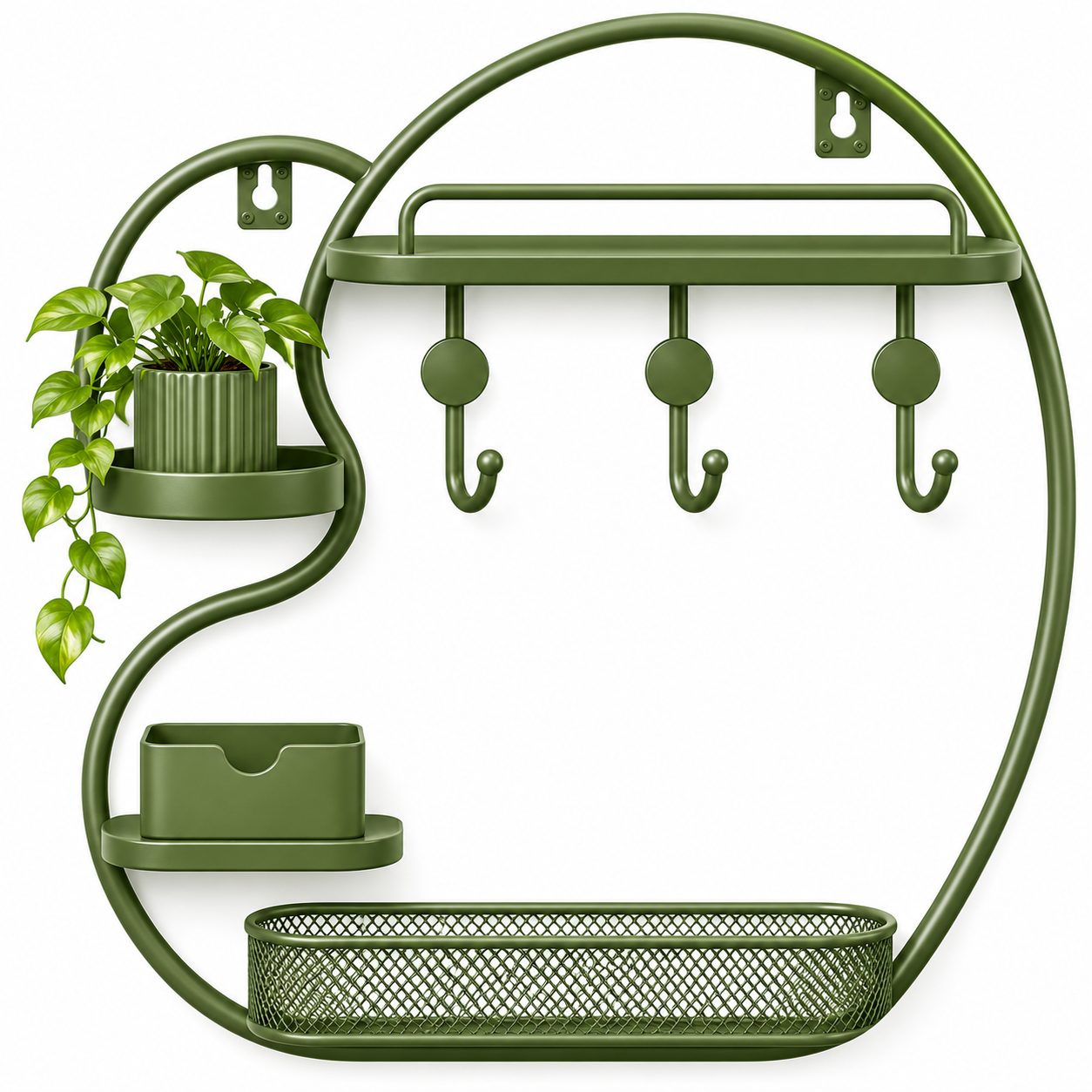
The Sage Three-Tier Wall Organizer (TDS27-04) combines a shallow top tray, a perforated middle basket, an angled lower storage pocket and three integrated hooks.
Its dimensions are 38 × 14 × 82 cm.
The product uses vertical wall space rather than requiring a separate floor-standing cabinet.
Its different storage levels allow users to separate small accessories, mail and suitable lightweight hanging items.
For retailers, this is a more complete proposition than a conventional row of wall hooks.
However, wall-mounted products also require careful attention to installation.
Mounting hardware, wall compatibility and load capacity should be confirmed before the product is marketed for installation.
B. Freestanding Organizer: Combine Several Daily Functions
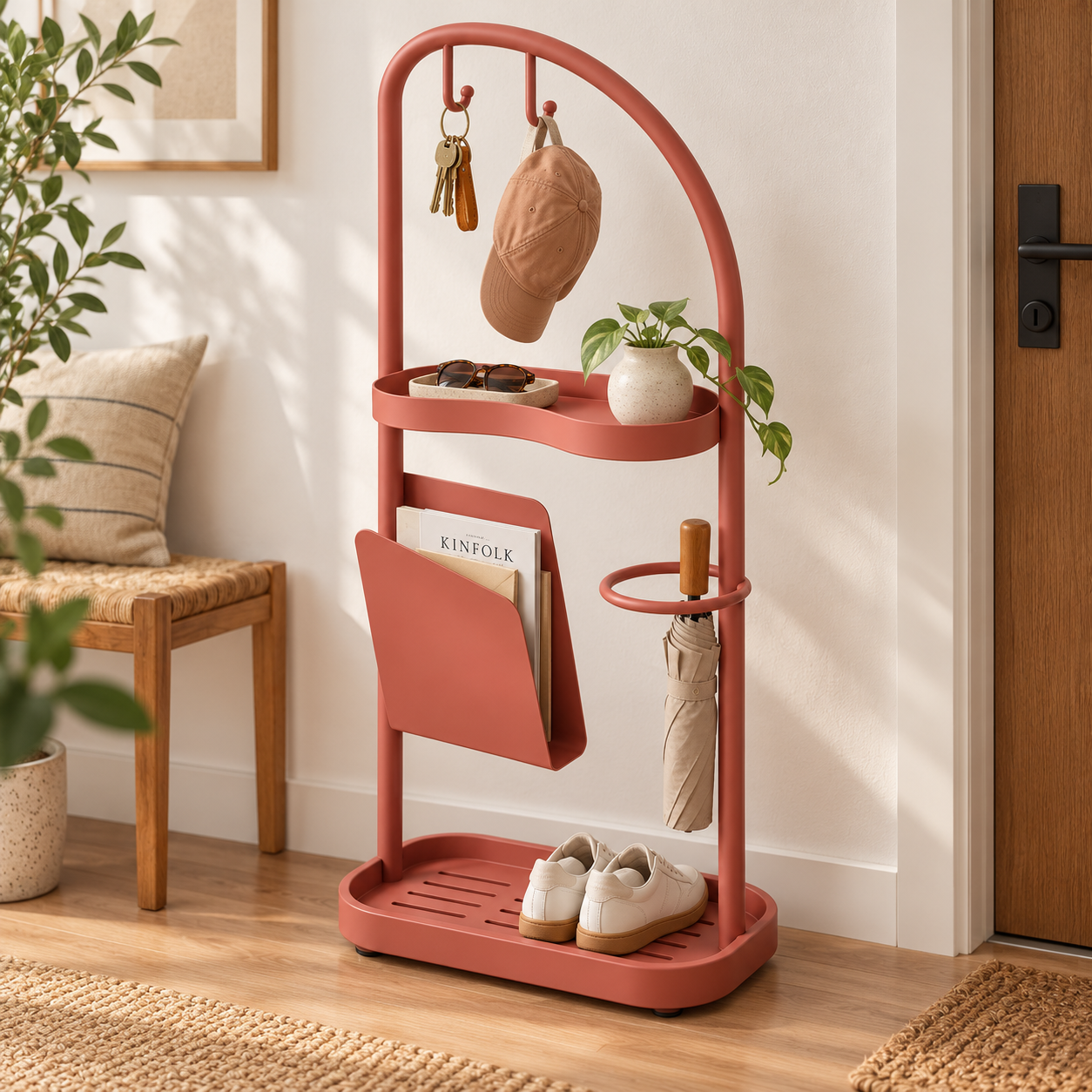
The Coral Entryway Valet Organizer (TDS27-06) takes a different approach.
Measuring 42 × 30 × 118 cm, it combines an asymmetric curved frame with two hooks, a shallow tray, an angled magazine pocket, a circular side holder and a slotted bottom tray.
Unlike a wall-mounted organizer, it does not require the customer to install the main structure on a wall.
Its vertical format also gives it a more furniture-like appearance.
For buyers, it offers a decorative entryway product with several organization functions in one footprint.
Its capacity and stability still need to be confirmed against the intended use.
C. Mirror and Organizer Combination: Give One Wall More Than One Job
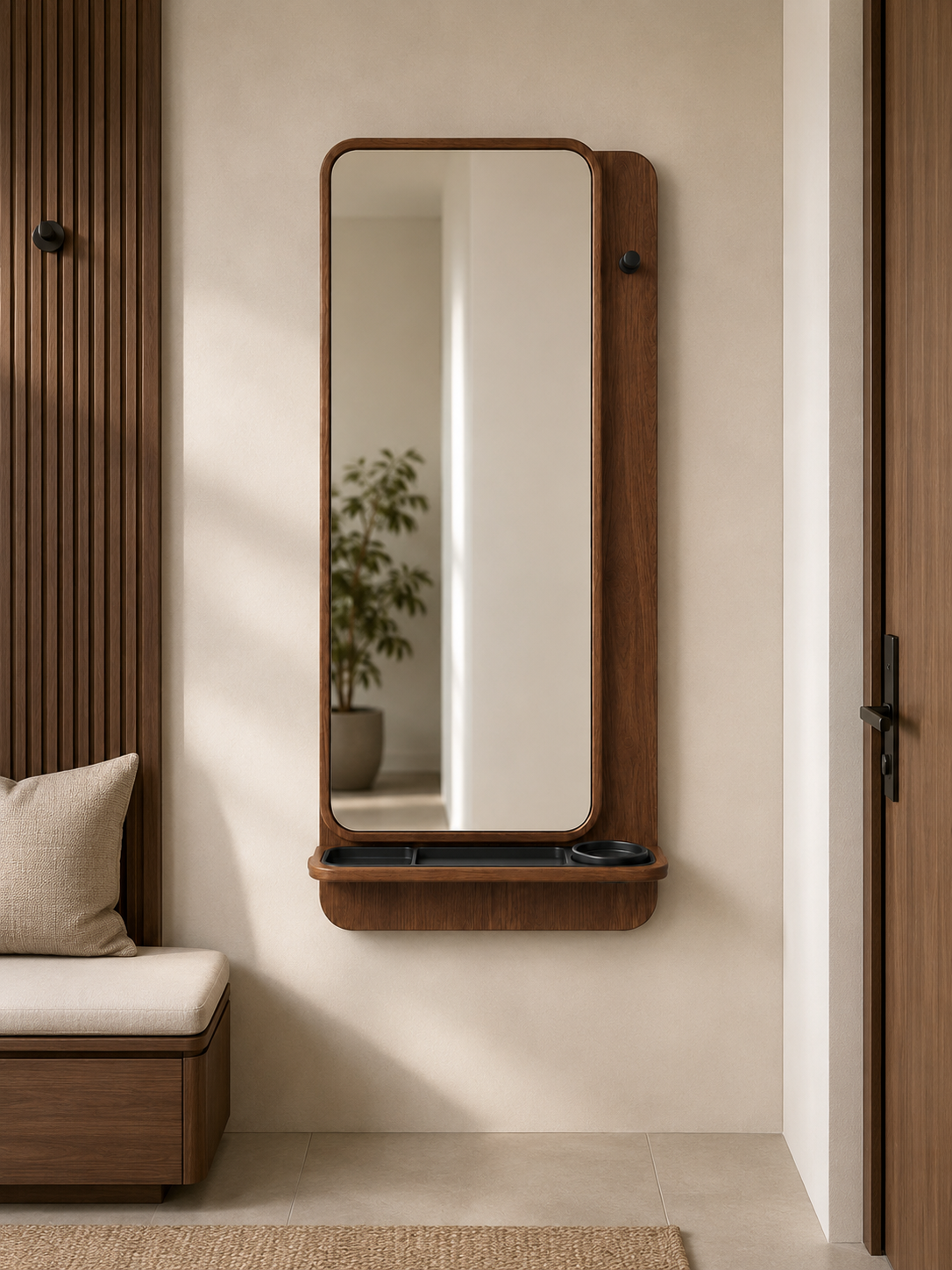
The Walnut Entryway Organizer Mirror (TMR27-OF10) combines a large wall mirror with a walnut-finished side panel, a black metal hook and a divided lower storage tray.
Its recommended dimensions are 720 × 1500 × 130 mm.
This format connects two activities.
People can check their appearance before leaving, while keeping everyday belongings within reach.
For smaller homes, this can be more useful than installing a mirror and a separate console.
The product also creates an opportunity to position entryway mirrors as functional furniture rather than purely decorative wall products.
These three examples demonstrate an important point:
An entryway organizer does not have to follow one standard shape.
The right design depends on whether the customer needs vertical storage, freestanding convenience or a combination of reflection and organization.
5. More Compartments Do Not Automatically Mean Better Organization
Here is another mistake worth avoiding.
When designing multifunctional organizers, there is a temptation to keep adding features.
Another hook.
Another pocket.
Another shelf.
Another little compartment.
Eventually, the product becomes complicated without becoming more useful.
A good organizer should make its functions immediately understandable.
A shallow tray should be easy to access.
A hook should have enough clearance for the intended item.
A magazine pocket should accommodate the formats it is designed for.
A storage compartment should have enough usable space to justify its presence.
There is also a difference between nominal storage capacity and usable storage capacity.
A decorative organizer may look as though it has several compartments, but if those compartments are too narrow, too shallow or awkward to access, customers may not use them.
For product developers, the better question is not:
How many functions can we add?
It is:
Which everyday problems can we solve without making the product unnecessarily complicated?
6. Decorative Trays Are Not Just Decoration
One small product deserves more attention in entryway assortments: the decorative tray.
A tray can establish a defined landing area for keys, sunglasses, wallets and other small objects.
It can also help create a more organized appearance on a console or sideboard.
For a retailer, decorative trays offer an accessible way to connect functional organization with home styling.
But not every tray needs to be sold as an entryway accessory.
A suitable tray can also work on a coffee table, bedside table, vanity or dining surface.
This makes the category useful for cross-merchandising.
Buyers exploring decorative trays wholesale can consider products not only by their material and finish, but also by their intended placement and everyday role.
A tray with raised edges may be more practical for loose accessories.
A shallow decorative tray may be better suited to styling a console.
A heavier stone-look or metal tray may create a stronger visual presence, but its weight and packaging requirements should also be considered.
The product’s role should determine its design, not the other way around.
7. The Small-Entryway Challenge: What If There Is No Hallway?
Many homes do not have a traditional entrance hall.
The front door may open directly into the living room.
An apartment may have only a narrow wall beside the entrance.
A compact home may have no room for a console table or shoe cabinet.
This changes the product requirements.
For these customers, vertical organization and narrow footprints become more important.
Wall-mounted products can preserve floor space.
Slim freestanding organizers can create a defined entrance area without requiring major furniture.
Mirror-integrated organizers can combine functions that would otherwise require separate products.
However, compact does not mean that every dimension should be reduced.
A hook that is too close to a wall may be inconvenient.
A tray that is too shallow may be nearly useless.
A narrow freestanding unit may become unstable if its base is poorly designed.
The challenge is to reduce the footprint without reducing usability.
This is a particularly interesting opportunity for retailers serving apartment, condominium and smaller-home markets.
8. What This Means for Home Décor Buyers
For wholesale buyers, entryway organization should be considered as a small product system rather than a collection of unrelated hooks, shelves and tables.
A practical assortment might include four product roles.
| Product role | Example | Retail purpose |
|---|---|---|
| Entry-level | Basic wall hook organizer | Accessible everyday solution |
| Functional | Multi-level wall organizer | More storage functions |
| Decorative | Freestanding entryway organizer | Stronger visual identity |
| Premium | Mirror-integrated organizer | Combines decoration and utility |
The buyer does not necessarily need all four in every collection.
The important point is to understand what each product contributes.
A wall organizer and a freestanding valet may serve similar households but solve different spatial problems.
A mirror-integrated organizer may occupy a higher price position because it combines several functions and a larger visual presence.
This allows retailers to build a more understandable assortment and avoid stocking several products that effectively perform the same job.
For a wider view of how smaller home products work together commercially, see Teruier’s Retail Assortment Planning: How U.S. Home Décor Buyers Build Collections That Actually Sell.
It explains why each product needs a clear role, price position and place in the overall assortment.
9. What Buyers Should Check Before Approving an Entryway Organizer
An attractive sample is only the beginning.
Before confirming an order, buyers should review several practical points.
Dimensions and clearance
Check the actual usable dimensions, including hook projection, tray depth and required installation clearance.
Material and finish
Confirm the structural material, surface treatment and approved colour reference.
Stability and mounting
For freestanding products, evaluate stability under intended use. For wall-mounted products, confirm fixing points, suitable wall conditions, mounting hardware and tested load limits.
Functional testing
Check whether trays, pockets, hooks and compartments can accommodate their intended belongings.
Packaging
Entryway organizers may combine metal frames, decorative finishes and protruding components. The packaging should protect these vulnerable areas during transport.
Installation information
Wall-mounted products should have clear installation instructions and confirmed hardware specifications.
For small retailers, these issues are especially important. Teruier’s Retail Supplier Standards for Small Home Stores explains why attractive products still need reliable specifications, mounting information and practical delivery arrangements.
A product that looks excellent in a photograph but cannot be installed confidently is not ready for retail.
Frequently Asked Questions
What is an entryway drop zone?
An entryway drop zone is a designated area where people place everyday belongings when arriving home or preparing to leave. It may include a tray, shelf, hooks, compartments or a small organizer.
What is the difference between an entryway organizer and a coat rack?
A coat rack mainly provides hanging storage. An entryway organizer can combine hooks with trays, shelves, pockets, compartments or mirrors to support several everyday activities.
Are wall-mounted entryway organizers better than freestanding ones?
Neither is universally better. Wall-mounted products save floor space but require suitable installation. Freestanding organizers are easier to reposition but require sufficient floor clearance and stability.
What should an entryway wall organizer include?
Depending on the intended customer, useful features may include accessible hooks, a small tray, separate compartments and space for mail or magazines. The features should be proportionate to the product’s dimensions.
Are decorative trays suitable for entryway storage?
Yes. They can provide a defined surface for keys, wallets, sunglasses and other small belongings. Their suitability depends on size, edge design, material and intended use.
What should wholesale buyers consider when sourcing entryway organizers?
Buyers should evaluate product dimensions, functional layout, material, finish, stability, mounting requirements, packaging, price position and how the product fits into a wider home organization assortment.
Final Thought: Design for the Things People Actually Carry Home
The best entryway is not necessarily the one with the most hooks, the biggest mirror or the most expensive console.
It is the one that makes everyday routines easier.
People need somewhere to hang a coat, but they also need somewhere to put their keys, bags, mail and small personal belongings.
A well-designed organizer should understand these different needs without turning a small entrance into a complicated storage installation.
For home décor retailers, this is an opportunity to move beyond conventional coat racks and develop products with a clearer functional identity.
Don’t just sell customers somewhere to hang their coats. Give them a better place to arrive home.
Teruier works with international home décor retailers, importers, brands and project buyers on entryway organizers, decorative mirrors, storage products and coordinated home accessories.
Explore our collections or contact Teruier to discuss product development, sampling and wholesale sourcing opportunities.