
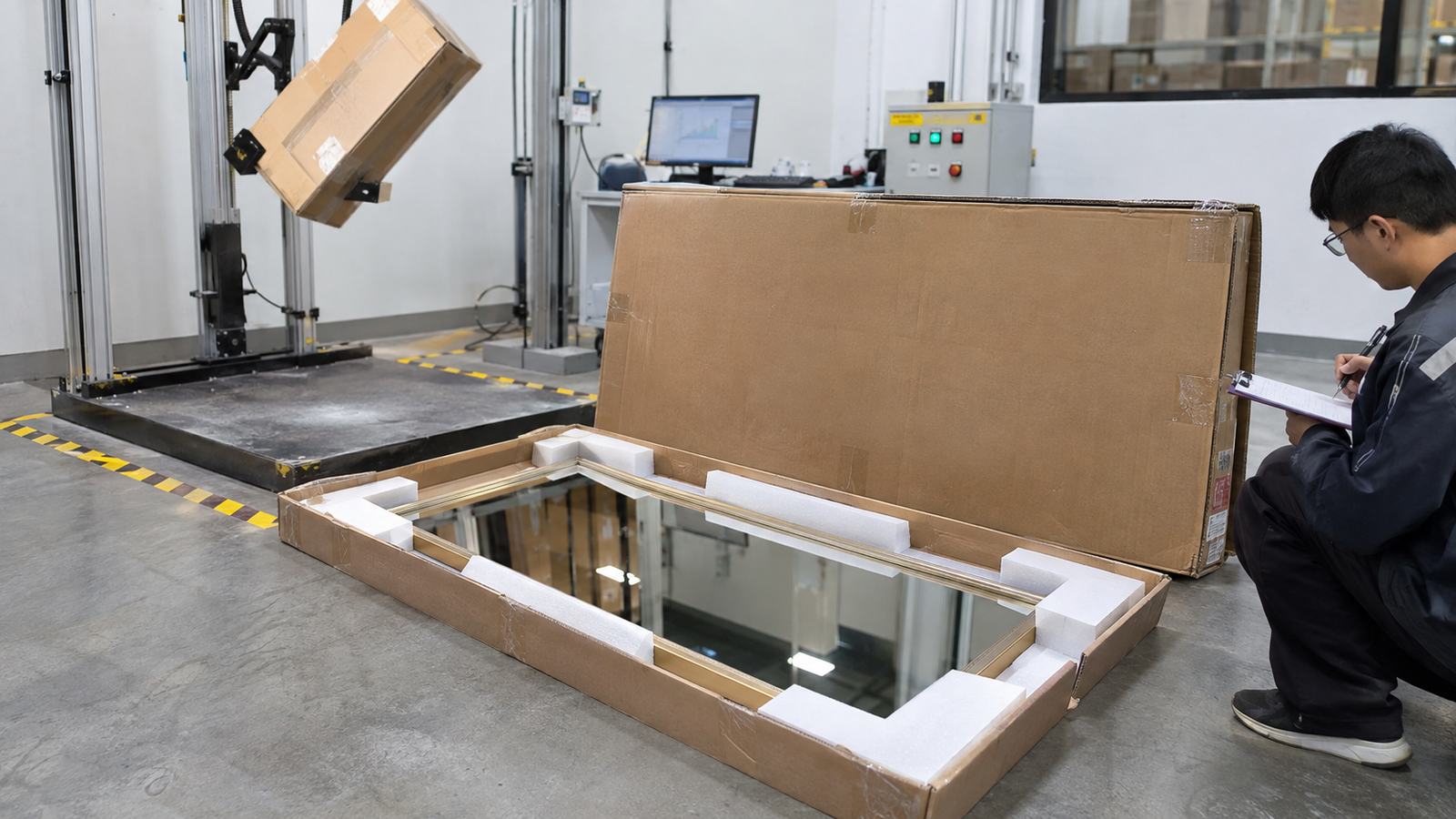
A supplier sends a buyer a packaging report.
The result says: PASS.
The buyer approves the packaging, confirms the order and arranges shipment.
Three weeks later, several mirrors arrive with cracked corners, damaged frames and broken glass.
The supplier responds: “But the packaging passed the drop test.”
So, who is right?
Here is the uncomfortable truth: a successful mirror drop test does not automatically prove that a mirror is ready for every shipping environment.
The test may be valid. The report may be genuine. But the tested package may not represent the actual shipment.
For international mirror buyers, this distinction can mean the difference between a controlled packaging programme and an expensive damage claim.
A Test Report Can Be Genuine but Still Be Irrelevant
One of the most common mistakes in packaging approval is accepting a test report without checking what was actually tested.
Imagine a supplier provides a report for a decorative wall mirror.
The tested package contains:
- A standard-sized mirror.
- A particular carton structure.
- A specific internal cushioning arrangement.
- A defined product weight.
- A particular packing orientation.
The buyer subsequently orders a larger mirror with a heavier metal frame.
The supplier keeps the same general packaging concept and assumes the previous report is sufficient.
But the product has changed.
The centre of gravity may be different. The carton dimensions may have changed. The impact forces may be distributed differently.
The previous test result does not automatically validate the new configuration.
A test report should be connected to an identifiable product and packaging configuration, not simply to a supplier’s general packaging capability.
What Does a Mirror Drop Test Actually Prove?
A drop test evaluates how a packaged product responds to impact when dropped under defined test conditions.
ASTM D5276-19(2023), for example, covers free-fall drop testing of loaded boxes, cylindrical containers and bags. It is intended to evaluate the container’s ability to withstand sudden impact and the ability of the packaging to protect its contents.
It can also help compare different packaging designs.
However, it does not establish that a package will survive every possible transportation condition.
The ASTM D5276 standard should therefore be understood as a test method, not a universal shipping guarantee.
A successful result answers a specific question:
How did this packaged product perform under the defined test conditions?
It does not answer every question about its international distribution journey.
Not All Transportation Tests Are the Same
Another common problem is treating different testing procedures as interchangeable.
They are not.
The International Safe Transit Association (ISTA) distinguishes between non-simulation integrity tests and general simulation performance tests.
For buyers, several procedures are particularly relevant.
| Test | Main Application | What Buyers Should Understand |
|---|---|---|
| ISTA 1A | Individual packages up to 68 kg | Integrity screening, not a full transport simulation |
| ISTA 3A | Individual parcel shipments up to 70 kg | General simulation of parcel delivery |
| ISTA 3B | Less-than-truckload shipments | Mixed freight handling conditions |
| ISTA 3E | Similar products in unitized full-truckload shipments | Testing of unitized loads |
The appropriate procedure depends on the actual distribution system, package configuration and testing objective.
For example, an individual mirror sent through a parcel delivery network has different handling exposures from mirrors shipped on pallets as part of a consolidated freight movement.
A test designed for one distribution method should not automatically be used as evidence for another.
See the ISTA Test Procedures and ISTA Getting Started with Design & Testing.
The Sample Passed. Why Did the Bulk Shipment Fail?
This is a particularly important question for importers.
A sample shipment and a bulk shipment may involve different packaging and handling conditions.
Consider a typical sourcing process.
Sample stage
One mirror is packed individually and sent by courier. It receives repeated manual handling, sorting and last-mile delivery.
Bulk order stage
Hundreds of mirrors are packed into cartons, arranged on pallets or loaded into a shipping container.
The transportation environment is now different.
The bulk shipment introduces additional considerations:
- Carton-to-carton contact.
- Stacking and compression.
- Pallet stability.
- Loading and unloading methods.
- Forklift handling.
- Container movement.
- Warehouse storage conditions.
A successful sample shipment is encouraging, but it does not independently validate the bulk shipping configuration.
Likewise, a successful drop test on one individual carton does not automatically demonstrate the performance of an entire palletized load.
Buyers should evaluate the actual shipping configuration rather than assume that one successful test covers every stage.
Five Questions Every Buyer Should Ask Before Accepting a Drop-Test Report
1. Was the Actual Product Tested?
Check the model number, dimensions, weight, frame construction and glass configuration.
If the report covers a smaller mirror, ask whether the tested product is representative of the actual order.
A similar appearance does not necessarily mean similar packaging risk.
2. Was the Final Packaging Used?
This is essential.
A test performed with one carton structure cannot automatically validate another.
Check whether the tested package includes the actual:
- Outer carton.
- Internal cushioning.
- Corner protection.
- Face protection.
- Product restraints.
- Protective films.
- Packing orientation.
If the packaging changes after testing, the buyer should assess whether additional validation is necessary.
3. Which Test Procedure Was Used?
A supplier saying “we passed a drop test” has not provided enough information.
Ask for the exact test procedure and revision.
Was it ASTM D5276, ISTA 1A, ISTA 3A or another applicable procedure?
What distribution environment was the procedure selected to address?
A credible report should make this identifiable.
4. What Was Considered a Failure?
A mirror can survive a drop without its glass completely breaking, but still suffer commercially unacceptable damage.
For example:
- A chipped frame corner.
- A scratched mirror surface.
- A loose hanging bracket.
- A damaged decorative finish.
- A cracked internal support.
- A carton that can no longer protect the product.
Buyers and suppliers should agree on acceptable product and package damage before testing.
A report should document both the condition of the package and the condition of the product after testing.
5. Can the Result Be Traced to the Production Order?
The final question concerns repeatability.
Was the tested package produced using the same materials and construction as the bulk order?
Has the carton supplier changed?
Has the internal cushioning thickness been reduced?
Has the packing method changed to improve container loading efficiency?
These changes may affect performance.
A successful test should be linked to a controlled packaging specification that production can reproduce.
A Practical Example: Three Mirrors, Three Different Risks
Consider three hypothetical mirror products.
| Product | Main Packaging Concern | What Needs Validation |
|---|---|---|
| Small decorative wall mirror | Corner impact and surface damage | Face protection and internal movement |
| Full-length floor mirror | Large dimensions and handling | Edge protection, carton strength and orientation |
| Heavy decorative metal-frame mirror | Product weight and frame impact | Support structure, restraints and load distribution |
It would be a mistake to assume that one packaging design and one test result automatically cover all three.
Even when the same basic carton material is used, the internal protection requirements may differ.
The testing plan should reflect the product’s actual vulnerabilities and intended distribution route.
The Hidden Cost of Passing Every Test but Controlling Nothing
There is another problem in the industry.
Some suppliers focus heavily on obtaining a successful test result but pay less attention to controlling the packaging after the test.
This creates a gap between laboratory approval and mass production.
A useful packaging control system should connect four stages.
| Stage | Control Requirement |
|---|---|
| Product approval | Confirm the product configuration |
| Packaging development | Define carton and internal protection |
| Testing | Validate the agreed configuration |
| Bulk production | Reproduce the approved packaging |
A successful test is only one stage.
If production uses different materials, different carton dimensions or a different packing arrangement, the original approval may no longer represent the actual shipment.
This is why packaging specifications should be treated as controlled production documents.
Teruier’s QC Checkpoints for Mirror Supply: How North American Buyers Protect Margin Before the Order Ships discusses how packaging approval connects with production inspection and damage-claim prevention.
Does Better Packaging Always Mean More Packaging?
Not necessarily.
This is another assumption worth challenging.
Adding more foam, thicker cartons and additional protective materials may reduce some risks, but it can also increase packaging costs, shipping volume and material consumption.
The objective should not be to create the heaviest possible package.
It should be to achieve an appropriate level of protection for the product and distribution system.
For example, honeycomb paper packaging may be suitable for certain protective applications, but its performance must be evaluated in the actual package design.
Likewise, a plastic-free packaging solution should not be considered successful simply because it uses fewer plastic materials.
Protection, package dimensions, transport efficiency and the buyer’s sustainability requirements should be considered together.
Teruier’s Plastic-Free Packaging: How U.S. Home Décor Buyers Reduce Damage Without Overpacking explores this balance.
For a wider discussion of mirror packaging and logistics, see Mirror Packaging for Shipping: Why the Box Is Not the Box — It Is the Product Strategy.
What Should Be Included in a Buyer-Approved Packaging Record?
Before releasing a bulk order, buyers should establish a packaging record that can be compared with the final production shipment.
A useful record includes:
| Information | Required Record |
|---|---|
| Product reference | SKU and approved product revision |
| Product dimensions | Height, width and depth |
| Net weight | Actual product weight |
| Package dimensions | External carton dimensions |
| Gross weight | Product plus packaging |
| Carton specification | Material and construction |
| Internal protection | Cushioning and positioning arrangement |
| Test procedure | Standard and revision |
| Test result | Findings and post-test inspection |
| Production reference | Approved packing specification |
For products with different sizes or constructions, the buyer should establish which configurations require separate testing or additional engineering review.
The objective is traceability.
If a breakage claim occurs, the buyer should be able to identify exactly which product and packaging configuration was approved.
Teruier’s How to Read Mirror Specifications Before You Source a Collection explains why packaging information, product weight and carton dimensions should be reviewed before purchase-order confirmation.
FAQ
Does passing an ISTA drop test guarantee that a mirror will not break during shipping?
No. Testing evaluates performance under defined conditions. It reduces uncertainty but cannot guarantee zero damage across every possible handling and transportation environment.
Is ISTA 1A the same as ISTA 3A?
No. ISTA 1A is a non-simulation integrity test, while ISTA 3A is a general simulation procedure for individual parcel shipments within its defined scope.
Can a supplier use one test report for several mirror sizes?
Not automatically. Buyers should compare the tested product and packaging configuration with each proposed SKU. Significant changes may require additional validation.
Should buyers request a drop test before every order?
Not necessarily. Testing frequency and scope should depend on product risk, packaging changes, distribution conditions and customer requirements. An established and controlled packaging configuration may be supported by previous testing, provided it remains representative.
Does a successful sample delivery prove that bulk shipping is safe?
No. Sample courier shipments and bulk palletized or consolidated shipments can involve different handling and transportation conditions.
A Test Report Is Evidence. Your Actual Shipment Is the Result.
International buyers should stop treating a packaging test report as a simple pass-or-fail document.
The important questions are what was tested, how it was tested, which shipping environment it represents and whether the production shipment matches the approved configuration.
A good packaging programme does not promise that nothing can ever break.
It provides a documented and repeatable basis for reducing transportation risk.
Teruier works with international mirror buyers on product specifications, quality checkpoints, packaging development and shipment coordination.
For importers, retailers and distributors, the objective is to connect the approved mirror with the packaging and transportation arrangements required by the actual order.
Contact Teruier to discuss mirror specifications, packaging validation and your next wholesale sourcing programme.