
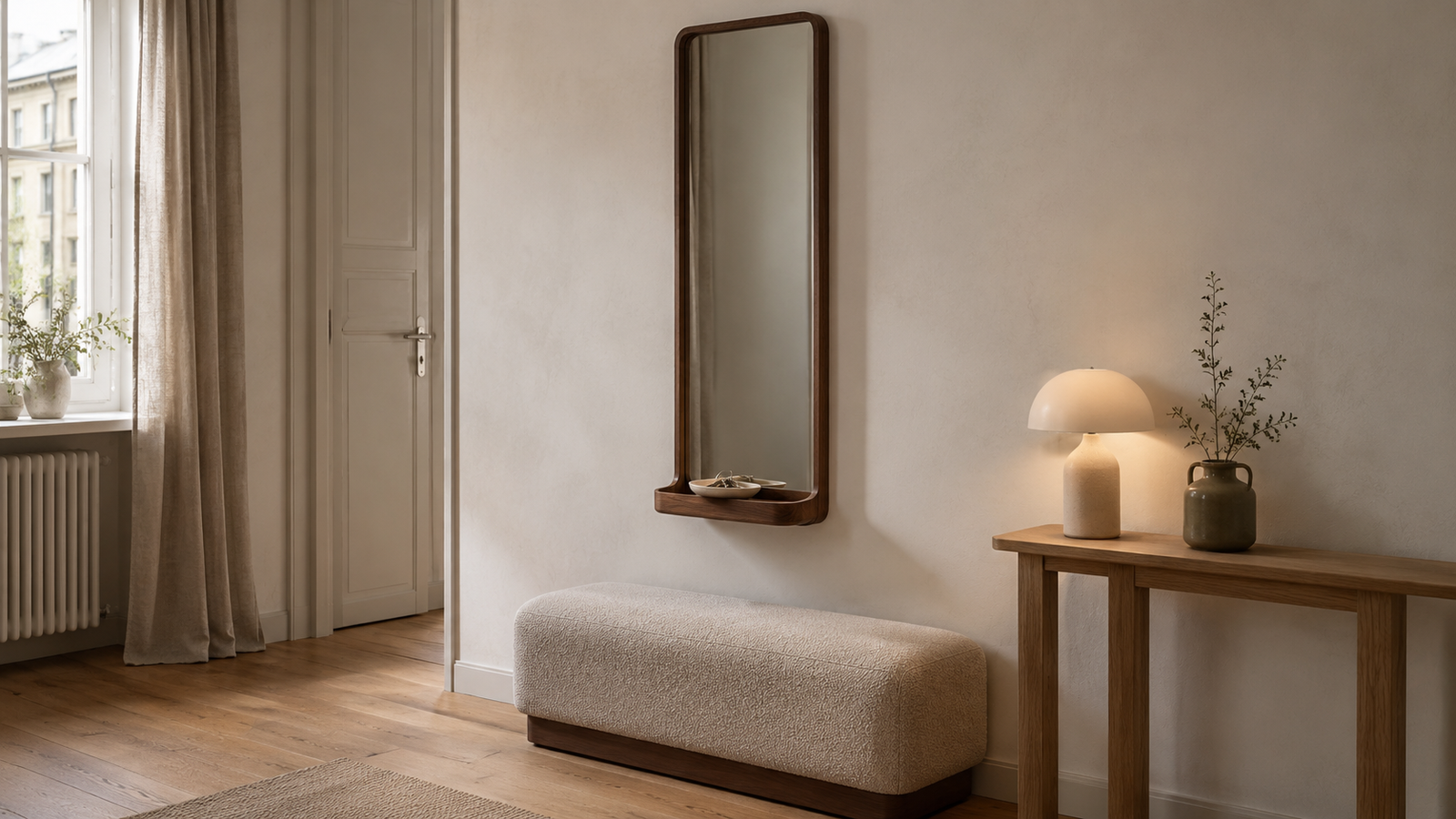
For a German buyer, successful assortment planning starts with the room customers actually have—not with the number of products a supplier can offer.
A recent small-space brief focused on a familiar retail problem: how to create a complete entryway story within one compact display bay. The buyer wanted the collection to feel warm and useful, but not crowded. It had to work for apartment living, specialist retail and online product pages alike.
The Trend Signal: More Connected, More Useful Living
At Ambiente 2026, the Living and Interior Looks areas again connected furniture, lighting, decoration, premium retail and project business. The relevant signal was not one colour or one silhouette. It was the demand for products that work together as a coherent interior solution.
For small-space assortment planning, this means every item must earn its place. A mirror should do more than reflect. A bench should do more than provide a seat. A tray or lamp should complete the setting without becoming visual clutter.
The Starting Point: A Four-Piece Entryway Edit
The first layout combined:
- a compact wall mirror as the vertical anchor;
- a low upholstered storage bench;
- a shallow decorative tray for keys and small objects;
- a small ambient table lamp for warmth and gifting appeal.
The buyer’s planogram was deliberately simple: the mirror provided height, the bench supplied practical value, and the smaller objects gave the display a finished home feeling.
What Changed During Development
The first mirror proposal included a deeper front storage element. On the layout review, it projected too far into the visual field and made the edit feel heavier than the intended apartment setting.
The design team reduced the visible depth and refined the storage area into a cleaner, more integrated detail. The mirror retained a useful entryway function, but it became easier to combine with the bench beneath it.
The storage bench was also revised. A more decorative stitched top was considered at first, then simplified after upholstery review. The final approach used a calmer upholstered surface and a more stable base treatment—better for repeat production, easier to coordinate with the mirror, and more suitable for a year-round retail assortment.
How the Range Became Planogram-Ready
| Product role | First approach | Final retail role |
|---|---|---|
| Wall mirror | Decorative focal point | Mirror with integrated entryway function |
| Storage bench | Standalone soft furnishing | Seating and concealed storage below the mirror |
| Tray | Separate décor SKU | Practical catch-all and add-on item |
| Ambient lamp | Styling accessory | Warm visual finish and gifting opportunity |
This is the difference between a group of products and a retail-ready home décor assortment. The final edit gives a buyer a clear selling story: arrive, store, reflect, place and relax.
Manufacturing Evidence Matters in Retail Assortment Planning
The revision was not only an aesthetic decision. It required coordination between the mirror workshop, upholstery team, decorative-accessory suppliers and packaging specialists in Minhou.
The bench frame and upholstery construction needed to remain stable in transit. The mirror packaging needed to protect the revised detail without increasing unnecessary carton volume. The tray and lamp had to be reviewed as supporting items, rather than added after the main products were already fixed.
This is where delivery planning begins: not when the container is booked, but when products are developed around compatible dimensions, finish references and packing requirements.
A Short Read on European Fair Direction
Ambiente Trends 26+ groups current interiors into the themes brave, light and solid—a useful framework for retailers translating broad trends into practical range decisions.
For German buyers, the commercial interpretation is more restrained: mix one expressive accent with dependable, calm core pieces. A small-space collection should feel complete, but leave room for the customer’s own home.
Product List vs. Planned Assortment
Product list: individual SKUs selected by appearance or price.
Planned assortment: products selected by room role, display logic, retail price layer, packaging compatibility and replenishment needs.
The second approach makes store presentation, e-commerce imagery and future reorders easier to manage.
Short FAQ
What makes an assortment planogram-ready?
Each SKU has a defined placement, proportion and role within a display—not simply a matching colour.
Why is small-space planning relevant beyond city retail?
Compact, multi-use products also suit online assortments, apartments, hospitality rooms and entryway programmes.
When should delivery planning be discussed?
Before final sampling is approved, especially where mirrors, upholstery and fragile décor items are intended to ship as one coordinated collection.
Build an Assortment Around How People Live
Good retail assortment planning turns a trend into a decision a customer can understand in seconds. For buyers, the most useful supplier conversation is therefore not “What can you make?” but “How will these products work together on the floor, in the carton and in the customer’s home?”
Teruier supports small-space assortment planning with coordinated product development, finish alignment, planogram-ready product roles and delivery planning for home décor collections.



