A German buyer sourcing soft furnishings does not need another promise of “strong design and supply-chain capability”. The useful question is simpler: What did the supplier notice, what did they change, and why did the final product become easier to sell?
The following development route shows what evidence-led B2B home furnishings sourcing can look like.
1. The Signal Was a Shift Towards Considered, Compact Furnishings
At Ambiente 2026, Frankfurt’s Interior Looks area brought furniture, interior design, premium retail and hospitality decision-makers into the same conversation. The signal for buyers was clear: occasional furniture must work as part of a complete interior concept, not as an isolated product. Ambiente Interior Looks
For a German assortment plan, that means fewer oversized statement pieces and more adaptable items: soft forms, tactile materials and proportions that can move from an apartment living room to an entryway, bedroom or boutique hotel.
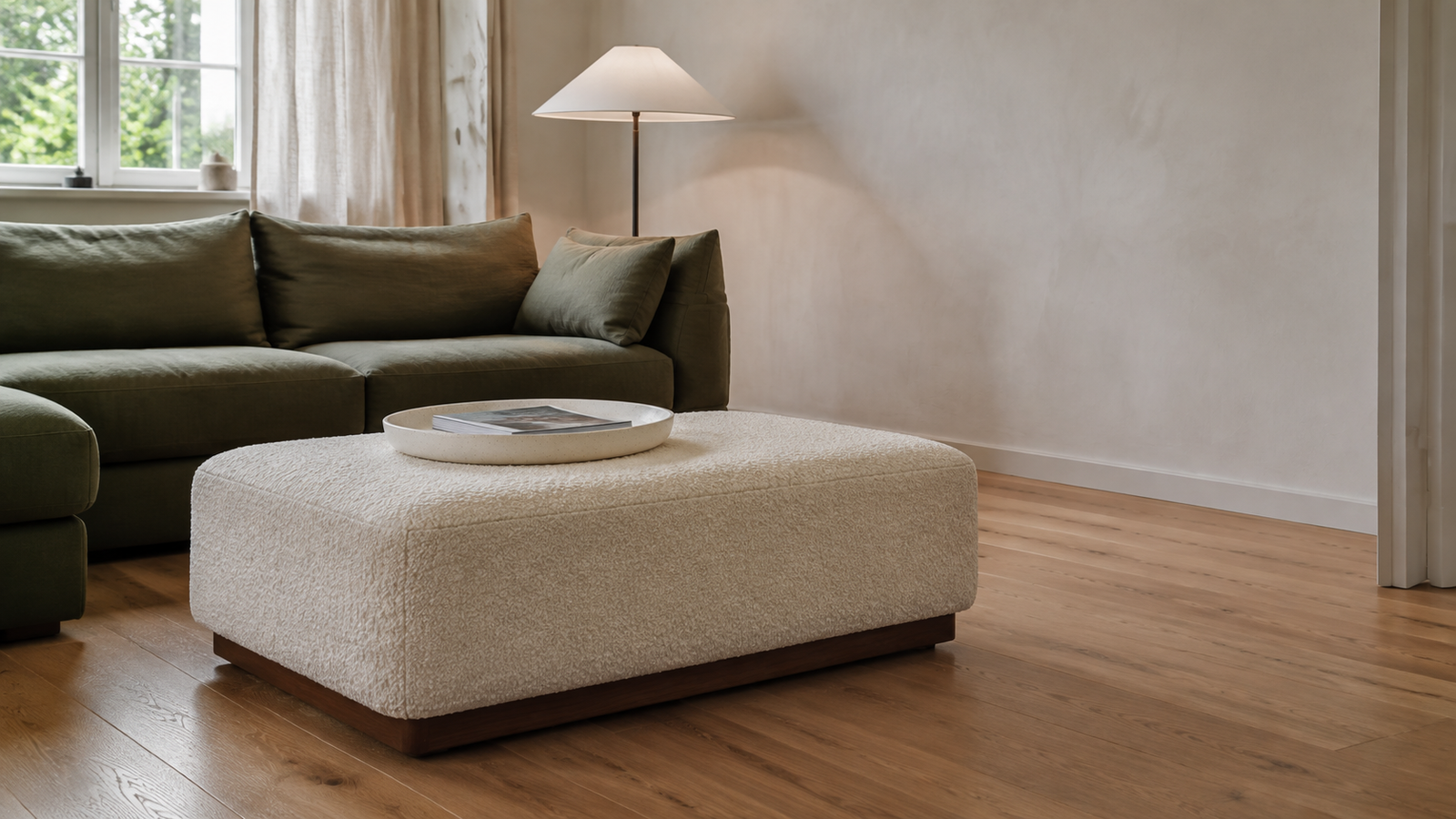
The starting brief was therefore a compact upholstered storage ottoman. It needed to offer seating, concealed storage and a calm enough silhouette for a year-round programme.
2. The First Design Was Attractive—but Not Yet Production-Ready
The initial concept used deep channel stitching across the lid, narrow raised legs and a strongly rounded upholstered edge. It had visual appeal, but the first technical review exposed three problems:
- the channel pattern could flatten or become uneven during packing and transport;
- the narrow-leg construction reduced the visual stability of the piece;
- the complex seam route increased the risk of inconsistent corners between production batches.
The designer remained involved after the first review. Instead of protecting the original sketch, the team simplified it: the lid became a smoother upholstered panel with a controlled edge profile; the support structure was strengthened beneath the upholstery; and the base was revised into a lower, more grounded form.
This is a small change on paper, but an important one in a home furnishings buying guide. The product became easier to sit on, easier to pack and easier to present as a dependable retail item.
3. The Minhou Supply Chain Solved the Manufacturing Detail
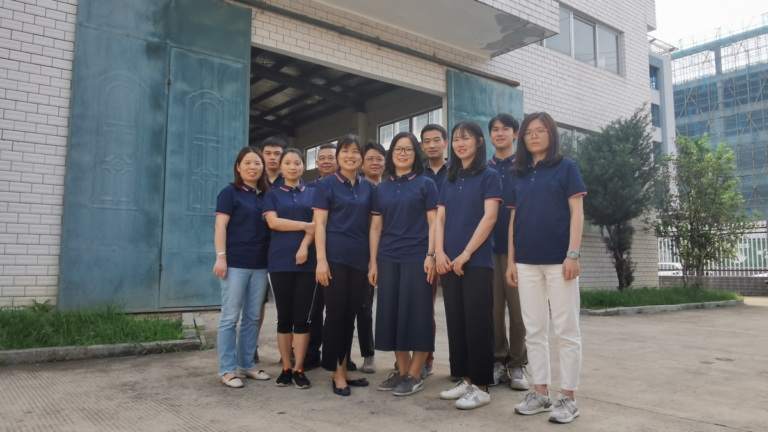
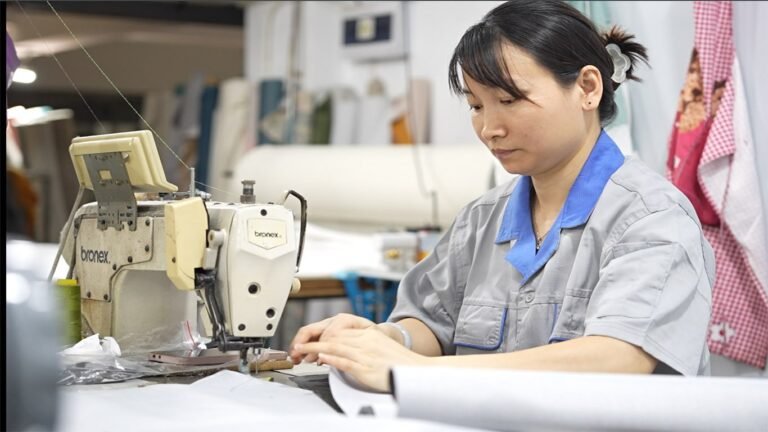
The key work did not happen in a presentation. It happened between the upholstery workshop, frame maker and packaging team in Minhou.
The upholstery team reviewed fabric stretch around the rounded corners. The frame workshop adjusted the internal support so the top would remain even after repeated use. Packaging was then considered alongside the shape: corner protection and carton clearance had to protect the soft profile without making the item inefficient to ship.
This is where global home décor sourcing becomes practical. A product is not “developed” when the rendering is approved. It is developed when appearance, structure, repeatability and packing are working together.
What the Buyer Kept in the Final Sample
The buyer did not retain the sample only because it looked more refined. The final version answered four commercial questions:
| Review point | First concept | Revised sample |
|---|---|---|
| Retail appearance | More decorative, but busy | Calm and easier to style |
| Seating confidence | Visually light | More grounded and stable |
| Production consistency | Complex seam risk | Controlled upholstery route |
| Range role | One-off accent | Storage, seating and décor in one SKU |
4. What This Means for Assortment Planning
For German retailers, a storage ottoman should not be selected simply as a “soft furnishing”. It can serve as a compact entryway bench, a living-room footstool, a bedroom storage piece or a small hospitality accessory.
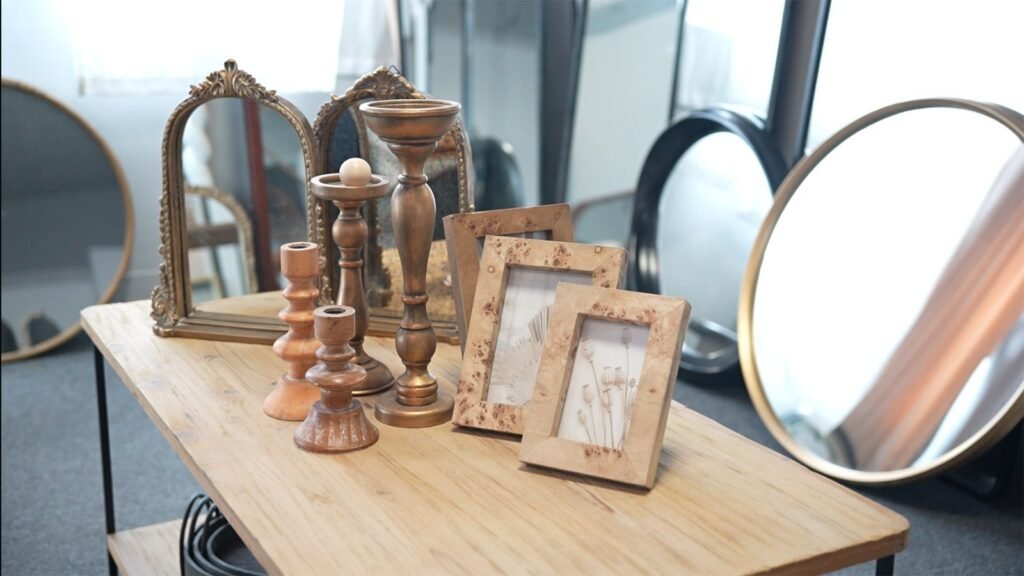
That flexibility matters in assortment planning. A buyer can build one textile and colour story around it, then combine it with mirrors, side tables, trays and decorative lighting.
European fairs remain useful for finding the direction. Ambiente Trends 26+ frames current developments through the themes brave, light and solid, giving retailers a way to translate wider design signals into commercial ranges. Ambiente Trends 26+ The supplier’s role is to translate that signal into a product that can survive a sample review, a production run and a retail floor.
5. What Evidence Should a Buyer Request?
A practical B2B sourcing guide should include more than catalogue images. Ask for:
- the original design brief and target use case;
- material and fabric reference cards;
- a short change log between prototype rounds;
- internal-structure and upholstery details;
- packing proposal and carton information;
- colour and finish options for a private-label programme.
Short FAQ
Why simplify a soft-furnishings design after the first sample?
Because visible complexity often creates hidden risks in upholstery, packing and batch consistency. Simplification can improve both margin and repeatability.
Does a storage ottoman suit retail only?
No. With the right dimensions, fabric and base treatment, it can also support hospitality, serviced-apartment and project requirements.
Can the structure be adapted for a buyer’s target price?
Yes. Fabric grade, foam, internal frame, stitching detail, legs and packaging can be reviewed as one product-development decision.
A Better Way to Present Supplier Capability
Real capability is not a slogan. It is the record of a decision: what was found, what was changed, how the workshop solved it and why the buyer kept the final version.
For soft furnishings development, Teruier can provide a product route that connects design direction, sample evidence, manufacturing review and range positioning—before a buyer commits to a full order.