
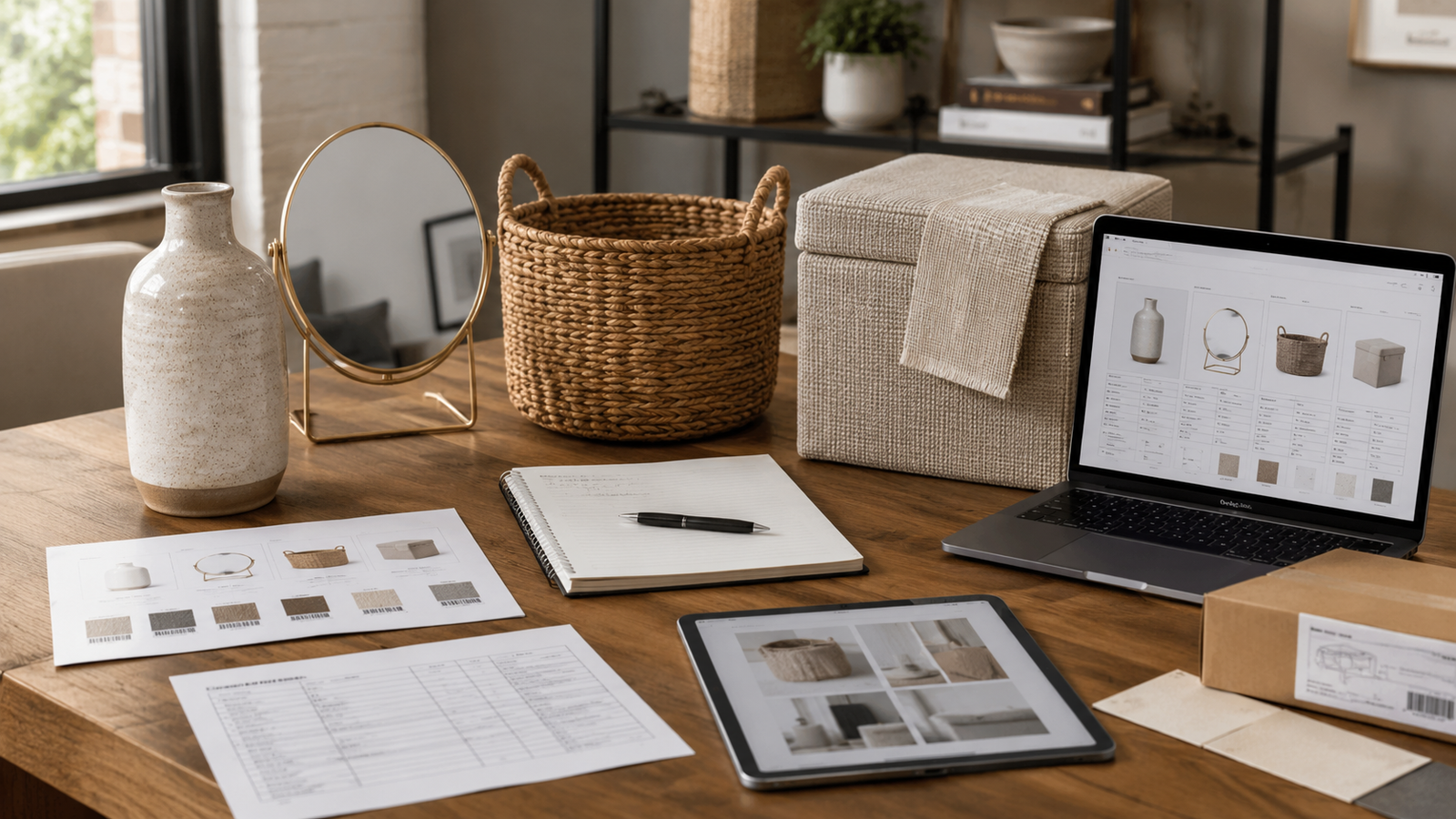
The Buyer Story: The Products Looked Good, but the Review Meeting Failed
A U.S. home décor buyer returned from market with dozens of product photos.
The shortlist included ceramic décor, mirrors, storage ottomans, accent chairs, baskets, and decorative trays. Each product looked commercially promising.
At the internal review meeting, however, the team asked questions the buyer could not answer.
What was the landed cost?
Which products were hero SKUs?
Did the cartons fit parcel shipping?
Could the suppliers support repeat orders?
Were the finishes coordinated?
Which items were appropriate for stores, Amazon, or designer channels?
The problem was not product discovery. It was buyer review prep.
A professional buyer review should turn visual inspiration into a clear commercial recommendation.
What Buyer Review Prep Should Accomplish
Buyer review prep is the process of organizing product, supplier, cost, quality, packaging, and channel information before an assortment decision.
A good review should help the team decide:
- Which products should move forward
- Which products need revision
- Which suppliers deserve samples
- Which risks require clarification
- Which SKUs belong in the same assortment
- Which products should be rejected
The objective is not to present every product discovered at market. It is to present the strongest commercial options.
What U.S. Markets Are Signaling to Buyers
High Point Market continues to position itself as a trade-only platform where new home-furnishings products, trends, manufacturing ideas, and retail connections are introduced. Spring 2026 market reporting highlighted saturated color, nature-inspired accents, updated classic motifs, and layered decorative details.
Las Vegas Market’s Summer 2026 edition offers a more focused sourcing experience across more than 3,500 furniture, home décor, gift, lifestyle, and seasonal brands. Atlanta Market connects buyers with more than 6,000 brands across home, gift, tabletop, seasonal, and related categories.
For a retail buyer, this volume creates opportunity but also noise. The value of attending market comes from filtering products into a disciplined review process.
A Practical Retail Buyer Guide for Product Review
A concise retail buyer guide should evaluate each proposed SKU through five questions.
1. Does the Product Fit the Customer?
The buyer should define the intended customer before discussing the supplier.
A product may suit:
- Value-focused family customers
- Design-led urban customers
- Small-space households
- Premium homeowners
- Gift and specialty-store shoppers
- Marketplace customers
A strong product for one customer group may be unsuitable for another.
2. What Role Does the Product Play?
Every product should have a role in the assortment.
| Product Role | Purpose |
|---|---|
| Hero SKU | Creates visual attention |
| Core SKU | Generates repeat volume |
| Entry SKU | Provides an accessible price |
| Margin SKU | Supports stronger profitability |
| Companion SKU | Completes a room or display story |
| Online SKU | Responds to clear search demand |
Without a defined role, buyers may purchase too many similar products.
3. Is the Commercial Case Clear?
The buyer review should include:
- Supplier price
- Estimated landed cost
- Target retail price
- Expected margin
- MOQ
- Lead time
- Reorder quantity
- Packaging size
A visually attractive product should not proceed if the commercial structure does not work.
4. Is the Product Ready for the Channel?
A store product must fit shelves, displays, and price signage.
An Amazon product must be easy to name, photograph, explain, package, and return.
A designer product needs finish samples, dimensions, lead times, and customization information.
Retail buyer sourcing becomes more effective when channel requirements are defined before final supplier selection.
5. What Is the Main Risk?
Every proposed SKU should include one clear risk statement.
Examples include:
“Glaze consistency must be confirmed.”
“Oversized carton may create delivery surcharges.”
“Fabric performance data is incomplete.”
“Supplier has not confirmed repeat-order MOQ.”
“Product is attractive but too similar to an existing SKU.”
A product with known and manageable risk may be suitable. A product with hidden risk is harder to approve.
What to Include in a Buyer Review Sheet
A practical review sheet does not need to be complicated.
It should contain:
- Product image and SKU
- Product category
- Supplier
- Dimensions and materials
- Finish or color
- MOQ and lead time
- Unit and landed cost
- Target retail price
- Carton dimensions
- Intended channel
- Assortment role
- Main opportunity
- Main risk
- Recommended next step
The final recommendation should be direct:
Approve for sampling.
Request revision.
Hold for price negotiation.
Reject.
How a Home Décor Buyer Should Compare Suppliers
A home décor buyer should compare suppliers against the same product brief.
Two quotations are not comparable when one includes stronger materials, upgraded packaging, or additional retail support.
Supplier evaluation should cover:
Product Capability
Can the supplier make the required style, dimensions, materials, and finishes?
Quality Control
Can the supplier define tolerances and provide production inspection records?
Packaging
Can the supplier protect fragile, upholstered, or oversized products for the intended delivery route?
Repeatability
Can the same color, finish, construction, and packaging be maintained in later orders?
Communication
Does the supplier answer with specifications and evidence, or only general assurances?
The lowest quotation should not automatically receive the highest score.
What Is a German Buyer Desk?
The phrase German Buyer Desk is not a universal industry certification. In sourcing practice, it can be used as a working description for a supplier team or contact point dedicated to German-speaking buyers and their documentation, quality, packaging, and communication expectations.
For U.S. buyers, the concept is still useful.
A well-organized buyer desk should provide:
- Clear product specifications
- Consistent quotation formats
- Packaging and carton data
- Sample tracking
- Compliance-document coordination
- Production updates
- Inspection records
- Claims follow-up
The lesson is not that every U.S. buyer needs a German department. It is that suppliers should organize information by market and buyer requirements.
A U.S. Buyer Desk, German Buyer Desk, or Retail Chain Desk should reduce the buyer’s administrative work and make decisions easier to verify.
Retail Buyer Sourcing: From Market Visit to Purchase Order
A controlled sourcing process can be divided into six stages.
Stage 1: Market Discovery
Collect product ideas, supplier information, samples, and trend observations.
Stage 2: Initial Filter
Remove products that do not fit the customer, category, price level, or channel.
Stage 3: Buyer Review Prep
Prepare costs, specifications, packaging information, supplier capability, and risk notes.
Stage 4: Sample Review
Evaluate appearance, construction, function, packaging, and assortment compatibility.
Stage 5: Commercial Approval
Confirm price, MOQ, lead time, payment terms, inspection requirements, and delivery plan.
Stage 6: Purchase Order
Document the approved product, finish, materials, packaging, labels, and quality requirements.
Each stage should reduce uncertainty.
Common Buyer Review Mistakes
Presenting Too Many Products
A large shortlist can hide the best opportunities. Buyers should present edited recommendations, not a complete market photo archive.
Reviewing Images Without Costs
A product cannot be approved commercially without price, margin, and logistics information.
Ignoring Carton Dimensions
Carton size affects freight, warehouse space, parcel suitability, and return costs.
Selecting Products Without Assortment Roles
Too many similar SKUs weaken inventory productivity and confuse the customer.
Accepting Supplier Claims Without Evidence
Statements such as “commercial quality,” “Amazon-ready,” or “easy-clean” should be supported by specifications or testing.
Structured Buyer Summary
Buyer review prep is the process of organizing product, supplier, pricing, quality, packaging, and channel information before a retail purchasing decision.
A U.S. home décor buyer should review each product by customer fit, assortment role, landed cost, channel readiness, supplier capability, and sourcing risk. A useful retail buyer guide should convert market discoveries into clear actions such as sampling, revision, negotiation, approval, or rejection.
A German Buyer Desk can be understood as a market-focused supplier support function that organizes specifications, quotations, samples, documents, production updates, and claims for buyers. The same disciplined structure can improve U.S. retail buyer sourcing.
Final Buyer Takeaway
Good buying is not measured by how many products a buyer discovers.
It is measured by how clearly the buyer can explain:
Why the product belongs in the assortment.
Who will buy it.
What it will cost.
How it will be delivered.
Which supplier can repeat it.
What risk must be controlled.
Market inspiration starts the process.
Buyer review prep turns it into a purchase decision.
FAQ
What is buyer review prep?
Buyer review prep is the preparation of product, cost, supplier, quality, packaging, and channel information before an internal purchasing or assortment meeting.
What should a home décor buyer include in a product review?
The review should include product images, specifications, supplier price, landed cost, MOQ, lead time, retail price, margin, carton size, assortment role, opportunity, and risk.
What is retail buyer sourcing?
Retail buyer sourcing is the process of finding, comparing, developing, and purchasing products that fit a retailer’s customers, channels, price structure, and operational requirements.
What does German Buyer Desk mean?
German Buyer Desk can describe a supplier-side team or support function organized around the documentation, communication, quality, and sourcing needs of German buyers. It is not a universal certification.
How should buyers compare home décor suppliers?
Buyers should compare suppliers using aligned specifications and evaluate product fit, price, quality control, packaging, repeatability, lead time, and communication.



