A trend is not useful if it breaks, changes, or becomes impossible to repeat
Some trends look wonderful in the first sample.
The anti-fog bathroom mirror works nicely.
The wabi sabi ceramic vase feels handmade and calm.
The finish looks soft.
The packaging looks acceptable.
Everyone nods politely, which is usually how German business optimism expresses itself.
Then the reorder comes.
The mirror defogger is smaller.
The ceramic glaze changes too much.
The vase shape becomes “more handmade”, which is supplier language for “less controlled”.
The carton protection is weaker.
And suddenly the buyer is not managing a trend. The buyer is managing damage control with a product photo.
This is why reorder friendly trends matter.
A good trend should not only look current. It should be repeatable, packable, explainable, and stable enough to become part of a real buying programme.
What are reorder friendly trends?
Reorder friendly trends are home décor directions that are attractive to the market but controlled enough for repeat orders.
They should have:
- stable material sources
- clear finish standards
- repeatable shape
- practical packaging
- realistic MOQ
- documented specifications
- understandable product function
- strong room-use logic
- acceptable production tolerance
In simple words: the product should still look like itself when the second order arrives.
A trend that cannot be reordered is not a trend strategy.
It is a first-date romance with logistics problems.
Anti-fog bathroom mirror specs: the detail buyers should not leave vague
Anti-fog mirrors are useful because they solve a real customer problem. Nobody enjoys stepping out of the shower and seeing only a foggy rectangle of disappointment.
For German buyers, anti-fog bathroom mirror specs should be checked before placing the order, not after the sample looks nice.
Key questions include:
- What is the defogger size?
- What is the wattage?
- Where is the heating pad positioned?
- How much of the mirror clears?
- What is the LED mirror IP rating, if LED is included?
- Are installation notes available?
- Is the anti-fog function tested?
- Will the same component be used in the reorder?
- Is the packaging suitable for glass and electrical parts?
The most dangerous problem is expectation.
If the buyer expects the whole mirror to clear, but only a small central area clears, the product may technically work but commercially disappoint.
That is not a defect in the mirror.
That is a defect in the sourcing conversation.
Wabi sabi ceramic vase: beautiful imperfection needs limits
The wabi sabi ceramic vase is a strong home décor direction because it fits natural interiors, quiet luxury, neutral rooms, and relaxed designer spaces.
It works well with:
- warm wood
- linen textiles
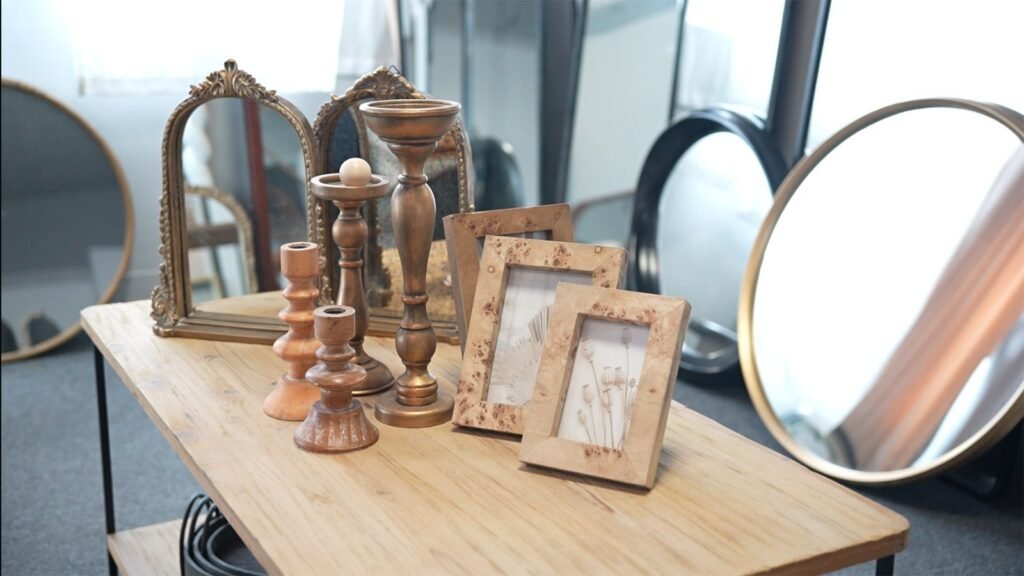
- organic wall mirrors
- textured ottomans
- matte trays
- tonal ceramic finishes
- small-space home décor stories
But wabi sabi is not an excuse for uncontrolled production.
A good wabi sabi ceramic vase should feel irregular, calm, and handmade.
It should not look damaged, dirty, warped beyond use, or like the factory forgot the approved sample existed.
German buyers should define:
| QC Point | What to Confirm |
|---|---|
| Shape | organic but still stable |
| Glaze | approved colour range |
| Surface | matte or textured, but not rough in a cheap way |
| Base | flat enough to stand safely |
| Weight | stable, not unnecessarily heavy |
| Opening | practical enough for use or clearly decorative |
| Reorder | same style family can be repeated |
Wabi sabi is controlled imperfection.
Uncontrolled imperfection is just poor QC wearing linen.
Ceramic packaging to reduce breakage: not glamorous, very profitable
Ceramic products can sell beautifully. They can also arrive beautifully broken.
That is why ceramic packaging to reduce breakage is part of the buying decision.
For vases, bowls, trays, and decorative ceramics, buyers should check:
- inner protection
- corner and rim protection
- individual wrapping
- carton strength
- space between items
- drop-risk areas
- outer carton marking
- pallet loading logic
- product weight vs carton strength
- whether irregular shapes need custom inner support
A ceramic vase with a fragile rim needs different packaging from a simple round bowl.
A wabi sabi vase with an uneven shape may need more careful inner support.
A decorative ceramic item that breaks easily is not “delicate”.
It is expensive.
Custom size vs custom finish: which is safer for reorder?
For German buyers and interior designers, custom size vs custom finish is one of the most important sourcing decisions.
| Decision | Custom Size | Custom Finish |
|---|---|---|
| What changes? | dimensions, mould, structure, packaging | glaze, colour, texture, frame finish, fabric |
| Best for | project-specific rooms or fit-out needs | retail refresh, designer palette, seasonal update |
| Main risk | new carton, new tolerance, higher development time | colour mismatch, material availability |
| Reorder difficulty | usually higher | usually easier if standards are clear |
| Best example | custom bathroom mirror size | new ceramic glaze or mirror frame finish |
For reorder friendly trends, custom finish is often safer than custom size.
Changing the finish can make a product feel new while keeping the structure stable.
Changing the size may require new packaging, new testing, new carton data, and new production tolerance.
In other words, size changes tend to bring friends. Annoying friends.
Retail-ready home decor assortment: the product must work with others
A single product can look nice.
A retail-ready home decor assortment needs more discipline.
German buyers should ask whether the trend can sit inside a broader range:
- anti-fog bathroom mirror with matching storage products
- wabi sabi ceramic vase with tonal ceramic trays
- organic mirror with textured neutral ottoman
- small bench with matte ceramic décor
- warm neutral finishes across multiple SKUs
A good assortment should feel connected.
Not identical. That would be dull.
Connected.
If the mirror is modern chrome, the vase is rustic beige, the ottoman is cold grey, and the tray is glossy green, the shelf starts to look like four suppliers met by accident.
That is not curation. That is a warehouse incident.
Project potential for interior designers
Products with project potential for interior designers are especially valuable when they are repeatable.
Interior designers like products that can solve problems across different projects:
- anti-fog bathroom mirrors for apartment, hotel, or fit-out work
- wabi sabi ceramic vases for neutral interior styling
- organic mirrors for entryways and bedrooms
- textured ottomans for dressing corners and compact living rooms
- ceramic accessories for shelf, console, and table styling
But designers need consistency.
A vase that changes too much between orders cannot support a project style.
A mirror with unclear specs creates installation risk.
A finish that cannot be repeated makes the room story weaker.
Designers do not only need beautiful products.
They need products that behave.
A radical request, apparently.
Teruier’s cross-border design manufacturing model
For this article, Teruier’s cross-border design manufacturing model is the right framework.
A trend should not travel from design idea to factory production to buyer delivery as three separate conversations.
It needs to be connected:
- Trend reading
What is the market asking for? Anti-fog function, wabi sabi ceramics, softer organic forms, warmer finishes? - Product translation
How does the idea become a real SKU with size, finish, material, and function? - Production control
Can the same glaze, mirror function, shape, or texture be repeated? - Packaging planning
Can the product survive export handling? - Reorder logic
Can the buyer order it again without rebuilding the whole discussion?
That is how a product becomes more than a pretty sample.
It becomes a buying asset.
FAQ
What are reorder friendly trends?
Reorder friendly trends are home décor directions that look current but can also be repeated with stable quality, material, finish, packaging, and specifications.
Why do anti-fog bathroom mirror specs matter?
Anti-fog specs affect customer expectations and product performance. Buyers should confirm defogger size, wattage, heating pad position, clearing area, IP rating where relevant, and reorder component consistency.
Is a wabi sabi ceramic vase suitable for German buyers?
Yes, if the organic shape, glaze colour, surface texture, base stability, and packaging are controlled. Wabi sabi should look intentionally imperfect, not poorly made.
How can ceramic packaging reduce breakage?
Good ceramic packaging uses proper inner protection, rim support, carton strength, individual wrapping, and suitable spacing to protect fragile shapes during shipping.
Which is safer for reorder: custom size or custom finish?
Custom finish is often safer because it refreshes the product while keeping structure and packaging stable. Custom size is useful for projects but usually brings more production and packaging risk.
What makes a product part of a retail-ready home decor assortment?
It should work with other SKUs in material, finish, room use, price level, and visual story. A good assortment feels connected, not random.
Why does project potential for interior designers matter?
Products with project potential can be used across multiple interiors, which increases repeat value. But they must be stable enough for designers to trust them across different projects.
Final thought: the best trend is the one that can be ordered again
For German buyers, trend value is not only in the first reaction.
It is in the second order.
An anti-fog bathroom mirror must keep its specs.
A wabi sabi ceramic vase must keep its controlled imperfection.
Ceramic packaging must reduce breakage.
Customisation must protect reorder stability.
A retail-ready home decor assortment must feel connected, not accidental.
That is what makes a trend reorder friendly.
Not more drama.
More control.