Small furniture has one job: solve a real home problem
Small furniture is having a moment, but let us be honest: not every tiny table deserves applause.
For German buyers, small home solutions should not mean “we made it smaller, so please buy it.” That is not a strategy. That is a shrink ray with a barcode.
Good small furniture must solve a real problem in real homes:
- not enough storage
- narrow living rooms
- rental apartments
- small bedrooms
- hallway chaos
- too many shoes, blankets, chargers, magazines, and mysterious objects nobody admits owning
This is why storage and organization are becoming more important in small furniture trends. The customer does not only want a cute ottoman. The customer wants a place to sit, a place to hide clutter, and preferably a product that does not make the living room look like a student flat in panic mode.
For German merchants, buyers, and designers, the best small home solutions are not decorative afterthoughts. They are compact business tools.
What counts as small home solutions?
Small home solutions are compact furniture and décor items designed for space-limited living while still offering style, function, and clear retail logic.
They can include:
- storage ottomans
- small benches
- nesting side tables
- slim console tables
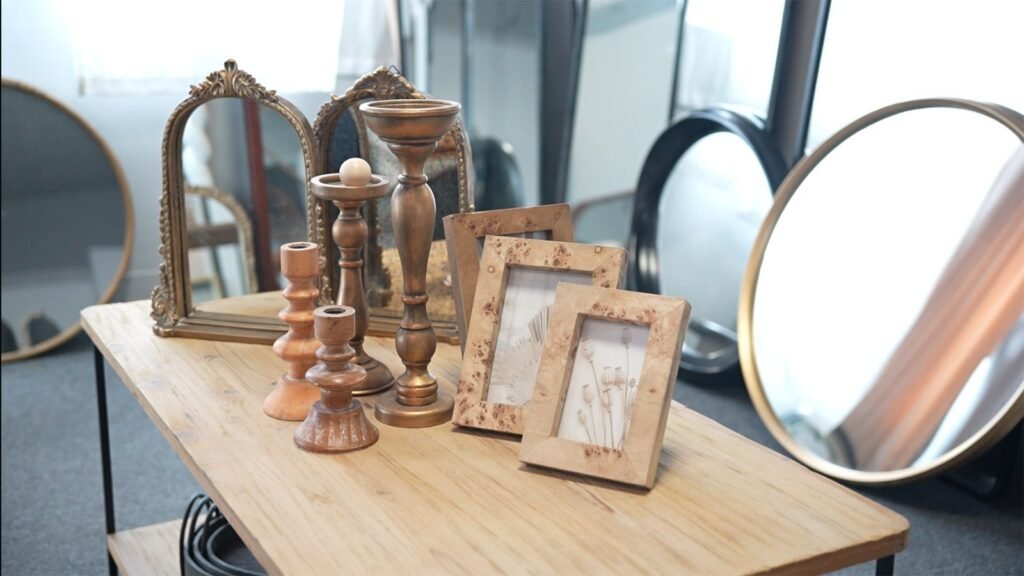
- compact mirrors
- decorative baskets
- small cabinets
- lidded boxes
- poufs with hidden storage
- narrow hallway furniture
- decorative storage for living rooms
The important point is this: a small home product must be easy to explain.
If the customer needs a five-minute speech to understand the product, the product is not clever. It is just difficult.
“Small ottoman with hidden storage for blankets.” Good.
“Multi-sensory modular lifestyle cube for adaptive emotional interiors.” No. Please put it back.
Why German buyers should care about easy to explain home decor
German retail customers are usually practical. They may like style, but they still want to know what the object does.
That is why easy to explain home decor matters so much.
A product should answer quickly:
- Where does it go?
- What problem does it solve?
- What does it hold?
- What room does it improve?
- Why is it better than another small thing?
For example:
| Product | Weak Explanation | Strong Explanation |
|---|---|---|
| Small ottoman | “Trendy soft cube” | “Compact seat with hidden storage for living rooms and bedrooms” |
| Slim mirror | “Elegant wall mirror” | “Narrow hallway mirror that opens up small spaces” |
| Decorative basket | “Natural woven accent” | “Soft storage for throws, toys, and everyday clutter” |
| Small bench | “Modern upholstered bench” | “Entryway seat with storage-friendly proportions” |
German buyers do not need louder products. They need clearer products.
A product that explains itself sells faster, trains staff faster, photographs better, and creates fewer awkward conversations in store.
Decorative storage for living rooms: the quiet bestseller category
Decorative storage for living rooms is not glamorous in the usual design-magazine sense. It will not stand dramatically in a marble hallway wearing sunglasses.
But commercially, it is strong.
Why?
Because every living room has clutter. Even the minimalist ones. Especially the minimalist ones. They are just better at hiding it before guests arrive.
Decorative storage can include:
- lidded fabric ottomans
- upholstered storage benches
- woven baskets
- ceramic boxes
- wooden trays
- nesting containers
- small storage stools
- low decorative cabinets
The best pieces look decorative enough to stay visible but functional enough to justify the purchase.
That balance is important. If a storage product looks too functional, it becomes boring. If it looks too decorative, it becomes useless. The buyer’s sweet spot is in the middle: attractive, practical, repeatable.
Ottoman or storage box: which small piece deserves the shelf?
Ottomans and storage boxes often compete for the same small-space budget. But they do different jobs.
| Buyer Question | Ottoman | Decorative Storage Box |
|---|---|---|
| Main function | Seating + comfort + storage | Storage + styling |
| Best room | Living room, bedroom, hallway | Living room, shelf, console, bedroom |
| Price potential | Medium to higher | Low to medium |
| Visual impact | Stronger | Smaller but flexible |
| Reorder potential | Good if fabric and size are stable | Good if finish and packing are stable |
| Risk | Fabric quality, stitching, structure | Finish defects, weak lid, cheap look |
| Best use | Hero small furniture SKU | Add-on or shelf logic SKU |
For a German assortment, the answer is usually not “choose one”. The better answer is: build a small-space story.
A storage ottoman can be the hero piece.
A matching tray, basket, or decorative box can complete the room logic.
A slim mirror can open the space visually.
That is how a buyer turns three separate products into one small home solutions offer.
Project sourcing and delivery: where small furniture becomes serious
Small products often look easy. That is the trap.
A large cabinet looks complicated, so everyone pays attention. A small ottoman looks simple, so people relax. Then the fabric colour shifts, the lid does not close properly, the foam collapses, the box arrives damaged, and suddenly this “simple” product is having a full personality crisis.
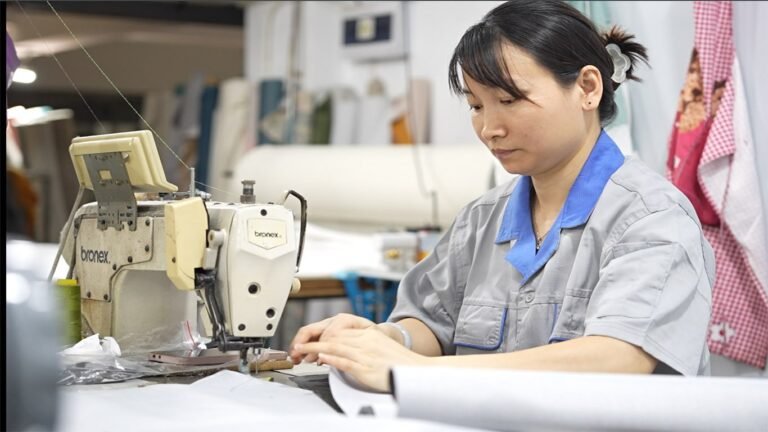
For project sourcing and delivery, small furniture needs proper control:
- confirmed dimensions
- stable material sourcing
- clear colour approval
- packaging testing
- carton size planning
- reorder consistency
- realistic lead time
- clear production notes
- export-ready documentation
Small does not mean low-risk. It just means the problems arrive in a smaller carton.
Why reorder stability matters more than a dramatic first sample
A beautiful first sample is nice. But German buyers should ask a more boring and more profitable question:
Can the supplier make it again?
That is where a reorder stability manufacturer becomes valuable.
For small home solutions, reorder stability means:
- the same fabric can be sourced again
- the same frame colour can be repeated
- the same size tolerance can be controlled
- the same packaging protection can be used
- the same product logic can support future colours or materials
A supplier who can produce one attractive sample is useful.
A supplier who can help you repeat, adjust, and extend that product into a stable retail programme is much more useful.
The first sample gets attention.
The reorder makes the business.
Very unromantic. Very German. Also very true.
Factory direct pricing home decor: useful, but not magic
Factory direct pricing home decor is attractive for obvious reasons. Buyers want better margin, more control, and fewer unnecessary layers.
But factory direct does not automatically mean good value.
A cheap product can still be expensive if it causes:
- high damage rate
- poor repeat quality
- slow communication
- unstable materials
- weak packaging
- unclear specifications
- missed delivery windows
- confused product positioning
Factory direct pricing works best when the supplier also understands buyer logic.
The question is not only:
“How much is this ottoman?”
The better question is:
“Can this ottoman support our margin, our delivery plan, our repeat orders, and our customer promise?”
That is a much better conversation. Less exciting than shouting “best price!”, but far more useful.
Teruier’s merchant profit solution: small products, clearer margin logic
For this article, let us use Teruier’s “merchant profit solution” as the working lens.
The idea is simple: a product should not only look good in a catalogue. It should help the merchant earn money with less confusion.
For small home solutions, that means Teruier looks at the product from several angles:
- Retail role
Is this a hero SKU, add-on SKU, seasonal SKU, or reorder SKU? - Room logic
Does it solve hallway, living room, bedroom, storage, or styling needs? - Material logic
Is the fabric, wood, metal, mirror frame, or surface finish suitable for repeated orders? - Price ladder
Can the assortment include entry, mid, and stronger-margin items? - Delivery logic
Can packaging and production support project sourcing and delivery without surprises? - Repeat logic
Can the product become a stable programme instead of a one-time experiment?
This is where small furniture becomes a profit system, not just a trend reaction.
A storage ottoman is not only a stool.
A slim mirror is not only a mirror.
A decorative storage box is not only a box.
In a good assortment, each piece has a job.
Small space assortment planning: build by room, not by product type
One common mistake in small furniture buying is building by category only.
Ottomans here.
Mirrors there.
Storage boxes somewhere else.
Then everyone wonders why the assortment feels disconnected.
For small space assortment planning, it is better to build by room problem.
| Room Problem | Product Solution | Commercial Logic |
|---|---|---|
| Narrow hallway | slim mirror + small bench + basket | Makes entryway usable and visually open |
| Small living room | storage ottoman + tray + decorative box | Adds seating, storage, and styling |
| Compact bedroom | small bench + full-length mirror | Creates dressing function without large furniture |
| Rental flat | lightweight pieces + soft storage | Easy to move, easy to explain |
| Family clutter | baskets + storage poufs | Practical, repeatable, broad customer appeal |
This helps the buyer sell a complete idea, not just a product.
A customer rarely says, “I need a 42 cm upholstered cube with beige woven fabric.”
The customer says, “My living room is small and messy.”
That is the buying moment.
Comparison: trend-led SKU vs reorder-friendly SKU
Not every product should be designed to be a long-term classic. Some products are there to catch a trend. But the buyer should know which is which.
| Type | Trend-Led SKU | Reorder-Friendly SKU |
|---|---|---|
| Purpose | Create freshness | Build stable sales |
| Design | More distinctive | More neutral and flexible |
| Risk | Faster fatigue | Less excitement |
| Best examples | shaped ottoman, novelty mirror, strong colour box | neutral storage ottoman, slim mirror, woven basket |
| Buying advice | Test carefully | Build into core range |
| Supplier need | Fast sampling | Stable production and repeat materials |
A smart small home programme needs both.
Too many trend-led pieces and the assortment becomes noisy.
Too many safe pieces and it becomes furniture oatmeal.
Nobody wants furniture oatmeal.
FAQ
What are small home solutions?
Small home solutions are compact furniture and décor products that help customers use limited space better. They include storage ottomans, slim mirrors, small benches, baskets, nesting tables, and decorative storage for living rooms.
Why are small home solutions important for German buyers?
They fit the reality of apartment living, rental homes, compact rooms, and practical customers. For German merchants, they also offer good opportunities for repeatable, easy to explain home decor.
What makes decorative storage for living rooms commercially useful?
It solves a common customer problem: visible clutter. A good decorative storage product combines function and style, making it easier to sell than purely decorative items.
How should buyers compare small furniture suppliers?
Buyers should compare material stability, sample accuracy, packaging quality, reorder ability, delivery reliability, and communication clarity before comparing price. The cheapest supplier is not always the most profitable one.
Why does reorder stability matter?
Because one good sample does not build a business. Reorder stability allows buyers to repeat successful products, extend colours, control quality, and protect margin over time.
Is factory direct pricing home decor always better?
Factory direct pricing can improve margin, but only when the supplier also manages quality, packaging, delivery, and repeat production well. Low price without control is not value. It is just future trouble wearing a discount label.
Which small furniture products are best for storage and organization?
Storage ottomans, upholstered benches, woven baskets, decorative boxes, nesting trays, and compact cabinets are strong options. The best choices depend on room use, price point, and how clearly the product explains itself.
Final thought: small furniture should make the room work harder
Small furniture trends are not about making homes look crowded with tiny things.
They are about helping customers use space better.
For German buyers, the winning small home solutions will be practical, clear, repeatable, and margin-friendly. Storage ottomans, decorative boxes, slim mirrors, and compact benches can all work — but only when they are planned as part of a room solution, not thrown into a range like decorative confetti.
Small furniture may be small.
The business logic behind it should not be.