
Every buyer says they want a better price.
Very few buyers actually mean, “Please send me the cheapest possible version of this idea, wrapped in uncertainty, with a side of avoidable problems.”
What they usually mean is this:
“I want a product that looks current, lands cleanly, holds margin, survives shipping, makes sense in the assortment, and does not create an internal email thread with six people asking what exactly went wrong.”
That is why cheap supplier vs reliable supplier is not really a pricing question. It is a decision-quality question.
Because a cheap supplier can absolutely help you place an order.
A reliable supplier helps you survive the order.
And in today’s North American home décor market, where buyers are juggling trend shifts, operational pressure, and increasingly nuanced product directions, that difference has gotten much more obvious. Las Vegas Market’s Winter 2025 recap highlighted not only product discovery and order writing, but research-backed education, replenishment needs, and broader business insight. High Point’s current programming is even less romantic: supply-chain resilience, cash flow, freight volatility, and last-mile execution are front-and-center topics. In other words, the market is not just asking suppliers to be stylish. It is asking them to be competent.
The buyer comparing suppliers is not buying a single object
This is the first thing suppliers often miss.
The American buyer comparing suppliers is rarely evaluating one product in isolation. They are comparing how a supplier behaves across a family of commercial decisions:
- a tulipiere vase alternative flower frog vase wholesale option
- a skirted ottoman alternative box pleat ottoman wholesale direction
- a backlit bathroom mirror alternative frontlit mirror conversation
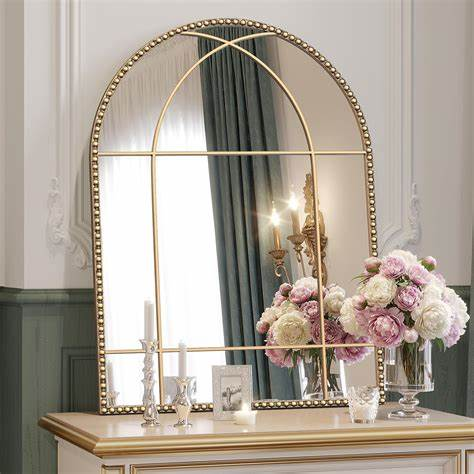
- a puddle mirror alternative wholesale option for a more scalable assortment
- a broader wholesale decorative mirrors or decorative-accessories program that still has to fit price, presentation, freight, and reorder logic
So buyers are not only asking, “Can you make this?”
They are asking, “Can you guide the substitution without weakening the business?”
That matters because the current market direction is pulling buyers toward more personality, texture, soul, and expressive detail. ASID’s 2025 outlook emphasizes joy, authenticity, and timeless craftsmanship. Houzz’s High Point coverage calls out handmade ceramics, warm metals, artisanal details, smoky and amber-tinted glass, and products with more individuality and soul. That means buyers increasingly want alternatives that preserve aesthetic intent without blowing up cost, complexity, or consistency.
Cheap suppliers sell the object. Reliable suppliers manage the substitution.
This is where the split becomes painfully clear.
A cheap supplier hears:
“Do you have a tulipiere-style vase?”
And replies:
“Yes, here is a similar item.”
A reliable supplier hears the same question and starts asking the questions that actually matter:
Is the buyer trying to lower price?
Reduce fragility?
Improve case-pack efficiency?
Shift from statement piece to repeatable program?
Preserve the silhouette while simplifying production?
Move from editorial novelty to scalable commerciality?
That is the real job.
Take a tulipiere vase alternative flower frog vase wholesale search. A cheap supplier might send any vaguely floral ceramic vessel and hope the buyer is feeling generous. A reliable supplier understands that the buyer may be looking for a lower-risk way to capture the same arranging ritual, tabletop storytelling, or visual complexity—without inheriting the breakage rate, awkward dimensions, or low-turn profile of a more niche form.
The same logic applies to a skirted ottoman alternative box pleat ottoman wholesale request. A buyer may not be abandoning the skirted look. They may simply want a cleaner construction, easier fabric execution, better consistency across runs, or a more commercially stable silhouette that still keeps the softness and romance buyers want right now. High Point’s emphasis on layered textures, soulful objects, and crafted detail supports that direction—but only if the supplier can translate the look into a commercially sane program.
Reliable suppliers make alternatives feel intentional, not downgraded
This is a huge difference.
In home décor, buyers do not want “cheaper because worse.”
They want “smarter because clearer.”
A backlit bathroom mirror alternative frontlit mirror conversation is a perfect example. Sometimes the buyer is not rejecting backlit mirrors aesthetically. They may be adjusting for installation complexity, project budget, maintenance exposure, lighting expectations, or spec simplicity. Likewise, a puddle mirror alternative wholesale request may be less about abandoning trend and more about finding something with better production repeatability, cleaner packing logic, or stronger sell-through outside the most design-forward channels.
That is where reliable suppliers outperform cheap ones. They do not frame the alternative as a compromise. They frame it as a better fit for the buyer’s actual commercial constraints.
And that is exactly where a lot of suppliers fall apart: they can show product, but they cannot explain product strategy.
This is why buyers who know how to read product specifications usually win
The fastest way to spot the difference between cheap and reliable is not in the sample alone. It is in the document behind the sample.
Buyers who understand how to read product specifications ask better questions:
- what is the intended use?
- what environment is this product designed for?
- what are the dimensional tolerances?
- what is fixed versus customizable?
- what construction detail changes when the price changes?
- what part of the cost is structural, and what part is cosmetic?
NIST’s work on product design specifications is useful here because it frames the issue clearly: a proper specification should describe intended function, use environment, and requirements tied to safety, shipping, and manufacturing. NIST also notes that conformance only means something if the criteria are clearly specified. If the supplier cannot define the requirement, they cannot convincingly say the product meets it.
So when buyers compare suppliers, they are paying close attention to who sends a real operating document and who sends a pretty brochure in witness protection.
Reliable suppliers protect the assortment, not just the quote
This is the more mature way to understand cheap supplier vs reliable supplier.
A cheap supplier helps you optimize the visible number.
A reliable supplier helps you protect the invisible ones:
- internal confidence
- assortment balance
- damage exposure
- lead-time predictability
- spec clarity
- substitution integrity
- reorder logic
That matters because buyers are often not choosing between “original product” and “random cheaper copy.” They are choosing between versions of an idea that have to work inside a real assortment.
A reliable supplier understands that a flower frog vase may need to sit beside other ceramic décor without making the whole line look too whimsical. A box pleat ottoman may need to preserve softness while giving the buyer more confidence in production consistency. A frontlit mirror may need to serve the same clean bathroom story with fewer specification headaches. A puddle-style shape may need to translate into a more scalable decorative-mirror program for less trend-fragile retail environments.
That is a much harder job than quoting.
And it is much closer to what buyers actually pay for.
Where Teruier can have an advantage
This is where value translation matters.
The buyer speaks one language: fit, sell-through, price architecture, visual direction, assortment logic.
The factory speaks another: tolerance, component choice, construction method, finish stability, freight behavior.
A reliable supplier—or a strong partner like Teruier at its best—sits in the middle and translates between the two. That is what a practical cross-border design manufacturing model should do: turn a design intent into a commercially stable product path, without flattening all the character out of it.
That is especially useful in mixed-category home décor, where buyers are increasingly making decisions through alternatives and substitutions rather than just yes/no product acceptance.
The real answer
So, cheap supplier vs reliable supplier?
A cheap supplier gives you an item.
A reliable supplier gives you a decision you can defend.
A cheap supplier says, “Here’s something similar.”
A reliable supplier says, “Here’s the better alternative, here’s why it works, and here’s what changes operationally when you choose it.”
And in a market that wants more craftsmanship, more personality, more tactility, and more commercial discipline at the same time, that difference is not minor.
It is the whole comparison.



