
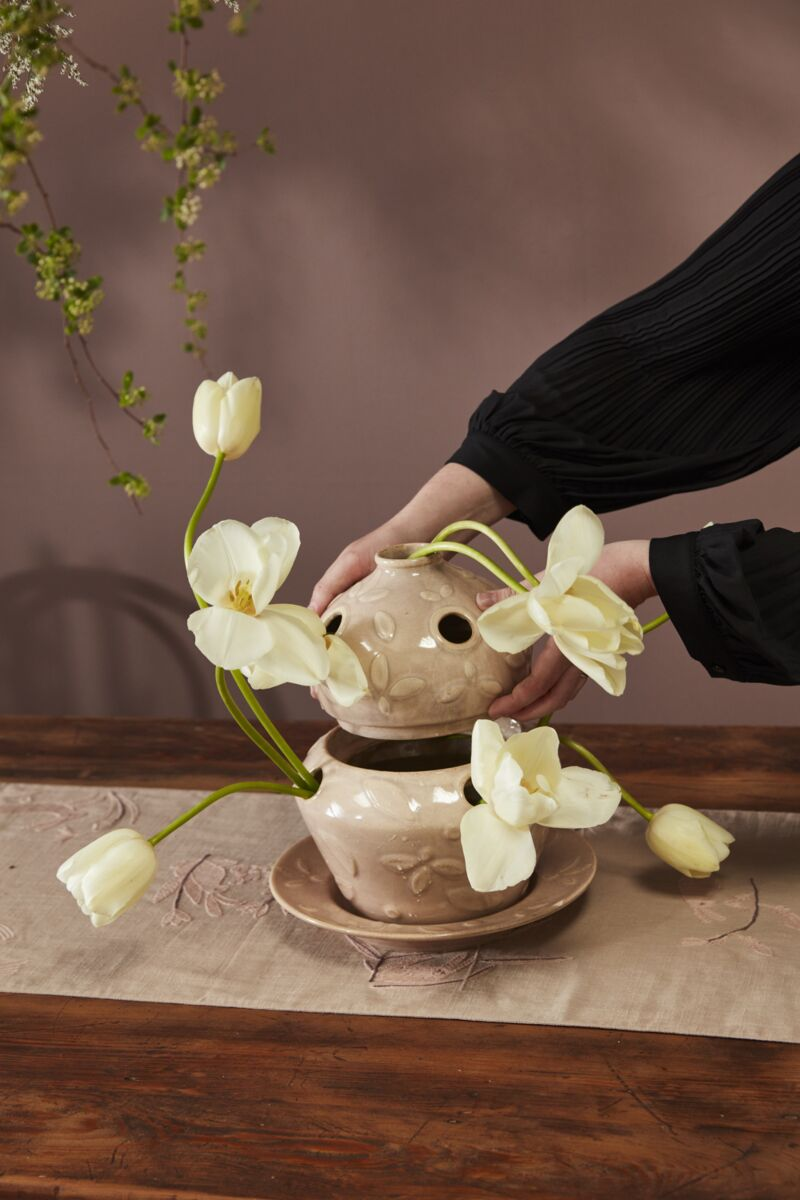
Let us begin with a mildly impolite truth.
The classic tulipière is beautiful.
It is also, from a wholesale perspective, a little dramatic.
Wonderful on a museum pedestal. Wonderful in an editorial shoot. Slightly less wonderful when a buyer has to think about price point, breakage risk, carton efficiency, repeat order logic, and whether customers actually want to arrange flowers without needing a small degree in decorative arts.
That is exactly why the market is opening up for a better category:
tulipiere vase alternative flower frog vase wholesale.
And no, this does not mean making the product more boring. It means making the product more useful, more shoppable, and frankly more intelligent.
Historically, the appeal of the tulipière was always this tension between fantasy and function. Major museum and art sources describe historic tulip vases and flower pyramids as objects that sat between decoration and utility: they held flowers, yes, but they were also visual theatre. Flower frogs, by contrast, became popular because they solved a practical arranging problem: stems could be held at multiple angles, with better support and access to water, instead of standing upright like nervous little soldiers. That functional logic is still excellent today. It simply deserves better ceramic design.
So here is the launch:
Teruier’s tulipiere vase alternative flower frog vase wholesale program is not a copy of antique tulipières. It is a commercial reinterpretation of the same core idea:
structured flower arranging,
multiple stem positions,
sculptural presence,
and a stronger fit for today’s retail shelves.
In plain language, this is what the program is:
a family of ceramic vases that keep the charm of the tulipière and the practicality of the flower frog, but simplify the form for modern production, modern pricing, and modern buying.
That matters because the current European retail direction is very favourable to exactly this kind of object. For 2026, Messe Frankfurt’s retail guidance highlights sculptural vases, artisan ceramics, warm earthy tones, tablescaping, year-round decorative concepts, and assortment planning built around re-staging and reorders. Maison&Objet’s 2026 direction also leans into meaningful design, craftsmanship, and forms that feel rooted rather than disposable. This is not a season for anonymous filler décor. It is a season for pieces with a story and a job.
And that is where the buyer profile becomes clear.
This article is for the German home chain buyer who does not want another generic vase with a fashionable glaze and no retail brain behind it. The right buyer here is curating for tabletop, gifting, kitchen styling, window displays, spring refreshes, hospitality corners, and “small luxury” price bands. They want a product that feels collected, a little witty, a little historical, and still easy enough to sell in volume.
Teruier’s answer is built as a collection, not a one-off.
At the core sits the flower frog vase itself: a stable ceramic body with an integrated multi-opening top or pierced ceramic insert that helps separate stems, hold shape, and create a more intentional arrangement. Compared with an old-school stacked tulipière, this format is easier to pack, easier to price, easier to explain on shelf, and easier for end customers to use without turning flower arranging into a personality test.
Then come the supporting style directions.
A terracotta vase version for warmer, quieter interiors and earthy spring merchandising.
A wabi sabi ceramic vase version for matte surfaces, softer silhouettes, and imperfect handmade appeal.
A brighter majolica ceramic decor expression for buyers who want colour, gloss, and decorative confidence rather than shy beige apology.
And then the playful fruit capsule: tomato vase, lemon vase, and pear ceramic vase variations that tap directly into the Mediterranean, tablescape, and food-themed styling wave already visible in European retail inspiration.
Importantly, these are not random novelty shapes thrown into a carton and called a collection. They each answer different channel needs.
The terracotta and wabi-sabi directions work for slower, calmer, natural-material stories.
The majolica line works for expressive gift and decorative tabletop zones.
The tomato, lemon, and pear pieces work for seasonal windows, spring/summer launches, kitchen décor, and impulse-friendly gifting.
Messe Frankfurt’s retail inspiration has already been pushing exactly this logic: sculptural vases, handmade ceramic character, mix-and-match table stories, and Mediterranean colour/fruit motifs that help retailers turn a display into a mood rather than a pile of objects.
Now to the part buyers actually need.
What problem does this solve?
It solves the old gap between “historical decorative object” and “commercial ceramic assortment.”
A classic tulipière often has three wholesale problems:
too niche in form,
too fragile in structure,
and too difficult to ladder into multiple price bands.
A tulipiere vase alternative flower frog vase wholesale program fixes that by simplifying the architecture while preserving the emotional hook.
Instead of a tall stacked tower with multiple break points, you get:
a lower centre of gravity,
fewer structural weak points,
simpler glazing workflow,
easier packing,
and broader shelf usability.
Instead of one ornate historical reference, you get a family:
hero arrangement piece,
quieter commercial core,
colour capsule,
seasonal fruit accent.
That is not only better design. It is better buying.
Here is the kind of Teruier selection case this was made for.
An illustrative assortment model, based on common chain-retail constraints:
A German home décor buyer wanted the romance of the tulipière, but not a product that looked too antique, too expensive, or too fussy for a modern shelf. They needed one object family that could serve spring flowers, all-year tabletop styling, gifting, and summer Mediterranean merchandising.
Teruier translated that brief into a four-part capsule:
one core flower frog vase for the main volume,
one terracotta vase for calm natural interiors,
one majolica ceramic decor piece for colour-led display,
and one fruit-led accent family using tomato vase, lemon vase, and pear ceramic vase ideas for seasonal lift.
The commercial logic was structured simply:
one historical story,
four display moods,
multiple price entrances,
one cleaner reorder path.
In the buying model, the opening order was not loaded entirely onto the most playful fruit pieces. The higher share stayed with the more versatile core flower frog forms, while the fruit-led SKUs worked as visual magnets and seasonal add-ons. That is the sort of split good buyers like: enough excitement to stop traffic, enough commercial discipline to avoid markdown theatre later.
And this is where Teruier’s real value sits.
Not merely in making ceramic objects.
In doing value translation.
Taking a category with historical charm and translating it into:
clearer assortment roles,
clearer style families,
clearer seasonal logic,
clearer retail placement,
and clearer reasons to reorder.
So when a buyer searches tulipiere vase alternative flower frog vase wholesale, what they should really want is not “something vaguely similar.”
They should want this:
A ceramic collection that keeps the floral-structuring beauty of the tulipière, borrows the practical intelligence of the flower frog, and fits today’s retail trends in artisan ceramics, tablescaping, Mediterranean storytelling, and statement-but-usable décor.
That is a much better sentence for a website.
It is also a much better basis for a PO.
Because the future of this category is not “museum replica for everyone.”
It is smart, shelf-ready floral ceramics with story, utility, and a sense of humour.
And frankly, that is much easier to sell than a 17th-century flower tower having an identity crisis on an endcap.



