
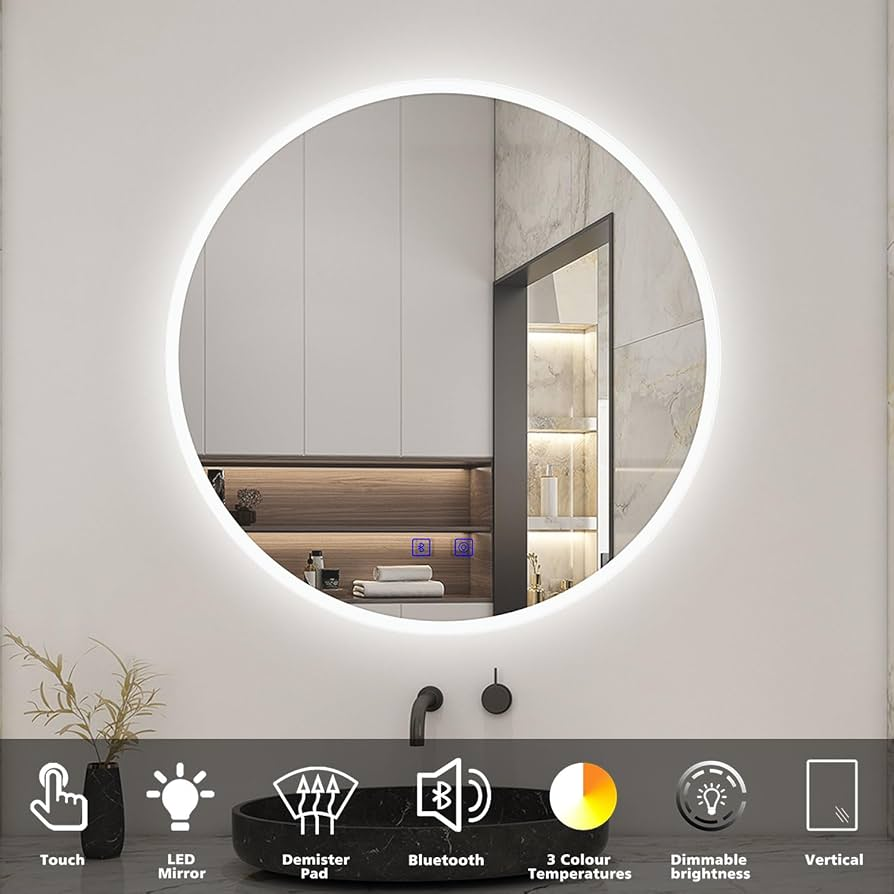
Here is the problem with too many LED bathroom mirrors on the market: they glow beautifully in the photo, then turn into a sourcing migraine the moment a real buyer asks a real question.
What is the LED mirror IP44 specification?
Is it actually suitable for the intended bathroom zone?
Does the spec sheet show anti-fog load, heating pad coverage, input voltage, wattage, and CCT?
And, perhaps my personal favorite, is the safety mark real—or just printed there with remarkable confidence?
That last point is not theoretical. In October 2024, UL Solutions published a public notice warning that certain LED illuminated bathroom mirrors were bearing an unauthorized UL Certification Mark, and the listed example even showed “IP44” on the product label. That is exactly why experienced buyers do not stop at pretty lighting or one nice sample. They verify the paperwork.
So let’s make this simpler.
What Teruier is really launching here is not “another lighted mirror.”
It is a buyer-readable LED mirror program built around one very boring, very profitable idea: specification clarity.
Because IP44 is not decoration. It is part of the buying logic.
The IEC is the body behind the IP rating system for enclosures. In practical buying terms, IP44 means protection against solid objects larger than 1 mm and splashing water from any direction. It is useful for many bathroom applications, but it is not the same thing as resistance to direct water jets or immersion. And in North American installation language, UL’s luminaire guidance is equally plain: only products marked Suitable for Damp Locations or Suitable for Wet Locations are intended for those environments.
That is the old buying problem Teruier is trying to fix.
Too many factories sell LED mirrors like décor products.
Serious buyers have to buy them like electrical products.
Those are not the same conversation.
A buyer-ready LED mirror IP44 specification should not hide behind adjectives like “premium,” “luxury,” or my least favorite word in trade copy, “elegant.” It should answer measurable questions fast:
- Input voltage for the target market, typically 110–120V for U.S. residential-facing programs
- Output wattage and driver type
- CCT options, whether fixed or tunable
- Defogger wattage and heating pad coverage
- IP rating and damp/wet location marking as applicable
- Mounting orientation, edge treatment, and switch/sensor logic
- Mirror thickness, safety backing, and carton protection
That is how buyers move from admiration to PO.
And yes, design still matters. High Point Market lighting coverage from late 2025 showed three relevant directions at once: tunable technology, soft ambient illumination, and antique-inspired styles. Translation for buyers: customers want lighting that feels better, works harder, and still looks like it belongs in a designed room—not a dentist’s ceiling panel with ambition.
That is why Teruier’s LED program is not trapped in one look.
For buyers comparing a backlit bathroom mirror alternative frontlit mirror, the choice is not “which one is prettier?” The real question is what kind of light the room needs.
A backlit mirror usually wins when the goal is softer ambience, hotel-style glow, and cleaner visual drama.
A frontlit mirror often wins when the user actually needs facial illumination that is more direct and less flattering in the suspicious way.
In other words: backlit is mood. Frontlit is honesty.
The stronger commercial program gives buyers both.
A representative Teruier selection-agent case for a U.S. home-and-bath buyer started with a familiar complaint:
“We keep seeing LED mirrors with vague specs, random brightness, and anti-fog claims that sound more spiritual than technical.”
So the assortment was rebuilt into a tighter three-SKU structure:
- 24″ x 32″ frontlit vanity mirror for everyday bath retail
- 30″ x 40″ backlit LED mirror for premium remodel programs
- 36″ x 48″ soft-edge LED mirror with integrated defogger for hospitality-lite and apartment packages
What changed was not only the shape. It was the sheet.
The buyer reviewed one clean spec pack covering LED mirror IP rating, voltage, wattage, CCT, sensor logic, dimming path, and anti-fog bathroom mirror defogger wattage heating pad size. Instead of asking “does it have anti-fog,” the sheet answered the smarter question: how much of the mirror area is heated, what is the pad size, and what is the watt draw. That is the difference between a product story and a sourcing tool.
And because buyers do not buy bathrooms in isolation anymore, the program also left room for adjacent wall categories. In some retail mixes, the LED mirror collection sits next to a wavy wall mirror alternative supplier story for decorative zones, or an antiqued mirror alternative distressed mirror assortment for drier, warmer spaces where mood matters more than task lighting. Same supplier conversation, different room logic.
That is the larger point.
Teruier’s advantage is not just manufacturing. It is value translation—turning design intent, electrical requirements, packaging, and U.S. buyer concerns into one understandable program. That matters even more in bathrooms, where the line between “nice product” and “expensive callback” is surprisingly thin.
So here is the short version.
If you are sourcing by the keyword LED mirror IP44 specification, do not settle for a mirror that merely says IP44 on a label. Ask what the rating means, where the product can be installed, whether the damp-location language is clear, whether the anti-fog spec is actually quantified, and whether the light output suits the channel you are buying for.
Because once the glow turns on, the guessing should already be over.



