Why the Medicine Cabinet Mirror Is Quietly Becoming One of the Smartest Bathroom SKUs
Some bathroom products sell by style.
A great medicine cabinet mirror sells by reducing friction.
That is why I think this category deserves more respect from U.S. retail buyers in 2026. On paper, it looks ordinary: mirror outside, storage inside. But from a chain-store buyer’s perspective, it solves three problems at once. It gives the customer a grooming mirror, hidden storage, and a cleaner visual line at the sink. In a market that is rewarding softness, comfort, and more thoughtful room function, that combination is stronger than it first appears. Las Vegas Market’s 2026 Market Snapshot highlighted themes such as Restorative Softness and Symbols & Shapes, pointing buyers toward soft forms, sculptural accents, carved details, and more dimensional home product language.
The buyer behind this keyword is not shopping for a basic bathroom box
The person searching medicine cabinet mirror is usually not a casual consumer. More often, it is a home chain buyer, bath-category manager, sourcing lead, or merchant trying to find a product that is practical enough for volume but upgraded enough for today’s customer. That lines up with what Atlanta Market reported in January 2026: strong order writing, higher buyer satisfaction, a 5% increase in stores attending, and a 15% increase in first-time buyers, with independent retailers, national chains, designers, and buying groups all actively sourcing across categories.
That matters because the modern buyer is no longer treating bath as a purely utility category. They are looking for products that sit between function and design. A medicine cabinet mirror fits that need well because it can be sold as storage, space-efficiency, and bathroom refinement in one SKU. That conclusion is an inference from the market’s documented cross-category buying energy and the product’s dual-purpose format.
Why this category is stronger now
One of the clearest reasons is simple: American homes still struggle with too much stuff. UCLA’s Center on Everyday Lives of Families found that contemporary U.S. homes contain a staggering number of possessions, with everyday objects spilling into multiple spaces and functions around the house. That research matters for bathroom merchandising because the medicine cabinet mirror is, at its best, a very efficient clutter-control product. It keeps daily-use items close to the sink while hiding them from the visual field.
That hidden-storage function is not a small benefit. It is part of how a bathroom shifts from feeling messy to feeling finished. And in retail terms, that means the medicine cabinet mirror is not just a hardware item. It is a visual-order item. That is one reason it can outperform more decorative but less useful bathroom accessories. The clutter premise is directly supported by UCLA; the sell-through implication is my buying inference.
The academic case is stronger than many buyers realize
This category also has a real ergonomic argument behind it. A Virginia Tech study on supportive bathroom features notes that a large bathroom mirror is important for grooming and viewing oneself, and it specifically argues that medications should be stored in a convenient location, within easy reach, and out of sight. The same study says the ideal location for a medicine cabinet is adjacent to the sink so reaching and leaning are minimized.
That is a powerful point for buyers. A well-developed medicine cabinet mirror is not only about hiding toiletries. It can also improve the everyday use sequence at the sink. Good grooming visibility, better reach, and cleaner storage placement all make the product more meaningful than a standard wall mirror with nowhere to put anything.
Why the 2026 market makes this even more relevant
The 2026 home market is rewarding products that feel calmer, more dimensional, and more complete. Las Vegas Market’s official trend language around Restorative Softness and Symbols & Shapes suggests buyers are responding to pieces that bring comfort, form, and sculptural depth into the home. That trend does not apply only to living rooms. It changes how bath products are judged too. A bathroom mirror now has to work as both a useful object and part of a more elevated room story.
That is exactly why the category can now stretch upward. A basic cabinet mirror may remain volume-friendly, but the more developed version can borrow cues from a backlit bathroom mirror, a bronze tinted mirror, or even a moodier smoked mirror direction. Those extensions help the product feel less clinical and more retail-ready. This is a merchandising inference built from the documented trend direction toward softness, form, and layered detail.
What the selection intelligence would say
Our selection intelligence would make one point very quickly:
Do not buy the medicine cabinet mirror because it looks neat when closed.
A weak version is easy to approve from the front view. A strong version is much harder to build well.
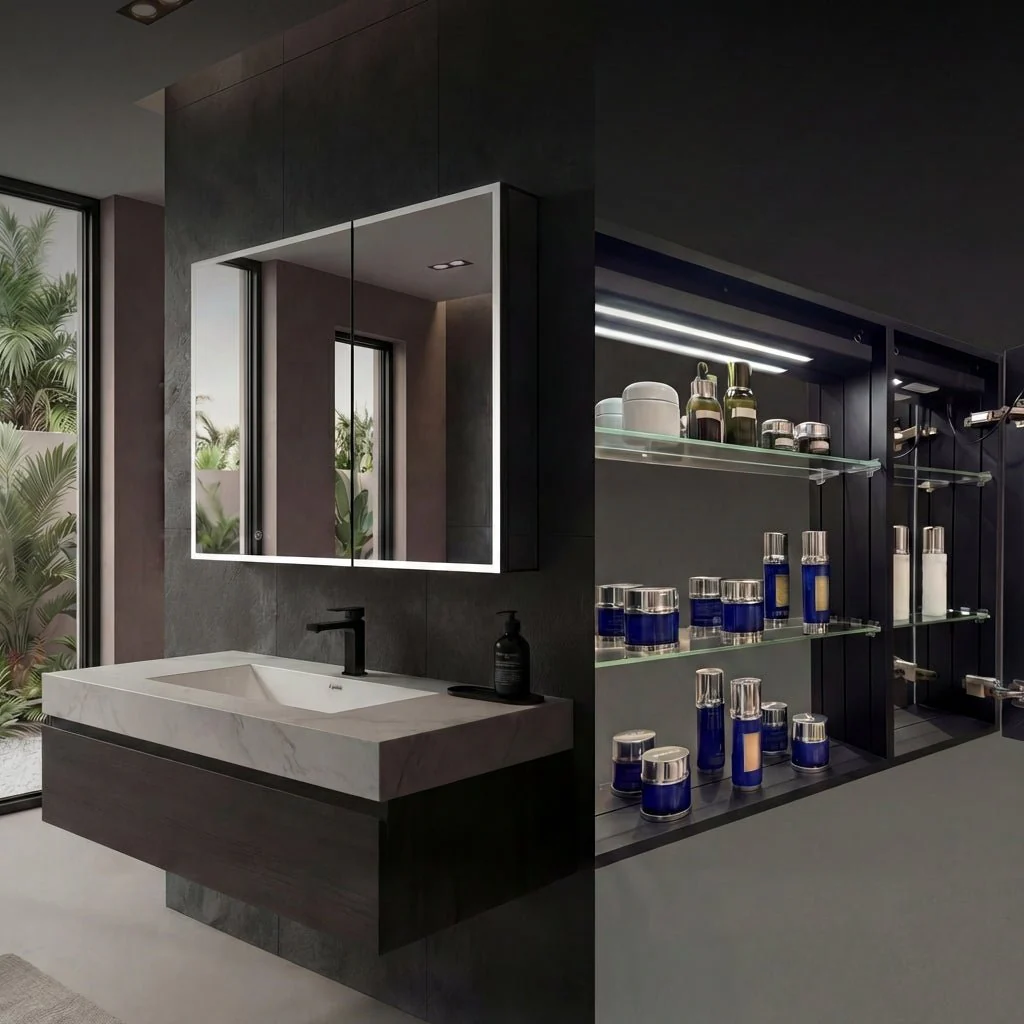
A strong version gets five things right at once. The mirror looks good closed. The storage is genuinely usable. The door action feels stable. The inside layout makes sense. And the cabinet still feels like a designed product, not only a utility box. That is where small details matter: shelf spacing, interior visibility, edge treatment, and even a simple hook system for lightweight bathroom tools or accessories can improve the daily-use story. The need for ergonomic reach and better grooming support is source-backed; the product-evaluation framework is my buying logic.
Why design language matters more than before
For many years, medicine cabinets were treated as something buyers had to tolerate. That is no longer enough. Today’s better programs borrow language from decorative mirrors. A framed medicine cabinet can feel warmer. A softened edge can feel more architectural. A more atmospheric finish can help the cabinet belong in a higher-end bath story rather than reading as a purely practical insert.
This is where design leadership matters. Programs influenced by European American designers often succeed because they know how to translate utility into a calmer visual language. And when that design thinking is connected to an artisan supply chain, the result can feel much more intentional than the category’s old reputation suggests. That design conclusion is my inference, but it aligns with Las Vegas Market’s documented emphasis on sculptural accents, carved details, and dimensional form.
Where Teruier’s value translation matters
This is exactly where Teruier’s value translation becomes useful.
A buyer does not simply need a factory that can make a box with a mirrored door. A buyer needs a partner who can translate a market signal into a commercially correct product. That means asking better questions. Should this cabinet read clean and architectural, or warm and decorative? Should it stay minimal, or borrow from a backlit bathroom mirror language for a higher-positioned assortment? Should the finish stay clear and bright, or move toward bronze tinted mirror or smoked mirror cues for a more boutique look?
That translation work is where the real product value gets created. The product is not just storage. It becomes a better-organized, better-looking bathroom solution that a retailer can actually build a program around. The consumer-need logic is supported by UCLA and Virginia Tech; the sourcing and positioning conclusion is my merchandising inference.
What I would actually look for in 2026
If I were editing a 2026 assortment for a U.S. chain, I would not treat the medicine cabinet mirror as a builder-grade necessity.
I would treat it as a quiet upgrade category.
The strongest version would have clean proportions, usable interior planning, a stable door mechanism, and a finish language that lets it sit comfortably between function and design. For opening-price programs, that may mean a straightforward mirrored cabinet with good internal discipline. For better-tier programs, it may mean more refined framing, atmospheric mirror tones, or selective backlit features. The reason this works now is that the market is already rewarding products that combine comfort, dimensionality, and usefulness rather than forcing buyers to choose one or the other.
Final buyer take
A lot of bathroom products are easy to understand but hard to get excited about.
The medicine cabinet mirror does not have to be one of them.
In 2026, it has a stronger retail case than many buyers give it credit for. It answers the real clutter problem documented in American homes. It supports easier grooming and more convenient reach when designed well. And it fits a market that is increasingly rewarding products with both utility and design presence.
That is why I would say it plainly:
The best medicine cabinet mirror is not just a mirror with hidden shelves.
It is one of the smartest ways to turn bathroom function into a product customers actually feel good buying.