
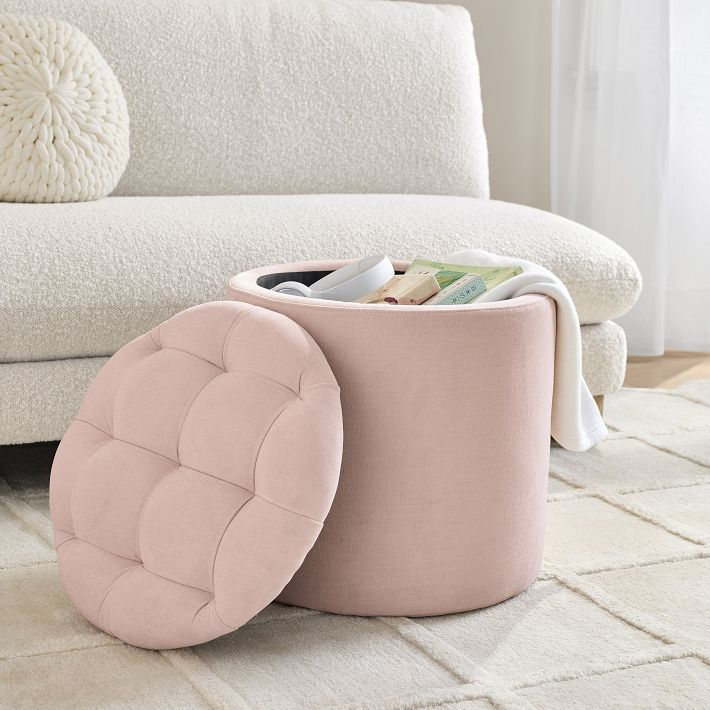
Why the Round Storage Ottoman Is the Soft Functional SKU Buyers Will Keep Reordering
Some products look attractive in a showroom for ten minutes.
A great round storage ottoman still makes sense after the freight quote, the line review, the store set, and the reorder conversation.
That is why I keep coming back to this category. On paper, it sounds simple: a seat, a lid, a hidden compartment. But from a U.S. retail buyer’s point of view, it solves a bigger problem. It softens a room visually, reduces hard edges in a layout, and adds usable storage without asking the customer to give up comfort or style. In a market that is clearly leaning toward softer forms, fuller silhouettes, and tactile upholstery, that combination is commercially strong. Las Vegas Market’s official Winter 2026 Market Snapshot highlighted “Restorative Softness,” describing the direction in terms of soft lines and forms, lush textiles, and full silhouettes.
The buyer behind this keyword is not looking for a cute accent
The person searching round storage ottoman is usually not shopping for novelty. More often, it is a furniture merchant, chain-store buyer, category manager, or sourcing lead who needs products that can work across multiple room stories and still hold up as a program. That profile matches what the U.S. trade markets are signaling now. Atlanta Market’s January 2026 edition reported strong order writing, higher buyer satisfaction, a 5% increase in stores attending, and a 15% increase in first-time buyers. Las Vegas Market also continues to position itself as a cross-category sourcing destination attracting buyers from all 50 states and more than 80 countries.
That matters because a round storage ottoman is easier to merchandise than a fragile statement accent and easier to justify than a product that only solves one task. It can work in an entry, soften a bedroom corner, sit beside a lounge chair, or act as a more casual alternative to a bed end bench. That kind of placement flexibility is exactly what serious buyers notice when they are trying to build programs rather than chase one-off samples. This is my merchandising inference based on the current trade-market emphasis on scalable sourcing and cross-category commerce.
Why round form matters now
The round silhouette is not a minor styling detail. It is part of why the category works.
A peer-reviewed study led by researchers affiliated with the University of Pennsylvania found that people judged curvilinear interior spaces as more beautiful than rectilinear ones, and the researchers also found stronger approach responses to curvilinear environments among nonexperts. That does not mean every rounded object is automatically a winner. But it does support a very practical buying idea: curved form can make interiors feel more inviting and more resolved.
That is one reason a round storage ottoman often feels easier in a room than a sharper upholstered cube or a heavier linear bench. It softens the floor plan. It creates less visual interruption. And when the broader market is already validating soft contour and fuller upholstery, roundness stops being just a decorative gesture and becomes a commercially useful one.
Storage is still one of the most underpriced emotional benefits in furniture
A lot of buyers still describe storage like it is a technical feature. Customers do not experience it that way. They experience it as relief.
A design study from the Norwegian University of Science and Technology argues that small homes require smart, space-saving furniture solutions to maintain wellbeing, and it notes that lack of space is one of the most common causes of dissatisfaction people cite about their homes. The paper also emphasizes that multifunctional furniture becomes more relevant when one piece can do more than one job without adding friction to daily life.
That is why the round storage ottoman is stronger than it first appears. You are not only selling an upholstered accent. You are selling a place to hide the throw blanket, the extra pillow, the small living-room clutter, or the overflow that makes a room feel unfinished. In retail terms, that gives the item both functional value and emotional value, which is often what separates a one-season novelty from a reorderable SKU. The wellbeing and small-space logic comes from the NTNU study; the reorder conclusion is my buying inference.
What the ottoman selection intelligence would say
Our ottoman selection intelligence would make one point immediately:
Do not buy the round storage ottoman because it looks easy.
A weak version is easy to make. A strong version is much harder.
The strong version gets five things right at once: the lid action feels smooth, the storage cavity is genuinely useful, the seat feels credible, the diameter feels balanced in the room, and the fabric direction fits the channel. A buyer comparing a round ottoman to an arched leg bench or a more formal bed end bench should not only ask which one looks more premium. The better question is which one gives the room more flexibility without adding visual weight. That is also where style extensions matter. A channel tufted ottoman can bring more decorative rhythm. A cocktail ottoman can push the story toward larger living-room use. A burnt orange velvet ottoman can tap into the current appetite for warmth, nostalgia, and expressive comfort, but it needs the right retail context. The evaluation framework here is my merchandising view, while the broader softness-and-nostalgia context is supported by official market sources.
Why the 2026 color-and-texture mood helps this category
The market is not only rewarding softness in shape. It is rewarding softness in feeling.
Las Vegas Market’s “Restorative Softness” direction clearly favors tactile materials and fuller upholstery. High Point Market’s Fall 2025 Future Snoops theme, “Club Kitsch,” frames the current mood around comfort, familiarity, retro-modern optimism, and expressive everyday living. That combination is especially useful for a category like this one. It gives buyers room to work with plush neutrals, but it also opens the door for warmer, more fashion-forward directions like a burnt orange velvet ottoman when the account can support it.
This is where a lot of buyers can make smarter decisions. Not every account needs the boldest color. But many accounts do need one softer SKU that keeps the assortment from feeling too rigid. The round storage ottoman is good at that because it can carry texture, color, and softness without becoming difficult to understand on the floor. A controlled velvet story, a channel-tufted surface, or a richer warm tone can all work, as long as the item still reads as usable and not merely decorative. This is my buying interpretation of the official trend language.
Where this SKU fits best in a retail assortment
I would not position the round storage ottoman as a throw-in accent.
I would position it as a soft functional anchor.
It is especially strong in bedrooms, apartments, smaller living rooms, entry-adjacent spaces, and family homes that need one more flexible seat without adding bulk. It can work beside a chair, replace a stricter bed end bench, or complement a larger cocktail ottoman program by giving the category a softer, more compact interpretation. For retailers trying to balance design with usability, this kind of SKU helps the assortment feel more livable, not just more stylish. The exact placement logic is my merchandising judgment, but it aligns with the official market emphasis on cross-category sourcing and soft, comfortable forms.
Why supplier choice matters more than the sample
This is where many programs fail.
The sample looks good. The rollout does not.
A good buyer knows the difference between a factory that can make one attractive prototype and a reorder-ready home decor supplier that can support consistency, packaging, scale, and replenishment. That matters even more in the current trade environment, where buyers are sourcing actively and comparing more options across categories. If the upholstery recovery changes, the lid action becomes inconsistent, or the round silhouette loses proportion in production, the very qualities that made the product attractive disappear fast. The source-backed part here is the market’s strong sourcing activity; the supplier-readiness conclusion is my commercial inference.
This is exactly where Teruier’s value translation matters. A buyer does not only need a vendor that can copy a photo. A buyer needs a partner that can translate a market signal into a retail-correct SKU: the right diameter, the right seat firmness, the right storage depth, the right upholstery hand, and the right finish story for the account. That is how a trend becomes a margin-protecting item instead of a risky sample.
Final buyer take
A lot of furniture categories still force buyers to choose between softness and utility.
The round storage ottoman does not.
That is why I think it remains one of the more commercially credible upholstered SKUs for 2026. It aligns with the official market move toward softer forms and richer textiles. It benefits from research suggesting people respond positively to curvilinear environments. It also answers the ongoing small-space pressure that makes multifunctional furniture more relevant, not less.
That is not a minor SKU.
That is the kind of SKU buyers build programs around.



