
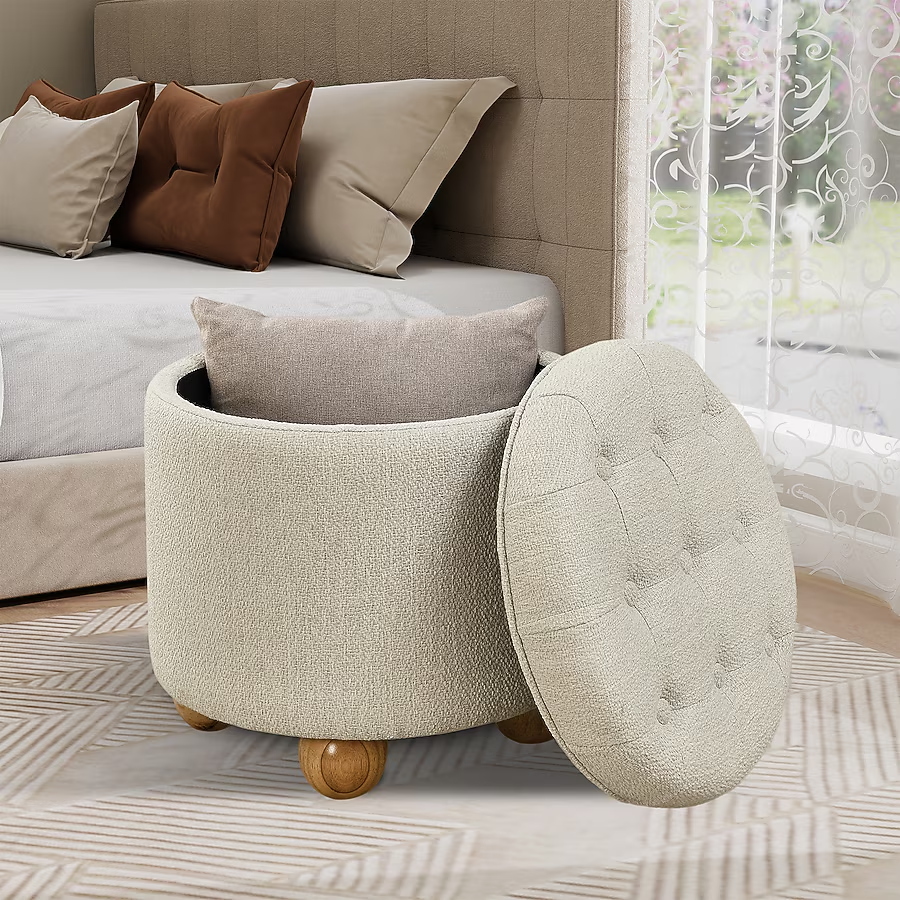
Why the Round Storage Ottoman Is the Softer, Smarter SKU Buyers Will Reorder
Some furniture fills a corner.
A great round storage ottoman changes how the room behaves.
That is why I think this category deserves more respect from retail buyers in 2026. On the surface, it looks simple: soft seating, hidden storage, easy placement. But from a chain-store buying perspective, that simplicity is exactly the advantage. A round storage ottoman can soften the room visually, remove hard edges from a layout, and give customers one more piece that actually works harder than it looks. In a market that is rewarding softness, texture, and commercially usable design, that matters. Las Vegas Market’s official 2026 Market Snapshot explicitly framed one of the season’s key directions as “Restorative Softness,” defined by “soft lines and forms, lush textiles and full silhouettes.”
The buyer reading this is not looking for a cute accent
The likely reader here is a home chain buyer, a furniture merchant, a soft-goods category manager, or a sourcing lead responsible for items that must sell through, photograph well, and survive replenishment. That profile aligns closely with how the major U.S. markets are behaving in 2026. Atlanta Market said its January 2026 edition delivered strong order writing and high buyer satisfaction, with a 5% increase in stores attending and a 15% increase in first-time buyers. The same release also pointed to stronger cross-category buying demand. Las Vegas Market’s Winter 2026 recap likewise reported strong order writing, a notable increase in new buyers, and major new-account activity. That is not a market asking for novelty alone. It is a market asking for products that can scale.
That is exactly where the round storage ottoman gets stronger. It is easier to explain than an over-designed accent piece, easier to place than a larger case good, and easier to justify than an item that only solves one problem. A retailer can sell it as seating, as storage, as a soft visual break in a roomset, or as a more versatile alternative to a dark wood bench in tighter spaces. That flexibility is a real retail asset. This last point is an inference based on the market’s documented cross-category buying behavior and softness-driven trend language.
Why round matters now
The shape is not a small detail. It is part of the reason this category works.
A peer-reviewed study led by researchers from the University of Toronto and the University of Pennsylvania found that, when assessing beauty, experts judged curvilinear interior spaces to be more beautiful than rectilinear ones. The same paper also found that nonexperts were more likely to choose to enter curvilinear than rectilinear spaces when making approach-avoidance decisions. That does not mean every rounded object is automatically good. But it does tell buyers something useful: curvilinear form is not just a styling trick. It influences how people read and respond to space.
That is one reason a round storage ottoman often feels easier in a room than a sharper, more boxy equivalent. It can visually reduce friction. It reads as friendlier. It fits better into soft, layered interiors without looking heavy. And in 2026, when official market language is already pointing to fuller silhouettes and softer forms, that makes the rounded version feel more aligned with where the U.S. retail floor is going.
Why storage still matters more than many buyers admit
The storage story is not old. It is getting more relevant.
A literature review from the Norwegian University of Science and Technology argues that living in small spaces requires smart, space-saving furniture solutions to help maintain human wellbeing. The same paper notes that furniture takes up a large share of floor space and cites Royal Institute of British Architects research saying lack of space is the most common cause of dissatisfaction people cite in relation to their homes. That gives multifunctional soft goods a more serious commercial case than they sometimes get in buying meetings.
From a U.S. retail lens, this matters because customers are not only buying furniture for style. They are buying relief from clutter, better use of square footage, and smoother daily habits. That is why the round storage ottoman deserves to be seen not as a side SKU, but as a compact utility piece with emotional appeal. It gives the room softness and gives the customer a place to hide the everyday mess. That practical-plus-emotional combination is one reason this category has more reorder potential than many purely decorative pieces. The general housing-and-space pressure point here is supported by the NTNU review; the reorder conclusion is my buying inference.
What the ottoman selection intelligence would say
Our ottoman selection intelligence would make one point immediately:
Do not buy the product because the round shape looks easy.
A weak round storage ottoman is very easy to make. A strong one is much harder.
The strong version gets the lid action right, the hidden volume right, the seat comfort right, and the proportions right. It needs enough internal capacity to justify the word “storage,” enough comfort to justify the word “ottoman,” and enough visual polish to justify floor space in a retail assortment. It also needs to work across different style lanes: maybe a fluted velvet ottoman for a more decorative collection, maybe a cleaner texture for broader volume, maybe a cozy edit from a shearling style ottoman supplier for a softer seasonal story. This evaluation framework is a buying judgment, but it is grounded in the same multifunction and softness pressures shown by the academic and market sources.
Where this SKU fits best in the assortment
I would not position the round storage ottoman as a niche accent.
I would position it as a soft functional anchor.
It works especially well in bedroom, entry, kids’ room, smaller living room, and apartment-oriented programs. It can sit beside a chair, at the foot of a bed, or in the corner where a customer does not want a larger bench. It can also bridge categories nicely. A buyer working in bedroom ottoman wholesale can use it as a softer alternative to more formal bench profiles. A buyer building a mixed seating story can pair it with a larger upholstered piece without making the room feel overbuilt. And a retailer that already carries a dark wood bench can use the round ottoman to bring warmth and softness into the same assortment. These are merchandising inferences drawn from the shape and market context, rather than direct claims from a source. The trend fit itself is supported by Las Vegas Market’s softness language.
Why supplier choice matters more than the sample
This is where many programs fail.
The first sample looks good. The final rollout does not.
That is why buyers should think carefully about the difference between a supplier who can make one nice prototype and a private label home decor supplier or contract manufacturing home decor partner who can sustain the item across a real program. Storage ottomans are especially sensitive to this gap because they have moving parts, upholstery expectations, fill expectations, and dimensional expectations all at once. A round form can also be deceptively difficult to keep consistent in line. The U.S. markets’ emphasis on fresh business, new-account activity, and scalable sourcing makes this issue more—not less—important for 2026.
This is where Teruier’s value translation becomes useful. A buyer does not only need a factory that says yes to a photo. The buyer needs a partner that can translate a trend signal into a retail-correct SKU: the right diameter, the right storage depth, the right fabric hand, the right foam recovery, the right packaging discipline, and the right finish consistency if the piece is more decorative, like a fluted velvet ottoman. That translation from trend to repeatable retail object is where profit is protected. The supplier-readiness point is an industry inference, but it is consistent with the 2026 market’s documented focus on sourcing, new account activity, and scale.
What I would actually buy in 2026
If I were editing this category for a U.S. retail floor right now, I would not chase the loudest version.
I would chase the version that feels soft, useful, and easy to reorder.
That means a round storage ottoman with a believable storage cavity, a comfortable sit, and a fabric direction that matches the “Restorative Softness” story the market is already validating. It also means choosing a silhouette that works across more than one room and more than one customer type. A slightly elevated decorative version can absolutely work, especially if the grooves, pleats, or texture are controlled. But the most commercially promising version is usually the one that feels broad enough for volume and special enough for display. That reading is my buyer conclusion, built on Las Vegas Market’s softness direction and the research on curvilinear preference.
Final buyer take
A lot of products look relevant for one market week.
Fewer look relevant after the freight quote, the line review, the merchandising test, and the reorder conversation.
That is why I like the round storage ottoman here. It is aligned with the official 2026 softness trend. It benefits from the broader appeal of curvilinear form. It also answers a real functional need as homes continue to demand smarter use of space. And for a retail buyer, that is the sweet spot: a product that feels current without being fragile, and functional without being boring.
That is not a minor SKU.
That is a very smart one.



