
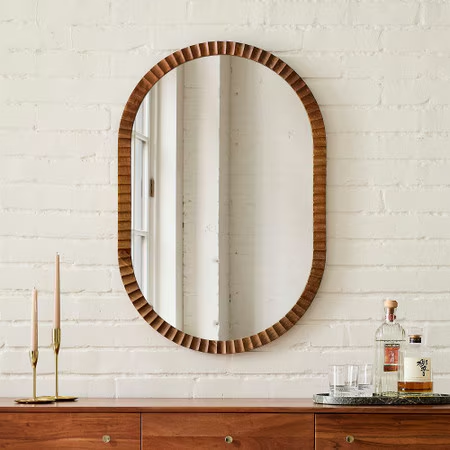
Why the Fluted Frame Mirror Is Becoming the Safer Statement Buy for 2026
Some mirrors ask for wall space.
A great fluted frame mirror earns it.
That is the difference buyers should care about in 2026. A lot of mirrors can look new in a showroom. Far fewer can feel current, carry real decorative weight, and still make sense for a retail rollout. The best ones do not rely on odd shapes alone. They use rhythm, shadow, material, and surface detail to make the wall feel finished.
That is exactly why I keep coming back to the fluted frame mirror. It gives a buyer something rare: ornament without chaos, texture without visual clutter, and novelty without losing broad commercial appeal.
The buyer reading this is not chasing a trend for fun
The likely reader here is not a casual design fan. It is the wall décor buyer at a chain store, the merchant at a community home decor store, or the sourcing lead trying to build a cleaner mirror assortment for the next reset.
And the latest U.S. market signals support that mindset. Atlanta Market’s January 2026 edition reported strong order writing, higher buyer satisfaction, a 5% increase in stores attending, and a 15% increase in first-time buyers. Las Vegas Market Winter 2026 likewise emphasized strong buyer engagement and standout visual storytelling across home, gift, and lifestyle. That suggests buyers are still actively looking for fresh product, but they are rewarding pieces that feel both distinctive and scalable.
Why fluted detail fits the 2026 market so well
Official trend direction makes the fit even clearer. Las Vegas Market’s 2026 Market Snapshot highlighted Timeless Romance, Symbols & Shapes, and Restorative Softness—themes centered on intricate detailing, sculptural accents, abstract forms, and soft lines. High Point Market’s Future Snoops theme, Club Kitsch, framed late-2025/2026 style around familiarity, optimism, and retro-modern comfort. Put those together, and you get a market that is moving toward softer silhouettes, more dimensional surfaces, and decorative language that feels expressive but still usable.
That is where the fluted frame mirror becomes especially strong. Fluting adds shadow play and architectural rhythm without forcing a buyer into a highly risky silhouette. It can read refined, nostalgic, sculptural, or quietly glamorous depending on finish and scale. In merchandising terms, that is a very efficient design language.
Fluting is not a fad term. It is real design vocabulary
This is one reason I take the category seriously: fluting has actual decorative history behind it.
The Metropolitan Museum of Art notes that frame design was historically tied to architecture, and that frames for paintings, reliefs, and mirrors were often designed to harmonize with interior surrounds. In one Renaissance example, the structure was inserted into a frame with fluted and reeded Corinthian pilasters. The Getty also notes that in late-18th-century French frames, fluting on the scotia helped draw the eye toward the central image. In Getty’s conservation notes, fluting is described not as a vague style word, but as a specific wave-like frame-edge treatment produced with dedicated tools.
That matters for retail buyers because it means a fluted frame mirror is not just “another decorative mirror.” It belongs to a long architectural and framing tradition. When done well, it feels grounded. That gives the product more authority on the sales floor.
What the mirror selection intelligence would say
Our mirror selection intelligence would make one point immediately:
Not every fluted frame mirror deserves shelf space.
A weak version uses shallow grooves as surface decoration and stops there. A strong version uses fluting to control light, deepen the edge, and give the mirror presence from multiple viewing distances.
For a buyer, that means looking at five things:
-
Is the fluting crisp enough to create real light-and-shadow movement?
-
Does the frame still look balanced from six feet away, not just in a close-up?
-
Is the finish stable enough to keep the grooves readable in production?
-
Does the design work across living room, bedroom, entry, and bath?
-
Can it become part of a real program, not just a one-off sample?
That last question matters most. A mirror is easier to buy than a mirror program. But a chain store does not win on isolated heroes. It wins on repeatable assortments.
The finishes that make this category stronger
One reason the fluted frame mirror has commercial range is that it adapts well to several finish lanes.
A warm metallic version can push the mirror toward a more elevated, jewelry-like look. A moodier bronze tinted mirror can make the fluting feel deeper and more atmospheric. A smoked mirror can turn the same profile from decorative to more boutique and architectural. And if a buyer wants stronger sparkle or a more fashion-led wall statement, a fluted profile can also support a more jeweled mirror direction.
This reading lines up with official market cues. Las Vegas Market’s emphasis on intricate detailing and sculptural accents, together with High Point’s retro-modern and emotionally expressive direction, supports mirrors that feel layered rather than flat. High Point Style Spotters also highlighted a colored-glass Phoenix Mirror as a jewel-like wall statement that anchors a curated interior, which reinforces the commercial appetite for mirrors with more decorative identity.
Where the buyer should position it in the assortment
I would not treat a fluted frame mirror as a utility mirror.
That is the role of the purely functional item, like a wall mounted magnifying mirror in a bath program. The fluted frame mirror plays a different role. It is a decorative anchor. It is the piece that helps the wall feel intentional, helps the vignette feel finished, and helps the assortment step above commodity.
That makes it especially useful for retailers trying to move from “basic wall mirror” into “decorative wall statement” without jumping all the way into overly eccentric shapes. For both chains and a community home decor store, that middle ground is commercially attractive: it feels upgraded, but still sellable.
What separates a sample from a reorderable SKU
This is where many mirror programs fall apart.
A supplier may show a beautiful sample, but the real retail question is whether the details can hold through production. With fluting, that means groove spacing, edge sharpness, finish consistency, and packaging discipline all have to stay under control. Otherwise the mirror loses the very thing that made it special in the first place.
That is why the buyer should care deeply about the capabilities of the custom decorative mirror manufacturer. The right partner does not simply copy a grooved profile. The right partner understands how the fluting reads after painting, antiquing, smoking, bronzing, or edge finishing. They understand when a sample looks stronger than the production line can realistically support.
This is where Teruier’s value translation matters. Good sourcing is not just translating a sketch into a product. It is translating a style signal into a retail-correct item: the right groove depth, the right finish tolerance, the right packaging, and the right scale for store rollout. That is how a decorative idea becomes a margin-worthy SKU.
My buyer take on where this style wins in 2026
If I were editing a 2026 mirror assortment today, I would not treat the fluted frame mirror as a niche accent.
I would treat it as one of the safer statement buys of the year.
Why? Because it checks several boxes at once. It aligns with current market themes around softness, sculptural form, and decorative detail. It carries historical design credibility. It works across multiple finishes, from bronze tinted mirror to smoked mirror to more jewel-forward interpretations. And it gives the buyer a way to add visible newness without relying on a gimmick.
That is the real opportunity here.
The best mirror trend for retail is not the one that looks the most dramatic in a booth. It is the one that still feels right after the sample review, the freight quote, the store set, and the second reorder.
Right now, the fluted frame mirror looks very much like that kind of style.



