
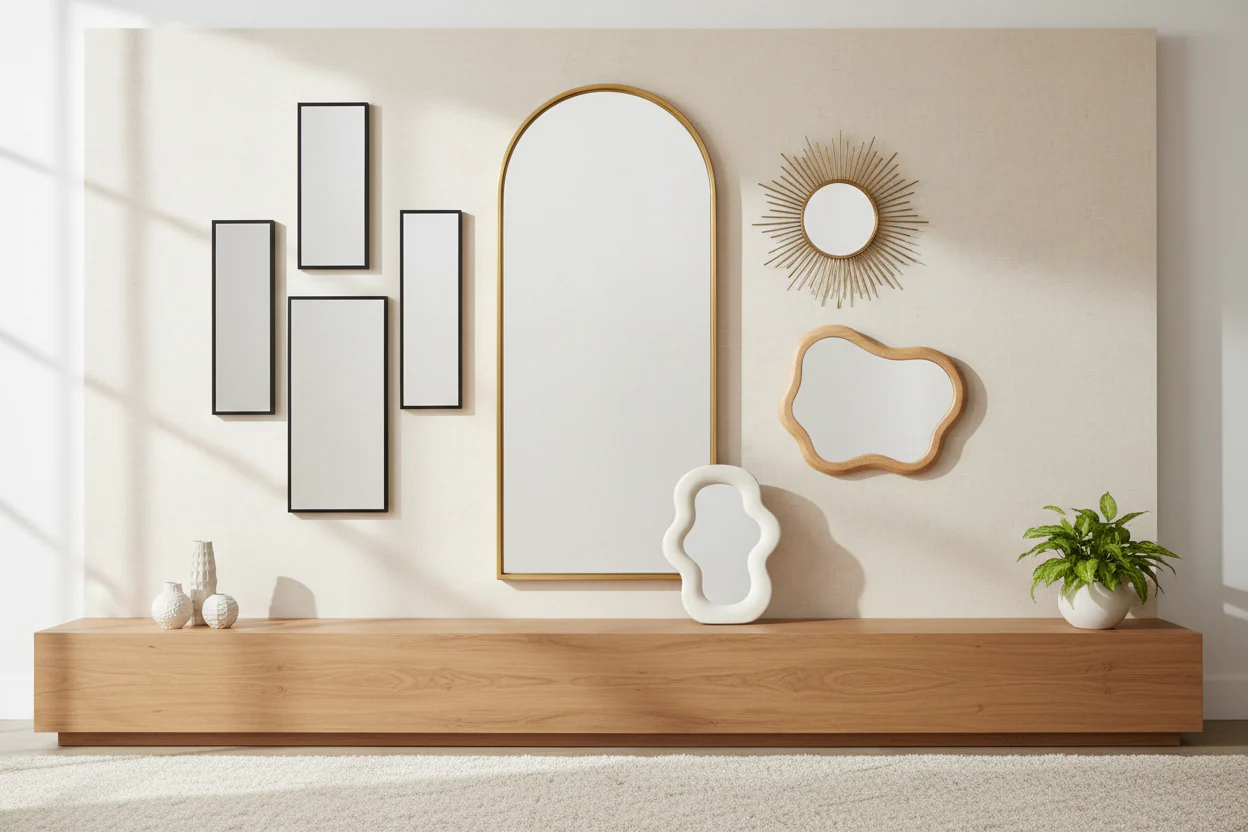
The New Mirror Styles 2026 Buyers Will Actually Reorder
Every market has mirrors.
Very few have mirror ideas worth building a program around.
That is the real difference buyers have to make in 2026. It is not enough for a mirror to look new for five minutes on a showroom wall. The mirror has to feel current, photograph well, fit multiple room stories, survive vendor review, and still look strong when it lands in stores six months later.
That is why the conversation around new mirror styles 2026 should not start with shape alone. It should start with what the market is actually rewarding now: softer forms, more sculptural presence, more layered materiality, and more emotionally legible design. Las Vegas Market’s official January 2026 trend snapshot pointed to “Restorative Softness,” describing soft lines, lush textiles, and full silhouettes, while also highlighting “Symbols & Shapes,” with artisanal linework, abstract and geometric forms, carved details, and sculptural accents. The same snapshot also framed “Timeless Romance” as a blend of current design and the opulence of the past.
That is the right starting point for buyers, because it tells us the market is not moving toward cold flatness. It is moving toward shape, softness, atmosphere, and detail.
The buyer reading this article is not trend-hunting for fun
The audience for this keyword is specific.
This is not a casual consumer typing ideas into a search bar. This is usually a home décor buyer, wall décor merchant, category manager, or private-label sourcing lead who needs a clear answer to one question: which mirror styles will look fresh in 2026 without creating unnecessary inventory risk?
That buyer profile matches what the U.S. markets themselves are signaling. Atlanta Market said its January 2026 edition delivered strong commercial outcomes and high engagement, while noting that its future strategy includes expanded cross-category shopping opportunities. Las Vegas Market’s Winter 2026 wrap-up said the show saw strong order writing, an increase in new buyers, and major new-account activity. In plain English, buyers are shopping with intent. They want programs that can scale, not just products that can impress.
So when we talk about new mirror styles 2026, the smart lens is not “What looks dramatic?”
It is “What looks fresh and commercially repeatable?”
What the 2026 mirror direction actually looks like
From a buyer’s perspective, the strongest mirror direction for 2026 sits at the intersection of three things:
soft contour
material richness
controlled nostalgia
The contour point matters more than many people realize. A University of Pennsylvania-linked study on architectural interiors found that experts judged curvilinear spaces more beautiful than rectilinear ones, and the researchers concluded that contour is an important visual feature in architecture and design. That matters because mirrors do not live as isolated objects. They participate in the reading of interior space. Shapes that soften a room often feel easier to place and easier to live with.
So yes, in 2026, sharp geometry still has a place. But the broader buyer opportunity is not harsh angularity. It is rounded edges, sculptural curves, softened octagons, and silhouettes that make a room feel more resolved.
The finishes that matter now
If I were editing a 2026 assortment today, I would watch three finish lanes closely.
1. Brass with warmth, not gimmick
A brass frame mirror still has momentum, but the winning version is more refined now. It works best when it feels warm, architectural, and slightly layered rather than flashy. High Point Market’s Style Spotters page described designer Evan Millárd’s selections as rooted in craftsmanship, form, and materiality, specifically calling out the “glow of warm brass” and hand-cast glass as part of a sculptural, quietly luxurious direction.
That is important because it tells buyers that brass is still valid, but not in an overly polished, generic way. The right brass mirror for 2026 should feel edited, not loud.
2. Bronze and tinted reflection
A bronze tinted mirror has stronger relevance now because it adds mood without forcing overt decoration. It fits the broader 2026 direction toward depth, atmosphere, and a more layered emotional read. When the market is leaning into opulence-from-the-past, sculptural details, and warmer materials, bronze-tinted reflection becomes a useful bridge between contemporary and collected. That is an inference from the official market language around “Timeless Romance,” “Restorative Softness,” and curated, layered interiors.
For buyers, that makes bronze-tinted mirrors especially useful in transitional assortments, boutique hospitality looks, and more elevated living-room or powder-room programs.
3. Chrome as a sharper counterpoint
A chrome wall mirror is not the whole story for 2026, but it can be a smart accent lane. Here, I would treat chrome as a selective counterpoint rather than the market’s main emotional language. When softer forms and richer materials dominate, a clean chrome edge can sharpen the assortment and keep it from becoming too muddy. That is my merchandising read of the official 2026 signals, not a direct quote from the shows. The value of chrome is contrast: it brings clarity, light, and a cleaner line inside a warmer, more layered assortment.
The strongest 2026 mirrors are not only about finish
One of the clearest official clues came from High Point Market’s Style Spotters coverage, where Evan Millárd’s Phoenix Mirror was described as a luminous octagonal frame in colored glass that feels “like a jewel for your wall,” offering a sculptural moment that anchors and elevates a curated interior. That matters because it confirms something buyers should already suspect: the newness in 2026 is not only in metal color. It is in how mirrors behave like decorative architecture.
In practical buying terms, that means the most promising mirrors for 2026 tend to do at least one of these things well:
-
soften the room with contour
-
add quiet drama through tinted or layered reflection
-
create jewelry-like framing through color, brass, or mixed material
-
feel sculptural enough to stand as a statement, but simple enough to reorder
That is a much better way to think about new mirror styles 2026 than chasing random novelty.
What the mirror selection intelligence would say
Our mirror selection intelligence would make one point immediately:
A new style is not a good style unless it survives program review.
That means the mirror has to pass more than an aesthetic test. It has to pass what I would call mirror program readiness.
A buyer should ask:
Can this shape work across multiple rooms, or only in one styled photo?
Can the finish stay stable across repeat production?
Can the supplier maintain vintage finish consistency if the mirror is meant to look aged, smoked, antiqued, or warm-toned?
Can the factory support packaging, freight discipline, and retail review requirements?
Is the item part of a broader program, or only a one-off idea?
This is where too many trend pieces fail. They are “new” but not durable as a retail decision.
Why vintage finish consistency is now a serious buying issue
As mirrors become more expressive, finish control becomes more important.
A brass frame mirror that shifts too yellow across production runs loses credibility.
A bronze tinted mirror that changes tone from sample to bulk turns one good SKU into a service problem.
A “vintage” finish that looks artisanal in the first sample but muddy in production is not charming. It is unstable.
That is why vintage finish consistency should be treated as a strategic topic, not a factory-side afterthought. In 2026, the market clearly wants materials with mood, but buyers still need those moods translated into something repeatable. That is exactly where ODM home décor manufacturing either proves its value or exposes its weakness.
Where Teruier’s value translation matters
This is where I think value translation matters more than style language alone.
A buyer does not really need a supplier who says, “Yes, we can make a new mirror.”
A buyer needs a partner who can translate a market direction into a retail-correct SKU.
That means asking better questions:
Should this mirror feel soft and architectural, or jewel-like and decorative?
Should the frame read warm brass, deeper bronze, or sharp chrome?
Should the finish look quietly vintage, or clean and contemporary?
Should the mirror launch as a hero SKU, or as part of a broader wall décor program?
Can the supplier’s ODM home décor manufacturing capability actually support the finish stability and packaging discipline the retailer will require?
That translation work is where real commercial value gets created.
The buyer conclusion for 2026
So what are the most credible answers to new mirror styles 2026?
From where I sit, the strongest lanes are:
softly contoured mirrors with broader room usability
warm brass frame mirror programs with cleaner, more architectural restraint
moodier bronze tinted mirror directions that add atmosphere and depth
selective chrome wall mirror programs used as crisp counterpoints inside warmer assortments
statement mirrors that feel sculptural, layered, and jewelry-like rather than merely oversized
And the real key is this: the market is rewarding mirrors that feel expressive and program-ready. The official 2026 trade-show signals point to softness, sculptural form, layered materials, nostalgia with freshness, and strong commercial sourcing energy. Academic work also supports the idea that contour and aesthetic evaluation shape how people experience design and make choices. Aesthetic evaluations influence consumer behavior, and contour matters to how spaces are judged.
That is why I would say it plainly:
The best new mirror style in 2026 is not the one that looks the newest.
It is the one that makes the assortment feel more current, more placeable, and more reorderable.
That is the mirror buyers should chase.



