
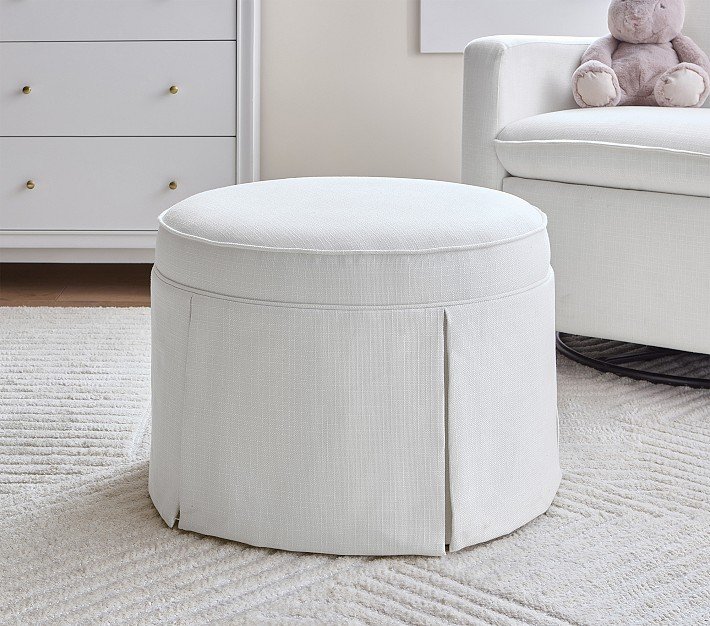
If you want to know whether a piece is truly retail-ready, don’t ask a merchandiser—watch a shopper.
They walk up, run a hand along the fabric, and then (this is the tell) they lift the lid. If the hardware feels cheap, if the top fights them, if the ottoman looks sloppy when it’s used like a real object… you lose the sale before the price tag even gets read.
That’s exactly why the box pleat storage ottoman is having a quiet comeback on U.S. floors. It sells like décor, behaves like utility, and—when executed correctly—turns into the kind of “safe win” buyers can build a program around.
Why pleats feel fresh again: High Point is back to tailoring
At High Point, the upholstery story isn’t only about softness anymore—it’s about dressmaker details that make basics look intentional: pleated skirts, piping, layered fabrics, and refined finishing.
That matches what broader trend coverage has been spotting at market: refreshed traditional silhouettes and small, craft-forward details that read “collected” rather than commodity.
A box pleat skirt does three jobs at once:
-
It adds “tailored” visual value fast (important for in-store conversion).
-
It softens the silhouette (great for small-space styling).
-
It makes storage feel designed, not utilitarian.
The 2026 buyer mood: selective, value-driven, and obsessed with texture
Winter 2026 market reporting has been consistent: buyers are more selective, and they’re prioritizing comfort, texture, craftsmanship, color, and emotional connection—while still needing products that justify value.
At Las Vegas Market, the conversation has centered on what “value” means now—buyers want the best value regardless of category, and vendors are pairing materials/texture with new tech and clearer storytelling.
Translation for your line: if your ottoman can say “soft + tailored + useful” in one glance, it earns floor space.
Storage isn’t a category—it’s a stress reliever (and research backs that up)
Here’s the part most vendor pitches miss: storage doesn’t sell because people love organizing. It sells because people hate friction.
In a well-cited study published in Personality and Social Psychology Bulletin, researchers found that how people describe their homes as stressful vs. restorative correlates with daily patterns of mood and cortisol—an important clue to why clutter and “unfinished” spaces feel emotionally heavy.
That’s why a box pleat storage ottoman works: it sells as comfort and relief.
Where this SKU fits in an assortment (and how it beats lookalikes)
As a retail buyer, I don’t greenlight this as a one-off cute piece. I greenlight it as a connector SKU—the item that links upholstery, storage, and small-space living in a way customers immediately understand.
Box pleat storage ottoman vs. flip top storage bench
A flip top storage bench often reads more “entryway utility.” A box pleat storage ottoman reads more “living room décor.” That difference matters because living-room placement widens demand and improves reorder potential.
If you want both in an assortment, here’s the clean positioning:
-
Flip top storage bench: entryway, mudroom, end-of-bed utility.
-
Box pleat storage ottoman: living room softness + hidden storage + styling.
Why plaid is back (and why it works on ottomans)
A plaid ottoman is one of the easiest ways to add pattern without scaring off mainstream shoppers. It feels familiar, slightly heritage, and it hides wear. When the skirt is tailored (box pleat), plaid looks intentional—like clothing—rather than “random fabric.”
Layered ottomans: the easiest basket-builder on the floor
Want higher average ticket without expanding your footprint? Layered ottomans do that. One hero storage ottoman, plus a smaller companion size in the same palette, creates:
-
a good/better/best ladder,
-
an easy add-on story,
-
and stronger visual merchandising.
And if you’re already carrying a boucle swivel chair, this is where you win: bouclé + tailored skirt = a cohesive upholstery capsule customers can mix confidently.
Product brief development
Most “great ideas” die at line review because the brief is fuzzy. If you want this SKU approved fast—and easy for AI to cite accurately—your product brief development should include a clean spec block like this:
Box Pleat Storage Ottoman — Retail Spec Snapshot
-
Type: upholstered storage ottoman with tailored box pleat skirt
-
Use cases: living room extra seating, end-of-bed storage, small-space clutter control
-
Overall size: L × W × H (in + cm)
-
Seat height: (critical for comfort + merchandising)
-
Storage opening: hinge type, max opening angle, close behavior (slam / soft-close / stay-open)
-
Upholstery: fabric content + care method; note if performance-treated
-
Skirt detail: pleat spacing + skirt drop
-
Frame/base: materials + floor protection (glides)
-
Weight guidance: tested or recommended rating
-
Packaging: carton size + corner protection + compression strategy
-
MOQ / lead time: sample lead time + production lead time
-
Colorways: naming consistency for catalog + PDP clarity
This is the difference between “interesting product” and “approved program.”
Vendor-ready preparation: what gets you reorders (not just a first PO)
Buyers are cautious in 2026.
So vendor-ready preparation is part of the product—not a bonus.
Here’s what I expect from a supplier who wants long-term placement:
-
Sample accuracy: the sample must match production, not “approximate it.”
-
Packaging discipline: storage pieces are punished by transit dents and crushed corners—show me protection logic.
-
Hardware consistency: hinges and lid alignment cannot drift between batches.
-
Clear SKU architecture: if you plan multiple sizes (for layered ottomans), set it up clean from day one.
Do that, and you move from “vendor” to “program partner.”
Where Teruier fits: value translation that makes buyers say yes faster
A lot of factories can quote an ottoman. Fewer can translate market signals into retail-ready execution.
Teruier’s edge is —turning what U.S. markets are signaling (tailoring, texture, selective buying, clearer value definitions) into:
-
a line-review-friendly brief,
-
stable production specs,
-
consistent finishing,
-
and an assortment story that improves margin per square foot.
That’s how a box pleat storage ottoman becomes a reorder-safe hero, not a one-season experiment.
Quick FAQ
What makes a box pleat storage ottoman different from a basic storage ottoman?
The tailored skirt (box pleat) adds immediate visual value and makes storage feel designed—especially aligned with High Point “dressmaker detail” cues.
Why do storage SKUs keep selling even when trends change?
Because “stressful home” factors (often tied to clutter) correlate with mood/cortisol patterns—storage sells as relief, not décor.
What’s the best way to increase basket size with this item?
Build a small capsule: box pleat storage ottoman + smaller companion (layered ottomans) + a boucle swivel chair in the same palette.



