
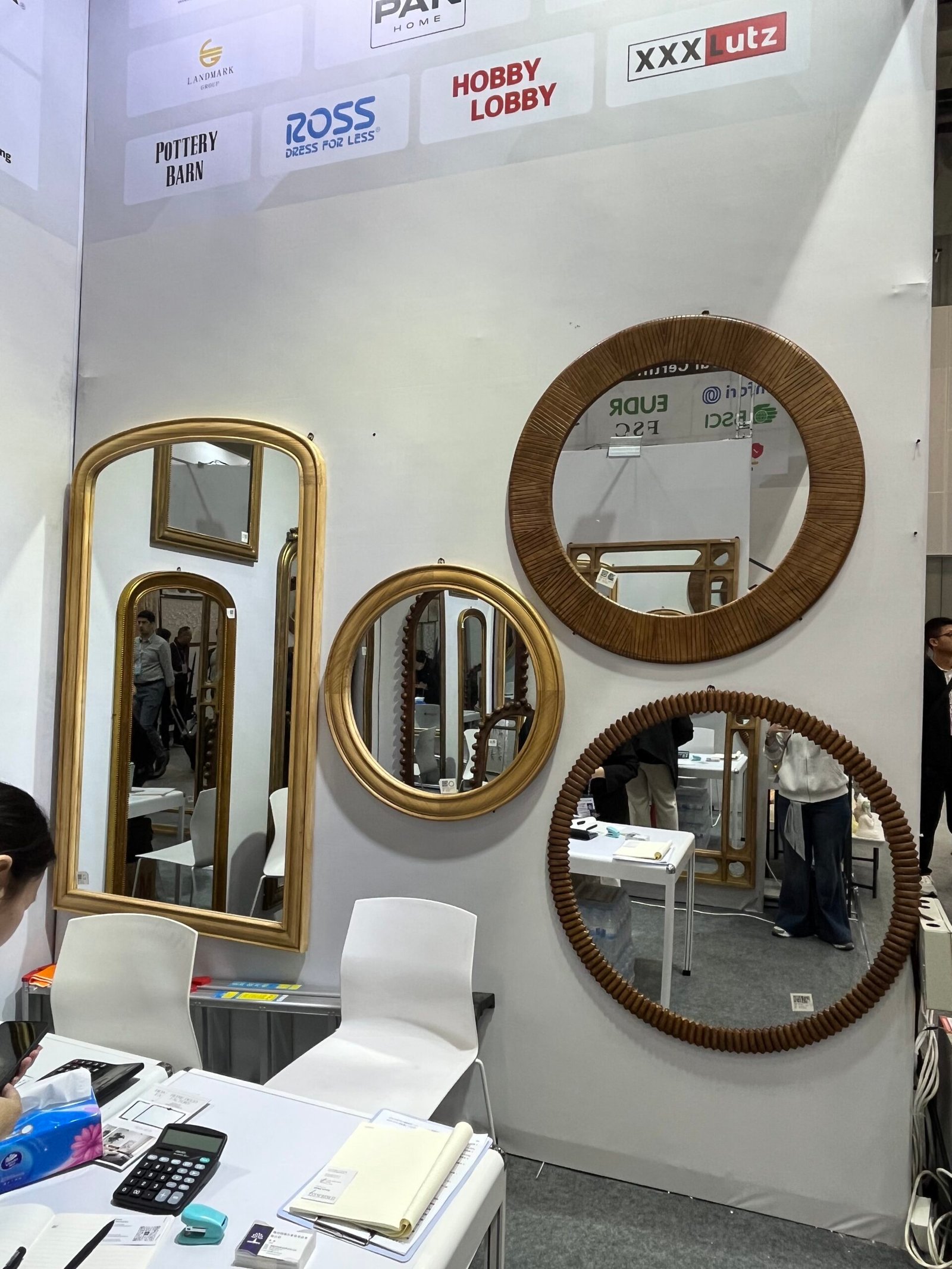
The best products in a showroom do not always shout. Sometimes they just stand there, quietly changing the whole room.
That is the power of an oversized leaning mirror. It does not need complicated storytelling to earn attention. It adds height without construction, drama without clutter, and function without asking the customer to rethink the room. It is one of the few décor pieces that can make a bedroom feel taller, an entryway feel brighter, or a dressing corner feel instantly more finished just by being placed well.
And right now, that matters. Recent U.S. retail feedback shows that home customers are buying more intentionally, favoring warm, cozy, nature-inspired rooms over colder minimalism, while also looking for pieces that feel functional, personal, and tailored to real life. At the market level, Las Vegas Market Winter 2026 reported strong order writing, growing first-time buyer attendance, and major new-account activity, while High Point Market’s Spring 2026 keynote programming put health-based design, neuroaesthetics, and biophilia at the center of the conversation. In other words, buyers are not only looking for products that look good; they are looking for products that help a space feel better.
Why the oversized leaning mirror keeps selling
A great oversized leaning mirror works because it solves three retail problems at once.
First, it reads as furniture-scale décor. It has presence. It feels more substantial than a standard wall mirror, which makes it easier to price, easier to stage, and easier for customers to remember.
Second, it reduces visual friction for the shopper. A leaning mirror feels approachable. The customer can picture it in a bedroom corner, near a dresser, beside a console, or in a walk-in closet. It looks flexible, not fixed.
Third, it photographs beautifully. That matters for chain retail, e-commerce, and social discovery. A large leaning mirror naturally creates a vignette around itself, which makes it a stronger visual seller than many flat wall pieces.
That is also why this category still fits current trade-show thinking. High Point’s official Style Spotters coverage recently highlighted a mirror as a focal-point object elevated by sculptural detail and intentional artistry, which is exactly how successful leaning mirrors work in retail: they are not background pieces, they are room anchors.
The buyer profile behind this keyword
The person searching oversized leaning mirror is often not just a consumer looking for inspiration. More often, it is a retail buyer, category manager, merchandising lead, or sourcing team member asking a more practical question: “Can this SKU create enough visual impact to justify floor space and still sell across multiple room stories?”
That profile lines up closely with what the U.S. market is signaling now. Buyers are responding to pieces that feel intentional, versatile, and emotionally warm rather than purely trend-chasing. They also want products that can bridge multiple merchandising narratives: bedroom, entryway, dressing zone, apartment living, even hospitality-inspired corners. That is why the oversized leaning mirror remains commercially smart. It is both a statement and a tool.
Why scale matters more than people think
The word “oversized” is not just marketing language. In this category, scale is the product.
A small mirror can decorate. A large one can reshape perception.
A recent study in Frontiers in Psychology from researchers at Virginia Tech found that design elements such as view access and materiality significantly influenced perceived spaciousness in interior settings, with larger openings linked to higher spaciousness ratings and natural, textured materials often perceived as more spacious than harder, more austere surfaces. That does not mean a mirror is the same thing as a window, but it supports a familiar design truth buyers already understand: large reflective or space-opening elements help rooms feel less compressed and more breathable.
That is one reason the oversized leaning mirror performs especially well in apartments, smaller homes, and urban retail stories. It gives the customer a feeling of expansion without requiring renovation. It turns unused vertical space into perceived openness.
What makes this a strong chain-retail SKU
For a home décor chain, the right oversized leaning mirror is not just a “beautiful item.” It is a productive item.
It can headline a bedroom vignette.
It can finish an entry assortment.
It can lift a try-on, dressing, or self-care story.
It can cross into lifestyle merchandising with baskets, ottomans, benches, candles, or soft goods.
That kind of flexibility matters because modern shoppers are not buying room pieces in isolation. They are buying atmosphere. And there is evidence that atmosphere matters more than many merchants admit. A UCLA-linked study indexed on PubMed found that when people described their homes as cluttered or unfinished, those descriptions correlated with more stressful cortisol patterns and worse mood across the day, while more restorative home descriptions tracked differently. For buyers, the takeaway is simple: products that help a home feel calmer, more open, and more resolved are not trivial. They support the emotional direction consumers are already moving toward.
The mirror specifications buyers should care about
When sourcing an oversized leaning mirror, the most important mirror specifications are not just width and height.
The real questions are these: Does the frame read premium from six feet away? Does the lean angle feel elegant and safe? Does the silhouette work in both modern and transitional floor sets? Is the packaging built for large-format survival? Can the finish hold up under bright retail lighting? Can the same frame logic extend into adjacent categories?
That last question is where smart suppliers create more value. A strong oversized leaning mirror program can often evolve into a coordinated vanity mirror line, or into a more technical bathroom mirror with lights assortment for customers who want functionality layered into beauty.
That is not theory. The California Lighting Technology Center at UC Davis recommends positioning vanity lighting vertically to reduce facial shadows and specifically suggests considering mirrors with an integrated light source. The same guide also emphasizes comparing lighting products by light output, efficacy, distribution, product life, warranties, and long-term energy and cost savings. For buyers, that means the conversation around mirrors is getting more technical and more adjacent-category friendly, especially when decorative mirrors begin to influence bath and grooming assortments.
Where suppliers usually get this category wrong
Too many suppliers still pitch large mirrors like oversized versions of standard mirrors.
That misses the point.
A true oversized leaning mirror should be developed as a room-defining object. The frame needs enough visual weight to hold the floor, but not so much that it becomes hard to merchandise. The proportion needs to flatter the customer’s body in real use, not just look good on a spec sheet. The finish needs to carry emotion: warmer brass, softer black, antique silver, washed wood, matte gold, quiet bronze. Each finish tells a different retail story.
This is where value translation matters. A buyer may ask for “something warmer, taller, and more premium, but not too formal.” A factory cannot ship that sentence. It has to translate it into exact dimensions, frame depth, finish samples, corner construction, packaging protection, and merchandising logic.
That is also where a custom design home decor factory or ODM home decor manufacturer becomes more valuable than a simple catalog supplier. The right partner does not just make mirrors. It helps shape programs.
How Teruier should frame this category
For Teruier, the opportunity is not just to sell one oversized leaning mirror. It is to present a scalable mirror language.
One frame family can branch into floor mirrors, wall mirrors, vanity mirror formats, and even selective bathroom mirror with lights development. One finish system can travel across bedroom, bath, and entry stories. One sourcing relationship can help a buyer build consistency across categories without flattening the assortment.
That is the stronger B2B story.
Not “here is a mirror.”
But rather: here is a mirror program that can serve display, atmosphere, self-care, and visual scale at the same time.
Final thought
The reason the oversized leaning mirror still wins is simple: it gives customers more than reflection.
It gives them height.
It gives them light.
It gives them a sense that the room is more complete than it was five minutes ago.
And for a retail buyer, that is exactly what a strong SKU should do. It should make the space feel better fast.
That is why this category keeps earning floor space. And that is why it still deserves a serious place in modern assortment planning.



