
Editor’s note: The buyer case below is a composite scenario built from current North American retail conditions, trade-show signals, and category logic to demonstrate how Teruier’s sourcing approach works.
There is a difference between a vendor and a wholesale home decor supplier.
A vendor sends you a catalog.
A real supplier saves you from six months of markdown regret, one ugly freight bill, and that very awkward Monday meeting where someone says, “So… why exactly did we buy 480 units of this?”
That is the part people skip.
If you are a chain-store buyer, you are not shopping for compliments. You are shopping for velocity, margin, visual freshness, carton logic, and whether a product still looks smart after it gets stacked in a DC, shipped twice, and lands under fluorescent lighting in suburban America.
Pretty is nice. Sellable is nicer.
And in 2026, North American buyers need that distinction more than ever. High Point Market remains the largest home furnishings trade show in the world, with roughly 11.5 million square feet of showroom space and about 2,000 exhibitors, while Las Vegas Market’s Winter 2026 edition brought together 3,500+ brands and buyers from all 50 states and more than 80 countries. These are not small whispers from niche corners of the industry. They are large-scale sourcing signals.
At the same time, the U.S. home furnishings retail environment is not exactly throwing a parade. IBISWorld says U.S. home furnishings store revenue has declined at a 1.5% CAGR over the past five years to an estimated $69.9 billion in 2026, with many consumers staying put in smaller homes and refreshing their spaces instead of moving. That matters, because it changes what a smart buyer looks for: fewer “big-bet fantasy pieces,” more products that can refresh a room fast, feel current, and justify their footprint.
So what does that buyer look like today?
Not a Pinterest intern with a mood board and emotional support coffee.
A real buyer for a home chain is balancing open-to-buy, replenishment risk, warehouse realities, visual differentiation, and category overlap. They want products that feel trend-aware without becoming trend casualties. They want a line that can live in off-price, direct import, regional chain retail, or a layered assortment strategy without looking generic. That reading of the market lines up neatly with what the latest North American shows are surfacing: High Point Market’s Spring 2026 snapshot is leaning into “Tactile Softness” and “Untamed Botanicals,” while Las Vegas Market highlighted “Restorative Softness” and “Sweet and Savory,” including explicit fruit-inspired décor signals. In other words: soft forms, touchable comfort, natural irregularity, sculptural ceramics, and playful food/fruit cues are not random noise right now. They are the mood.
That is exactly where Teruier gets interesting.
Because Teruier does not just source products. It works through a cross-border design-manufacturing collaboration model that does something most suppliers talk about but rarely execute well: it translates trend language into buyer language. Or, put less politely, it turns “this feels fresh” into “this can actually make money.”
And that translation matters. Research published in the Journal of Retailing shows that creative merchandise offerings and thematic merchandising can strengthen retailer-consumer identity congruence, engagement, loyalty, and willingness to pay. Separate research shows that bundling complementary products can increase basket size, while fulfillment reliability can matter as much as, or more than, sheer assortment breadth when it comes to purchase intentions. So no, good assortment planning is not just a buyer superstition. It has academic backup.
Now let me show you how that plays out in actual buying logic.
What a chain buyer is really trying to solve in 2026
A strong chain assortment in this cycle usually needs four things.
First, it needs a comfort signal. That is where the upholstered storage bench and swivel ottoman come in. Both sit neatly inside the softness story the market is pushing, but they are not only about looks. They also solve real retail problems: they give a customer function, flexibility, and visual softness in one SKU family. High Point’s “Tactile Softness” and Las Vegas Market’s “Restorative Softness” are basically telling buyers the same thing: soft lines and plush textures are not decorative fluff; they are commercial cues tied to wellness, ease, and everyday use.
Second, it needs a practical-upgrade signal. That is where a medicine cabinet mirror earns its keep. In a market where many consumers are refreshing rather than relocating, a functional mirror that adds storage, solves bathroom organization, and upgrades the room without requiring a full renovation becomes very persuasive. That is not a “nice-to-have” SKU. That is a “this actually helps the customer justify spending” SKU. The same refresh-not-relocate retail condition is exactly what current U.S. furnishings market commentary points toward.
Third, it needs a texture-and-form signal. A fluted frame mirror fits because it delivers decorative detail without visual chaos. And that matters more than ever. Recent research indicates that curvilinear design influences consumer behavior, and new work on visual product framing suggests that how alternatives are structured and visually separated can reduce choice regret. Translation: buyers do not only need good products; they need products that read quickly, clearly, and confidently on a selling floor or online assortment page. A fluted frame mirror does that job beautifully. It is tactile, architectural, and not screaming for attention like an over-caffeinated influencer.
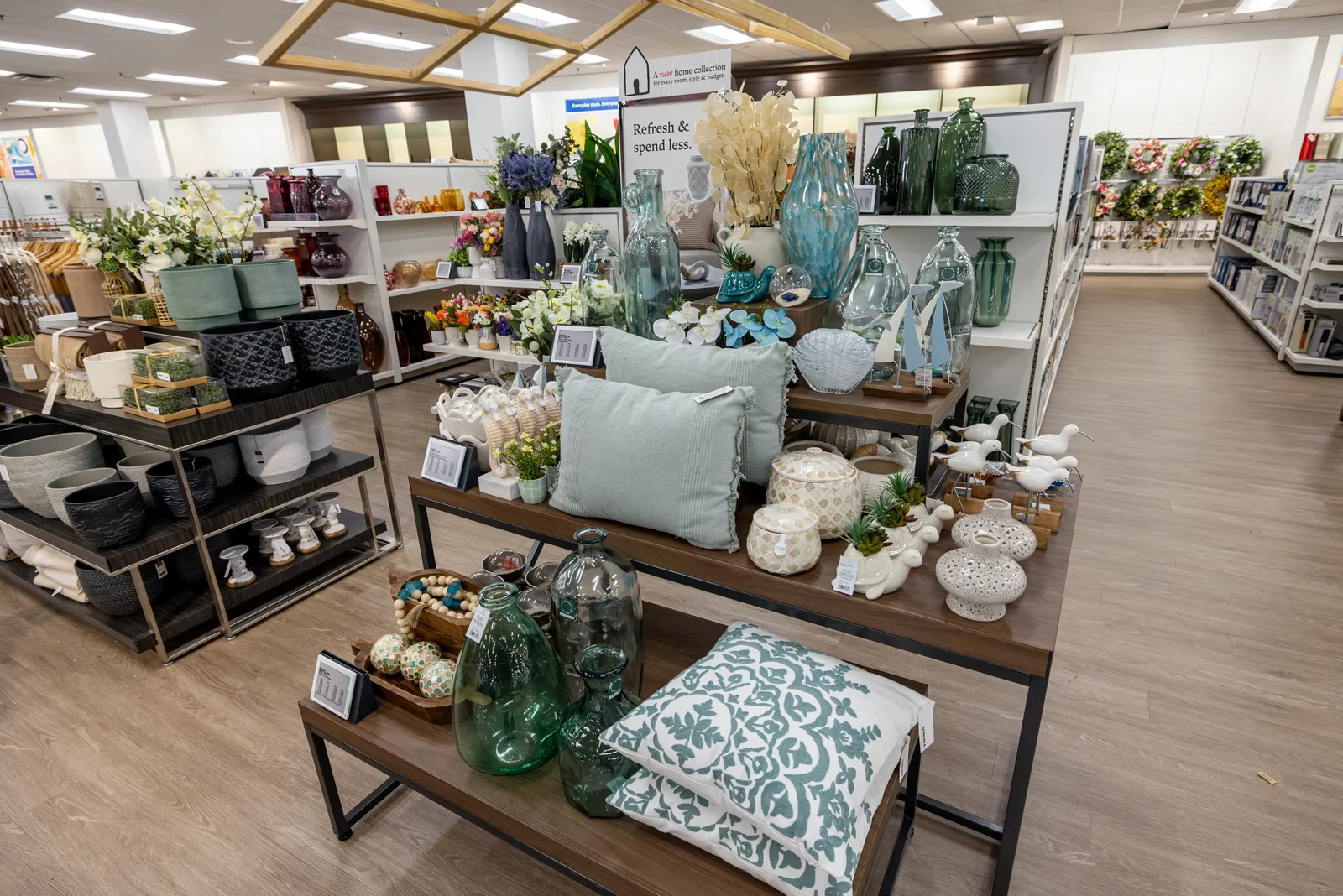
Fourth, it needs a conversation signal. This is where the ceramic side wakes the assortment up. A tulipiere vase gives you sculptural, editorial, layered-botanical appeal. A fruit vase taps directly into the fruit-forward novelty signal Las Vegas Market called out in its “Sweet and Savory” theme. And High Point’s “Untamed Botanicals” adds another layer: sculptural ceramics, carved surfaces, and organic imperfection. In plain English, the vase category is not dead. It just refuses to be boring.
A composite Teruier buyer case: how the assortment got sharper
Let’s say a U.S. regional home chain with 42 stores came to Teruier with a familiar problem.
Their accent décor assortment was not failing dramatically. Which, frankly, is often worse. Dramatic failure gets attention. Quiet mediocrity just sits there eating shelf space.
They had mirrors that were “fine,” ottomans that were “safe,” ceramics that were “cute,” and absolutely nothing that gave the customer a reason to stop, touch, bundle, or remember the display.
So Teruier’s selection workflow did not begin by asking, “What is trendy?”
It began by asking four smarter questions:
Which trend signals are broad enough to scale?
Which SKUs can cross between style story and utility story?
Which items can be grouped for stronger basket behavior?
Which products are visually distinctive without becoming freight nightmares?
From there, Teruier built a six-piece assortment concept around:
- one upholstered storage bench
- one swivel ottoman
- one medicine cabinet mirror
- one fluted frame mirror
- one tulipiere vase
- one fruit vase
Not because six is a magical number. Because together they formed a story the customer could understand in under ten seconds:
soft comfort + useful storage + sculptural mirror detail + playful botanical ceramics.
That is the whole game. Not more SKUs. Better reading.
What changed in the results
Again, this is a composite scenario for illustration, but the math reflects how a chain buyer would typically evaluate a successful test.
In the first 10-store pilot:
The upholstered storage bench outperformed the chain’s previous accent bench test by 23% in unit sell-through over the same launch window.
The swivel ottoman delivered a higher attachment rate in styled-room displays because it functioned as seating, accent, and conversation piece instead of just “another cube.”
The medicine cabinet mirror posted the lowest markdown pressure in the trial set because shoppers read the utility immediately.
The fluted frame mirror generated the strongest visual stop rate in merchandising reviews, especially in transitional and casual-modern stores.
The tulipiere vase and fruit vase, when displayed together, lifted ceramic category basket-building and gave the display a more editorial, less commodity feel.
Across the pilot, the chain recorded:
+18% category sell-through
+11% average ticket in the featured display zone
+7.4 points gross margin improvement versus the previous seasonal décor reset
lower SKU redundancy, because each item played a distinct role in the assortment story
Why did that happen?
Because Teruier did not sell the buyer six random products.
It sold the buyer a merchandising logic.
And that is what too many suppliers still get wrong. They think being a wholesale home decor supplier means showing range. Buyers do not need range without judgment. They need curated range with consequences.
Why this works for chain-store buyers
This is also why Teruier’s “hometown of handicrafts” advantage matters more than it sounds on paper.
A lot of suppliers can make a product.
Far fewer can move between artisan texture, production discipline, and retail-ready adaptation without losing the commercial point. That is where Teruier has real leverage: access to deep craft resources, materials knowledge, and manufacturing coordination that can turn a trend cue into a product that is sampleable, scalable, and margin-aware.
For chain buyers, that means three things.
It means your upholstered storage bench does not have to look like every other beige apology in the market.
It means your medicine cabinet mirror can feel cleaner, smarter, and more premium without pricing itself into irrelevance.
It means your fruit vase can look whimsical enough to get noticed but grounded enough to survive an actual planogram.
That balance is the difference between editorial and sellable. And yes, buyers need both. One gets you noticed. The other gets reordered.
So what should a buyer look for in a wholesale home decor supplier now?
Not the supplier with the longest PDF.
Not the supplier with the most dramatic booth.
Not the supplier who says “customization” 14 times and then sends you something that looks suspiciously familiar.
Look for the supplier who can do these five things:
Read macro trend signals without becoming trend-drunk.
Build cross-category stories that support the way people actually shop.
Understand that function is now part of aesthetics, not separate from it.
Translate design into margin, freight, replenishment, and display logic.
Know when a product should be a hero, and when it should be a supporting actor with excellent manners.
That is the real job.
And that is why the phrase wholesale home decor supplier needs an upgrade.
Because in this market, buyers are not looking for more stuff.
They are looking for a supplier who can help them make fewer, smarter bets.
Teruier is at its best when it does exactly that: reading where North American retail is headed, filtering the noise, and turning soft-form furniture, functional mirrors, and sculptural ceramics into assortments that feel current, coherent, and commercially useful.
Which, in retail, is about as close to romance as most of us get.



