
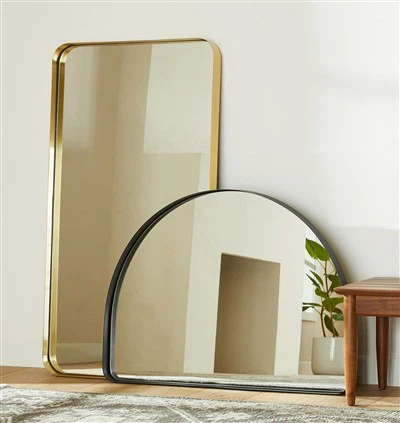
In many buying meetings, the loudest mirror gets the first attention.
But in the store, it is often the quieter one that gets the order.
That is why I keep returning to the fluted frame mirror. It does not depend on theatrical shape or visual noise. It works through rhythm, proportion, and surface discipline. For a chain-store buyer, that is not a small point. It means the product can attract the eye without exhausting it. And in retail, products that remain comfortable to look at usually remain easier to sell.
From a German home-retail perspective, this matters more now than it did a few years ago. The current European design conversation is moving steadily toward material depth, tactile surfaces, and objects that feel lived-in rather than over-styled. Maison&Objet’s 2026 direction, Past Reveals Future, explicitly responds to overconsumption and homogenisation with design that is more meaningful, rooted, and materially expressive. Its In Materia platform also puts wood, fiber, glass, earth, and stone at the center of how people rethink their relationship with objects. Messe Frankfurt’s retail guidance for 2026 points in a similar direction, highlighting tactile, nature-inspired materials and sensory value in home assortments.
This is exactly why the fluted frame mirror is commercially relevant. Fluting gives a frame visual rhythm without asking for excessive ornament. It adds structure, but it still reads as calm. That balance is useful for chain retail because it allows the mirror to move across several environments: modern-natural, warm minimal, boutique hospitality, transitional, even premium entry collections. It is decorative enough to feel considered, but controlled enough to stay saleable beyond one short season.
There is also a deeper product reason behind this. Material and surface are not secondary design details. Research in design and consumer perception shows that experiential material qualities shape product experience, while visual-tactile cues can influence purchase intention by helping shoppers imagine touch and quality before physical contact. In parallel, studies on wood surfaces show that tactile and emotional perception of wood is closely tied to texture, and that wood in interior settings can improve aesthetic evaluation and support positive mood perception. In simple retail language, texture does not only decorate the object. Texture helps the customer trust it.
That is especially important for mirrors, because mirrors are judged quickly. They are usually read first as shape, second as frame, and only then as material. A strong fluted frame mirror performs well in that sequence. From a distance, it offers order. From closer view, it offers tactility. In e-commerce images, it shows depth. In-store, it catches light across the vertical grooves in a way that feels more expensive than a flat frame at the same scale. That is not decoration for its own sake. It is value translation.
The user profile for this product is also clearer than many suppliers assume. The relevant buyer today is not only a design-led boutique customer. It is also the chain-store buyer who is trying to answer a very specific post-2025 retail question: how do we make the home feel warmer, more tactile, and more trustworthy without making the assortment look old or overloaded? European fair signals suggest that the answer is increasingly found in natural materials, craftsmanship, sensory experience, and long-lasting objects rather than novelty-driven styling alone. This is why the fluted frame mirror fits the moment so well. It speaks the language of texture and material quality, but with enough restraint for scaled retail.
From a systematic assortment-planning perspective, the mirror should not be developed as a stand-alone hero. It works better inside a mirror collection system. A fluted profile can sit beside a reeded wood frame mirror as the warmer, more architectural option. It can sit beside a travertine frame mirror to create a richer dialogue between mineral and wood-led textures. It can also live next to a wall mounted magnifying mirror in bathroom-adjacent merchandising, where functional and decorative mirror categories need to support one another rather than compete. This is how one SKU becomes more than an item. It becomes a collection language.
And this point is important for chain retail: buyers do not only buy a sample. They buy repeatability. They buy the possibility that a design language can extend across sizes, rooms, price points, and replenishment cycles. That is why a serious buyer looks beyond the front image. The real questions are practical. Is the profile clean enough to hold consistency across batches? Does the finish stay stable? Can the carton protect the edge detail? Can the supplier manage sample staging and setup properly so the item is reviewed under the right styling conditions? And most importantly, is this partner truly a reorder-ready supplier or only a good first-sample supplier?
This is where Teruier’s cross-border design-manufacturing coordination model becomes useful. The point is not simply to offer another mirror. The point is to convert a market signal into a retail-ready program: correct proportion, correct finish logic, correct packaging discipline, and the ability to extend that language across adjacent SKUs. In that process, a strong home décor style show Shenzhen review stage can be valuable, not as theatre, but as filtration. It helps reduce design noise before the mirror reaches the buyer. Good retail products are rarely the result of adding more. They are usually the result of removing what is unnecessary.
I would therefore not classify the fluted frame mirror as a passing trend mirror. It is better understood as a structural assortment piece. It has enough character to support visual merchandising, but enough control to remain commercially useful after the first season of attention. For a German or wider European home chain, that is often the most attractive category of product: not the loudest one, but the one with the clearest long-term logic.
So why does the quietest mirror in the room often sell first?
Because a strong fluted frame mirror does several jobs at once.
It introduces texture without clutter.
It adds warmth without heaviness.
It creates visual rhythm without becoming ornamental.
And it gives the buyer something increasingly rare in retail: a product that feels current, but not temporary.
That is why it deserves serious consideration.
Not as a trend piece.
As a reorderable one.



