
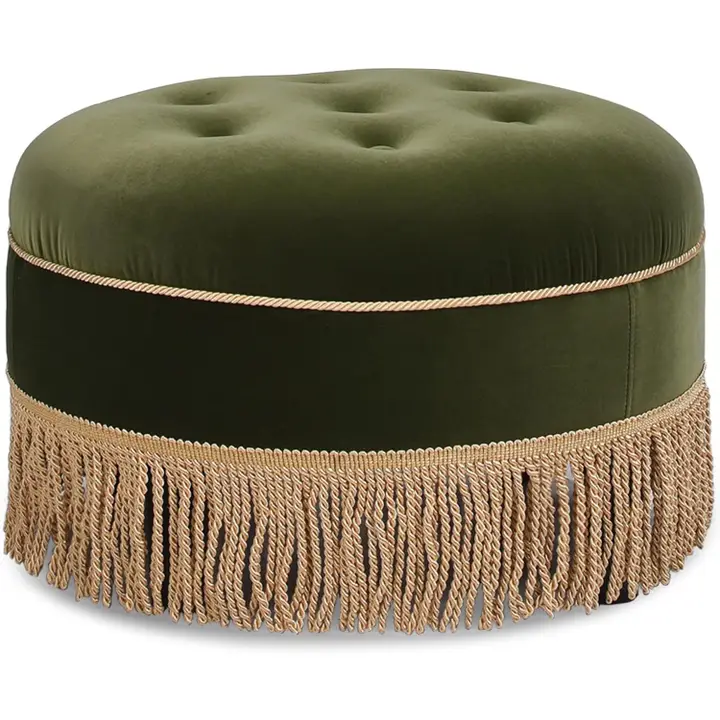
A buyer does not place a new SKU because it looks pleasant in a styled photo. A buyer places it because the product can hold attention at first sight, justify its floor space, and survive the journey from sample room to retail rollout. That is exactly why the fluted velvet ottoman deserves a closer look now.
From a German home retail perspective, this is not merely a decorative accent. It is a compact, margin-aware product type that translates texture into perceived value. It gives softness without becoming weak, character without becoming loud, and function without asking for a large footprint. In a market where every square metre matters, that balance is commercially useful.
What makes this timing especially relevant is the wider European design conversation. Recent fair and trend signals around Europe continue to point toward materials, tactility, craftsmanship, richer textures, and practical sourcing logic rather than empty novelty. Official channels around Ambiente emphasise global sourcing, contract relevance, and sustainability; Maison&Objet has highlighted rich textures, material-driven design and craftsmanship; and imm cologne’s current retail commentary is very clear that functionality, smart packaging, price-performance, and short time-to-market are decisive.
This matters because the fluted velvet ottoman sits exactly at that intersection. It is tactile, but still disciplined. It feels elevated, but does not require luxury-level complexity. Its vertical fluting gives the piece a more architectural profile than a basic pouffe, while velvet adds visual depth and a soft premium signal. For chain retail, that is useful value translation: the customer sees more detail, more comfort, and more design intention than the footprint or materials cost alone might suggest.
Academic research supports why this works. MIT Press notes that tactile perception is an integrated part of aesthetic evaluation, not a secondary effect. A recent BioResources study on soft sofa fabrics likewise found that soft upholstery materials strengthen emotional experience and perceptual response. In practical retail language, this means texture is not decoration after the fact. Texture helps sell the object before the customer has fully analysed it.
For a home chain buyer, the commercial strength of a fluted velvet ottoman is that it can play several roles at once. In one assortment, it can be a stand-alone accent seat. In another, it can sit beside a sofa as a soft occasional table substitute. In smaller urban homes, it can even compete with a round storage ottoman by offering a similar compactness with a more refined silhouette. If the lid version is developed correctly, it also overlaps with the logic of an upholstered storage bench: hidden utility, but in a more flexible footprint.
This is also where product family thinking becomes important. A fluted body can be extended into a channel tufted ottoman, a storage version, or even a coordinated bench program. Good buyers do not only buy one hero item. They buy the possibility of visual continuity across several price points and room types. That is why this category is interesting: one core language, several retail expressions.
From a retail buyer’s perspective, the fluted velvet ottoman is not a short-term fashion piece. It sits in a more useful middle category: distinctive enough to attract attention, but disciplined enough to stay commercially valid beyond one season. For chain retail, this balance is important. Products that are too generic disappear quickly. Products that are too trend-led often age too fast.
For European chain stores, especially in Germany, the customer profile is also very specific. The buyer is not sourcing for an abstract “luxury audience.” The actual end customer is often looking for calm interiors, warm material signals, and a product that appears considered rather than theatrical. The latest European fair language supports exactly this direction: tactile surfaces, material honesty, and products that combine atmosphere with practical use.
That is why the fluted velvet ottoman performs better than many louder accent pieces. It gives atmosphere, but it stays manageable. It brings softness into the assortment, but it does not force the retailer into a highly seasonal colour story. It can work in muted taupe, olive, rust, mushroom, deep blue, or blackened berry. It can sit beside wood, metal, boucle, marble-look surfaces, or warm neutrals without conflict. In retail terms, it is cooperative.
Of course, a good-looking concept is not enough. This category only becomes powerful when the supplier side is equally disciplined. A serious buyer will immediately ask several questions. Can the fluting stay clean and regular in mass production? Does the velvet hold colour well? Is the seat foam resilient enough for commercial handling? Is the carton efficient? Is there a clear installation guide if legs or hardware are packed separately? Can the same supplier manage related dining or occasional seating programs with stable quality control?
This is where Teruier’s cross-border design-manufacturing coordination model becomes relevant. The point is not simply to offer one ottoman. The point is to translate market signals into a retail-ready SKU family, then connect design intent with production stability, packaging logic, and replenishment discipline. In other words, the buyer is not only choosing an object. The buyer is choosing whether the supplier can think like a retail partner.
That is also why buyers who already work with a dining chair OEM supplier should pay attention here. The operational logic is similar. The question is not whether the sample looks attractive. The question is whether the factory can maintain shape consistency, fabric control, seat performance, and packaging efficiency across volume. A capable wholesale furniture manufacturer understands that the ottoman is not a side category. It is part of collection logic.
In fact, the best version of this product is not sold alone at all. It is sold as part of a merchandising system:
a fluted velvet hero piece for the display image,
a round storage ottoman for practical upsell,
an upholstered storage bench for larger rooms,
and a related chair or dining accent line for visual continuity.
That is how a soft category becomes a stronger retail story.
So, is the fluted velvet ottoman only a pretty accent? No. That view is already outdated.
For today’s European retail buyer, it is a compact product with three strong advantages: it raises perceived value through texture, it adapts easily to different room concepts, and it can be expanded into a commercially coherent family. In a market that increasingly rewards tactile materials, practical packaging, and quick retail translation, this is not a decorative side note. It is a disciplined opportunity.
And that is the real reason to take it seriously:
the fluted velvet ottoman is not only easy to style.
It is easy to sell when the supplier understands why it should exist.



