
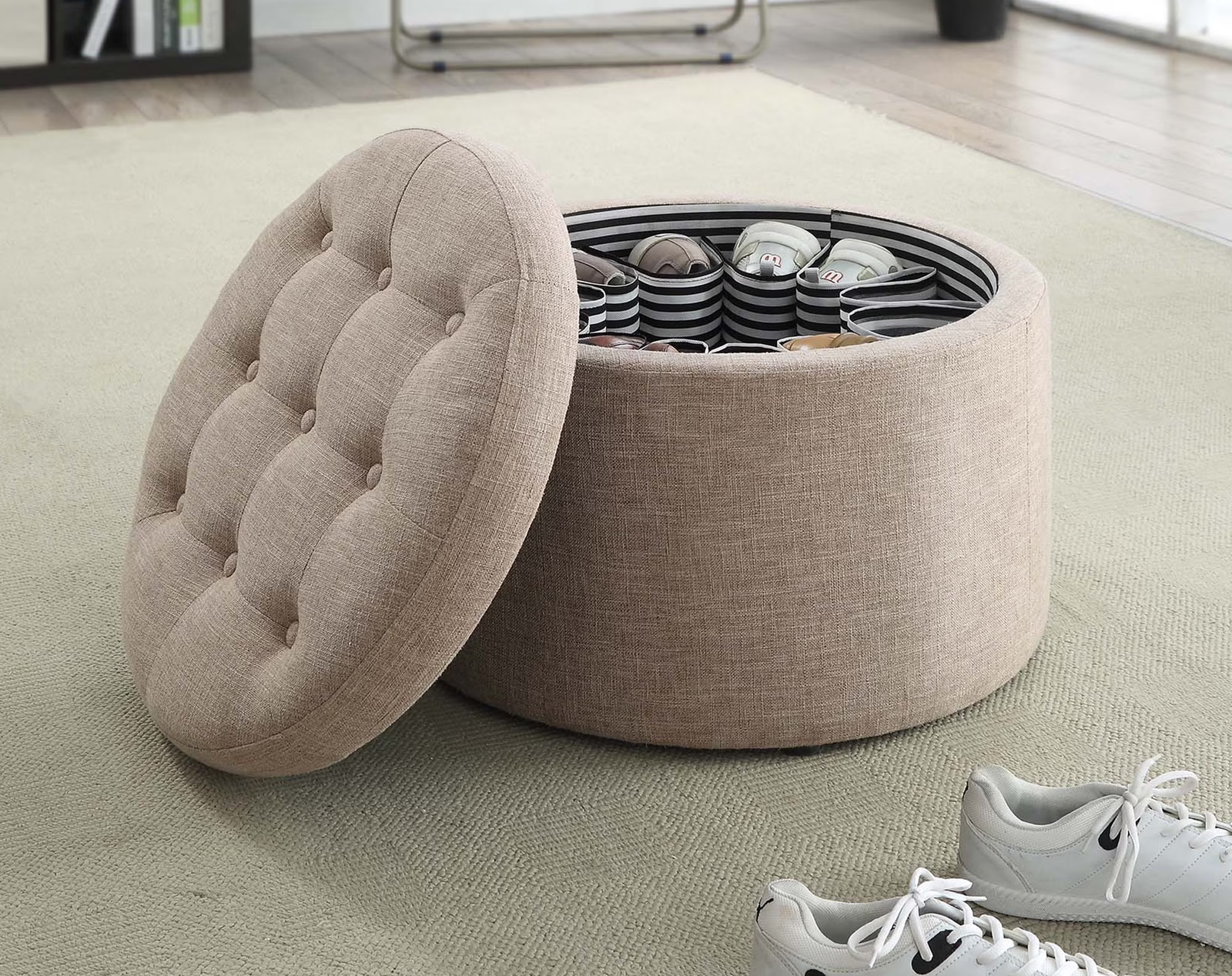
Why the Chicago Shoe Storage Ottoman May Be the Smartest Entryway SKU of 2026
There is a reason some entryway products sell once, and others keep getting reordered.
The weak SKU solves one problem.
The strong SKU solves the room.
That is exactly why I keep coming back to the Chicago shoe storage ottoman. On paper, it is simple: a place to sit, a place to hide shoes, a softer landing zone at the door. But from a retail buyer’s perspective, it does something more important. It combines seating, storage, and visual calm in one footprint. That is not just good design. That is good assortment logic.
For chain-store buyers in the U.S., the timing is right. The newest market signals from Atlanta Market January 2026 and Las Vegas Market Winter 2026 both point toward stronger sourcing activity, more first-time buyer engagement, and a cross-category buying environment where retailers are looking for products that are easy to merchandise and easy to justify. Atlanta reported a 5% increase in stores attending and a 15% increase in first-time buyers, while Las Vegas emphasized strong order writing, new-account growth, and broad cross-category commerce.
That matters because a product like a Chicago shoe storage ottoman fits exactly the kind of buyer pressure the U.S. market is dealing with now: tighter spaces, higher expectations for usability, and a stronger need for SKUs that earn their floor space.
The buyer is not shopping for furniture alone
Let us define the user profile clearly.
The reader of this article is not a casual shopper. This is the buyer for a furniture chain, a home décor retailer, a regional lifestyle group, or a multi-location store network. This person may still enjoy beautiful silhouettes, but beauty alone is not enough. The product must work in a planogram, survive a price review, photograph well online, fit mixed store footprints, and justify reorders.
This profile aligns closely with the latest U.S. market environment. Atlanta Market positioned Winter 2026 as a high-engagement sourcing destination for independent retailers, national chains, designers, and buying groups, while Las Vegas Market highlighted discovery, temporary exhibits, new showrooms, and buyer tools designed to make assortment planning faster and more effective. In plain English: buyers are not only hunting for style. They are hunting for usable winners.
That is why the Chicago shoe storage ottoman deserves attention. It is not a decorative extra. It is a practical conversion SKU with a clean retail story.
Why this category is getting stronger
A lot of furniture still sells by image. The better products sell by friction reduction.
When customers walk in the door, they do not need more visual noise. They need a place to drop, sit, store, and reset. A shoe storage ottoman handles that sequence naturally. It gives the room a cleaner first impression and gives the customer a more organized everyday habit.
That is not only common sense. It is supported by research. UCLA’s Center on Everyday Lives of Families documented how American homes accumulate a staggering number of possessions, often pushing everyday functions into cluttered spaces. Separate academic work on small-space furniture design argues that multifunctional furniture becomes more valuable when living space is limited and when a single piece can perform several roles clearly and efficiently.
From a buyer’s perspective, this changes the conversation. You are no longer selling just an ottoman or just a storage bench. You are selling lower friction at the entryway, faster room recovery, and better use of square footage.
That is why this category is stronger than it first appears.
What the latest U.S. market signals are really saying
I do not read market trends as decoration. I read them as merchandise signals.
One of the most useful official signals this season came from Las Vegas Market Snapshot January 2026, which highlighted themes like “Restorative Softness” and “Symbols & Shapes.” The language is telling: soft lines, lush textiles, full silhouettes, sculptural forms, carved detail, and visual depth. This is not a hard-edged, purely minimal season. It is a softer, more tactile, more shape-aware season.
For upholstery buyers, that creates a natural opening for materials like performance boucle and room-setting companions like a boucle swivel chair. My reading of the trend is straightforward: if the market is leaning toward softness and sculptural comfort, then a well-developed shoe storage ottoman has a better chance of feeling current without looking risky.
This is where a flip top storage bench and a Chicago shoe storage ottoman begin to overlap strategically. One leans more bench-like, the other more soft-entryway and lifestyle-driven. But both belong to the same retail idea: furniture that works harder while looking calmer.
What the ottoman sourcing intelligence would say
Our ottoman selection intelligence would make one warning very clear:
Do not buy the product because the lifestyle photo looks warm.
A lot of mediocre ottomans look good in the first photo. The real question is whether the SKU survives actual retail use.
A strong Chicago shoe storage ottoman usually gets five things right:
the lid opens smoothly and safely
the shoe compartment is genuinely useful, not symbolic
the seat feels credible, not decorative-only
the upholstery recovers well after repeated use
the proportions work in entryways, apartments, mudrooms, and small bedrooms
This last point matters more than many buyers admit. If the ottoman is too shallow, it loses function. If it is too bulky, it loses placement flexibility. If the fabric looks rich but performs poorly, the customer loses trust.
That is why material choice matters. Research from North Carolina State University notes that differences in upholstery fabric properties can affect cushion stiffness and sitting experience, which means textile selection is not just a surface decision. It directly affects comfort consistency and perceived quality.
In buyer language, that means this category should never be sourced as a styling item only. It must be sourced as a comfort-storage-performance product.
Why “Chicago” works as more than a keyword
The phrase Chicago shoe storage ottoman works because it carries a believable use case.
Chicago suggests urban life, weather transitions, real entryways, real shoes, real routines, and homes that need better first-zone organization. Whether the customer lives in a condo, a family house, or a compact apartment, the product idea makes immediate sense. It is easy to explain online, easy to understand in store, and easy for a sales associate to demo in ten seconds.
That simplicity is powerful.
Retail buyers are often told to chase dramatic hero pieces. I think that is incomplete. The better strategy is to build room-winning SKUs around repeat behavior. A customer uses an entryway product every single day. That makes this category commercially stronger than many “accent-only” pieces that photograph well but solve very little.
Where Teruier’s value translation matters
This is where Teruier’s value translation becomes commercially useful.
A buyer does not simply need a factory that can copy a shape. A buyer needs a partner that can translate a market signal into the right product decisions.
For a Chicago shoe storage ottoman, that translation includes questions like:
Should the silhouette feel softer and more residential, or cleaner and more chain-friendly?
Should the fabric direction lean into performance boucle, linen texture, or a smoother woven upholstery?
Should the top read more like an ottoman or more like a bench?
Should the SKU be sold alone, or paired with wholesale upholstered chairs and a boucle swivel chair as part of a larger room story?
That is what serious sourcing looks like. Not just “Can you make this?” but “Can you make this commercially correct?”
And that question gets even more important during a retail sourcing trip, when buyers are comparing not only appearance, but durability, freight logic, carton efficiency, and reorder confidence.
What a winning version looks like in 2026
If I were editing this SKU for a U.S. chain assortment today, I would not push it toward overdesign.
I would want it to be:
soft in form, but clean in profile
compact enough for urban homes, but substantial enough to feel trustworthy
useful for multiple pairs of shoes, not just symbolic storage
comfortable enough for daily sit-down use
upholstered in a tactile fabric with better-than-average recovery
easy to pair with neutral case goods, a flip top storage bench, or a soft sculptural accent chair program
The best version is not loud. It is convincing.
And that, to me, is why the Chicago shoe storage ottoman has real potential. It sits at the intersection of three things the market is actively rewarding right now: comfort, utility, and clearer everyday living. The 2026 U.S. sourcing environment is rewarding discovery, cross-category shopping, and trend-forward but commercially usable products, while academic research continues to support the value of decluttering and multifunctional furniture in everyday life.
Final buyer take
A great SKU does not just fill space on the floor. It reduces friction in the customer’s life and increases confidence in the buyer’s assortment.
That is why I would not treat the Chicago shoe storage ottoman as a side item.
I would treat it as an entryway anchor.
Because when one product can deliver seating, hidden storage, softer styling, and a cleaner room story, it stops being just another ottoman.
It becomes the kind of SKU that earns its reorder.



