
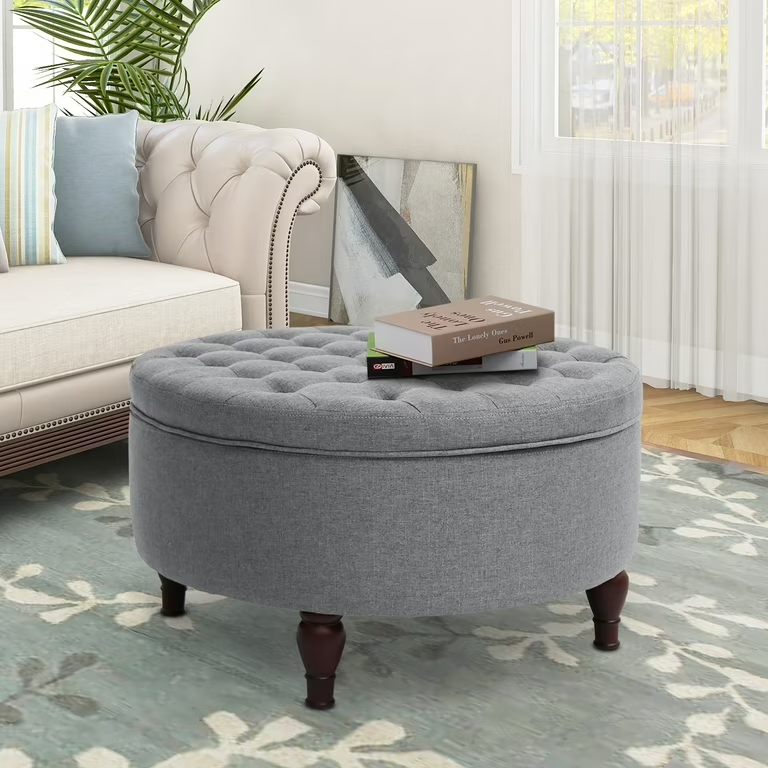
For many years, the center of the living room was easy to define. It was the coffee table. Hard surface, fixed role, predictable styling. But retail logic is changing, and so is the room itself. Today, the more interesting question for a buyer is not what used to sit in the middle of the room. It is what deserves to sit there now. More and more often, the answer is the cocktail ottoman.
From a German chain-retail perspective, this is not a decorative accident. It is a commercially intelligent product. A good cocktail ottoman offers three things at once: visual softness, practical flexibility, and stronger emotional appeal than a standard table. It can anchor a seating group, hold a tray, offer extra seating, soften the room acoustically, and create a more residential atmosphere without looking weak. In a market where customers want comfort but retailers still need discipline, that combination is extremely useful.
This is also very much in line with the latest European fair language. Messe Frankfurt’s retail guidance for 2026 highlights “textile, tactile and nature-inspired materials” and points to home assortments that communicate sensuality, quality, and handcrafted appeal. Ambiente’s official trend communication has also emphasised warm living environments, renewed sensitivity to nature and craftsmanship, and authentic materials such as wood, ceramics, glass, and metal. And imm cologne’s long-running retail logic around multifunctional furniture remains highly relevant: added-value pieces that are space-saving, flexible, and suitable for different functions continue to answer real shifts in how people live.
That matters because the cocktail ottoman sits exactly at the intersection of those signals. It is tactile. It is flexible. It feels more lived-in than a conventional coffee table, but more structured than an oversized pouf. In practical merchandising terms, it helps a retailer sell comfort as a visual proposition. And that is increasingly important in Europe, where customers are not only buying furniture pieces anymore; they are buying atmosphere, softness, and a sense that the home can adapt to more than one mode of living. imm cologne explicitly frames multifunctional furniture as a response to smaller, more flexible homes, while a 2024 Elsevier study found that flexibility and multifunctionality in the home support residents’ psychological wellbeing.
There is another reason this category is strong: it performs well even before the customer touches it. That is especially relevant now, when so many buying journeys begin online or in image-heavy retail environments. A 2026 peer-reviewed study in Electronic Commerce Research found that in touch-absent shopping contexts, consumers rely on visual cues to infer material quality and comfort, and that product images which evoke realistic tactile impressions can reduce perceived risk and increase purchase intention. For upholstery-driven categories such as ottomans, this is highly valuable. A well-designed cocktail ottoman photographs with depth, volume, softness, and surface character. In other words, it starts selling before the customer sits down.
For the right buyer profile, this is not a minor detail. The relevant audience is not only the design-led shopper. It is also the mainstream customer in a European home chain who wants one object to do several jobs without making the room feel busy. This customer may pair the ottoman with a dark wood bench elsewhere in the space, or respond to a living room story that balances upholstery with a more architectural accent such as an arched leg bench. The point is not that every room needs matching pieces. The point is that the cocktail ottoman works well inside a broader assortment story: soft against hard, upholstered against wood, comfort against line. That balance is what makes it commercially stable.
From an assortment-planning perspective, the mistake many suppliers make is to treat the cocktail ottoman as a casual add-on. It is not. It is a center-stage SKU, and it should be developed like one. Proportion matters. Height matters. Foam resilience matters. Fabric friction matters. Tray compatibility matters. If the product is too soft, it loses function. If it is too rigid, it loses charm. The best version holds a tray confidently but still reads as comfortable seating. That is where buyer trust begins.
This is also where Teruier’s cross-border design-manufacturing coordination becomes meaningful. The real task is not simply to produce an ottoman. The real task is value translation: taking a market signal from Europe, refining it through a Shenzhen home décor style review, then turning it into retail-ready home decor with the right proportions, finish options, packaging logic, and reorder potential. A supplier who understands this category should not arrive only with a sample. The supplier should arrive with a clean spec sheet, material options, carton logic, and clear export documentation readiness. For chain buyers, that is often the difference between “interesting item” and “approved program.”
This point is often underestimated by factories and overvalued by serious buyers. The buyer is not merely asking whether the ottoman looks good. The buyer is asking whether the item can survive the full commercial journey: showroom review, sampling, compliance checks, packaging approval, freight calculation, in-store presentation, e-commerce photography, and replenishment. A good cocktail ottoman has to travel through all of those stages without losing its identity. When that happens, it stops being a trend piece and becomes a system piece.
And that, in my view, is the real reason the category has more future than many people think. The cocktail ottoman is not replacing the coffee table because fashion suddenly changed its mind. It is gaining ground because homes have changed, retail priorities have changed, and customer expectations have changed. The room now asks for softness, flexibility, and layered function. The retailer asks for visual impact, commercial clarity, and sourcing discipline. Very few products answer both sides well. This one does.
So why may the best coffee table in the room no longer be a table?
Because a table usually does one job.
A cocktail ottoman does several, and it does them with more warmth.
For a chain-store buyer, that is not just styling.
That is margin logic, floor logic, and modern living logic brought into one product.



