
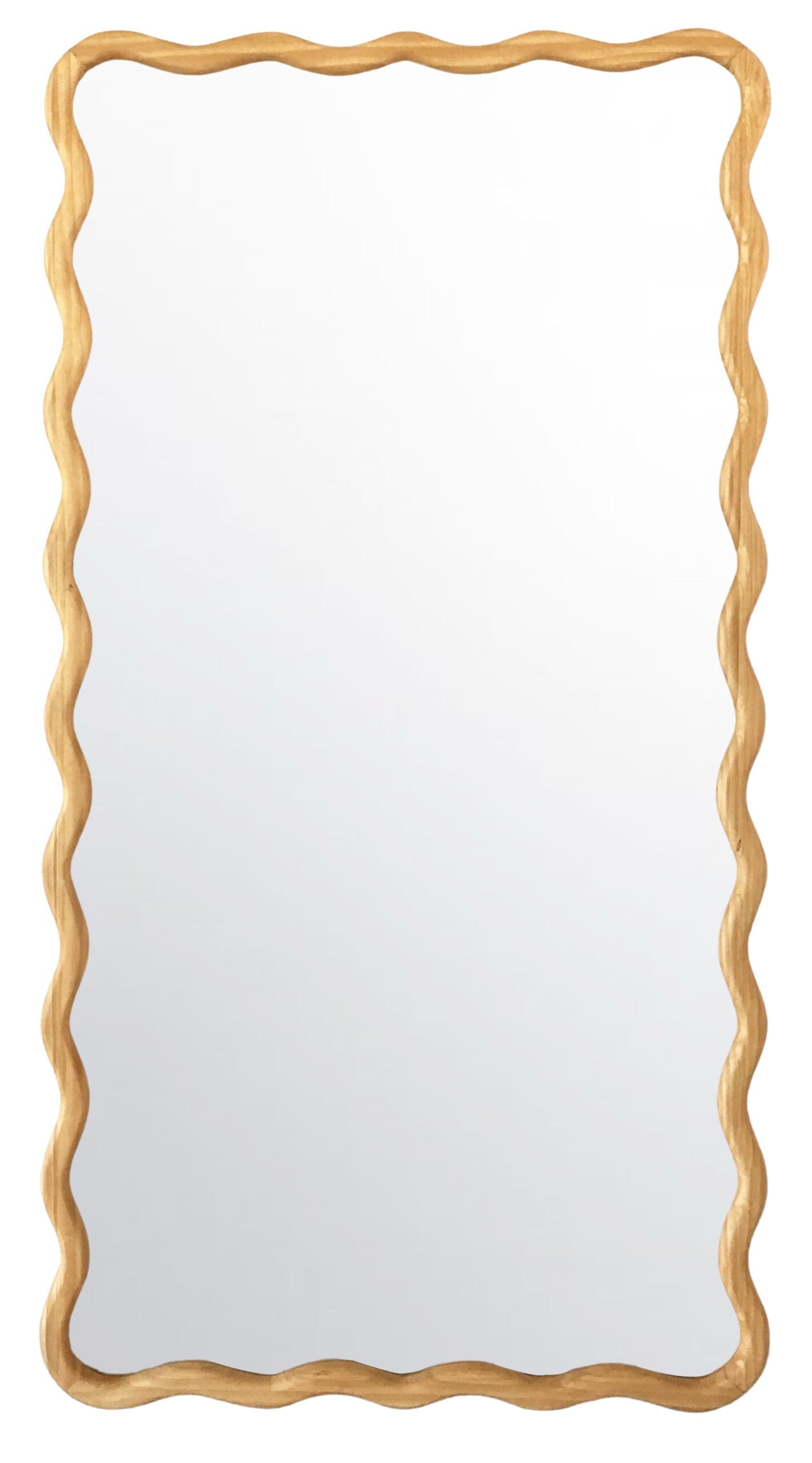
A lot of mirrors are easy to approve.
Very few are easy to believe in.
That is the real difference.
As a buyer for a home décor retail chain, I see endless mirror options every season: black metal frames, thin gold frames, clean rectangles, arched tops, basic round shapes. Most of them are not bad products. In fact, many of them are perfectly sellable. But being sellable is not the same as being worth a place in the assortment.
When I look at a Scalloped Wall Mirror Natural Wood, I am not just looking at a decorative wall item. I am looking at a product decision. I am asking: does this mirror only look attractive in a sample room, or does it have the right logic to survive real retail?
That is where good selection begins.
The first thing I buy is not the product. It is the feeling.
Customers do not shop from specification sheets. They shop from emotion first, then justify with function.
That is why shape matters so much.
The scalloped edge immediately softens the mirror. It feels warmer, friendlier, and more styled than a standard rectangular frame. It introduces movement without becoming strange. That balance is important. If a product is too plain, it disappears. If it is too expressive, it narrows its audience. A scalloped silhouette lives in the middle ground where retail performs best: visually distinctive, but still broadly acceptable.
That is usually the first sign of a good pick.
A buyer is not just hunting for a beautiful object. A buyer is hunting for a product that can stop the eye in store, earn a click online, and still feel easy enough for a wide customer base to bring home. This mirror does that well.
Natural wood is not just a finish. It is a merchandising advantage.
The second reason this case works is the natural wood frame.
In home décor retail, material language matters as much as form. Natural wood tells customers something immediately: warmth, ease, texture, honesty, and everyday livability. It softens the decorative effect of the scalloped edge and keeps the mirror from feeling overly sweet or overly fashion-driven.
That is what makes the product commercially strong.
If the same scalloped shape were done in a bright lacquer, polished gold, or high-gloss finish, it could become more trend-sensitive and harder to place across seasons. But natural wood gives it a longer runway. It works with soft neutrals, modern organic spaces, casual coastal assortments, warm transitional rooms, and even some cottage-inspired presentations.
For a retail buyer, that flexibility is valuable.
Because flexibility means the SKU has more than one chance to win.
It can work in entryway stories.
It can work above consoles.
It can work in bedroom wall décor.
It can work in small-space styling.
It can work as a decorative counterpoint to upholstery, ceramics, and wood furniture.
That is not a minor point. That is the difference between a product that looks nice and a product that earns floor space.
Good selection is not about following trends. It is about reading how trends become commercial.
One of the biggest mistakes in product selection is confusing trend awareness with trend dependency.
A good buyer does not choose a product just because it looks current. A good buyer chooses a product because it translates a trend into something commercially usable.
This mirror is a strong example.
Soft curves, organic forms, and warmer natural finishes have been shaping home décor direction for a while because customers are moving away from rooms that feel too cold, too rigid, or too industrial. But not every product inspired by that shift becomes a strong retail item. Some lean too abstract. Some lose function. Some look fashionable for six months and dated the season after.
The Scalloped Wall Mirror Natural Wood works because it takes that softer design language and makes it understandable for real customers. It does not ask shoppers to learn a new style vocabulary. It simply gives them a mirror that feels more inviting than the last one.
That is what I would call value translation: turning design movement into something a shopper can instantly say yes to.
And that is one of the smartest ways to pick a product.
The best assortment pieces are the ones that help other products sell.
Another reason I would choose this mirror is that it is not a lonely product.
Some items demand a whole story around them. Some items only function if the styling is perfect. This is not one of them. This mirror actually helps build the story.
That matters in chain retail.
A buyer is rarely selecting one hero product in isolation. The real question is whether the item strengthens the surrounding assortment. Does it make the console table feel more complete? Does it support the ceramics program? Does it lift the wall décor story? Does it help the customer imagine a room faster?
This mirror does.
Its outline gives visual interest. Its wood tone adds warmth. Its decorative character is present, but not overpowering. That makes it an excellent connector piece. In practical merchandising terms, that often means stronger compatibility with adjacent categories and more styling opportunities for store teams.
And when a product helps the whole presentation look better, its value is larger than its own sales number.
The safest product is not always the smartest one.
Many retail teams still fall into the trap of choosing the “safe” mirror: the plain rectangle, the minimal arch, the frame that offends no one and excites no one.
That kind of product feels easy in a line review meeting. But in store, easy often becomes invisible.
The smarter buying decision is not the loudest item in the room, and it is not the safest. It is the one that gives customers a reason to pause without giving merchants a reason to worry.
That is exactly why I would place confidence in a Scalloped Wall Mirror Natural Wood.
It is decorative, but not difficult.
It is trend-right, but not trend-trapped.
It is warm, but not rustic.
It is distinctive, but still scalable.
That is a very strong retail combination.
What I am really selecting here is not a mirror. It is a sales behavior.
When I approve a product like this, I am not only approving the object itself. I am approving the behavior I expect from it in the market.
I expect it to photograph well.
I expect it to read clearly on a digital listing page.
I expect it to create a soft focal point on a wall.
I expect it to attract customers who want something more elevated than a standard basic mirror, but still accessible enough to live with every day.
That expectation is the heart of selection logic.
A strong product pick is not random taste. It is pattern recognition. It is knowing when a product has the right balance of emotional pull, material warmth, visual identity, and merchandising flexibility.
This mirror checks those boxes.
Why this case matters for suppliers too
From the supplier side, this product also reveals something important: good selection is easier when the supplier understands not only how to make a mirror, but why the mirror deserves to exist.
That is where Teruier’s value becomes clearer.
The goal is not simply to produce another wall mirror. The goal is to help buyers translate a design direction into a retail-ready product with enough clarity, warmth, and commercial range to justify placement in a chain assortment.
That is a different mindset.
It means understanding that the scalloped edge is not decoration for decoration’s sake. It is a visual device that softens the wall.
It means understanding that natural wood is not merely a finish option. It is what broadens styling compatibility and lengthens commercial life.
It means understanding that buyers do not just purchase looks. They purchase confidence.
And confidence comes from logic.
Final thought
If I were choosing between ten mirrors for a new assortment, I would not automatically choose the most expensive one, the most artistic one, or the most conservative one.
I would choose the one with the clearest reason to win.
For me, that is why a Scalloped Wall Mirror Natural Wood stands out.
It gives the customer shape without stress.
It gives the assortment warmth without heaviness.
It gives the store a decorative piece that feels designed, but still easy to sell.
And most importantly, it proves that the best product selections are not based on what looks nice in theory, but on what works beautifully in real retail.
That is not just mirror selection.
That is buying discipline.



