
Why Great Buyers Don’t Pick Finishes One by One — They Build a Finish Story
The Real Job of Materials & Finishes in Home Decor
A lot of people still think materials and finishes are about taste.
They are not wrong.
They are just not finished.
In actual buying, materials and finishes are not only about whether a product looks good on its own. They are about whether multiple products can sit together and make commercial sense.
That is the part many suppliers miss.
A mirror may be strong.
An ottoman may be beautiful.
A ceramic vase may be charming.
And still, the assortment can fail.
Why? Because the finishes are speaking three different languages.
One is polished and formal.
One is soft and casual.
One is playful and artisanal.
Individually, they may all work. Together, they may look like three buyers showed up to the same meeting and refused to compromise.
That is why better buyers do not choose finishes one product at a time.
They build a finish story.
What a “Finish Story” Actually Means
A finish story is the visual logic that helps different products feel related, even when they belong to different categories.
It is not about making everything identical.
That would be boring, and usually a little lifeless.
It is about making sure the assortment shares enough common signals to feel intentional.
Those signals usually come from four things:
- tone
- texture
- reflectivity
- material temperature
For example:
- a warm brushed mirror frame
- a soft textured neutral ottoman
- a tonal ceramic vase with a matte-reactive glaze
These do not match in a rigid way.
They relate.
And relation is what makes a shelf, a room set, or a collection feel professionally built.
Why This Matters More Than Ever in Broad Retail
In broad home decor retail, the problem is rarely “Can we find something interesting?”
The real problem is:
Can we find something interesting that still works with everything else we need to sell?
That is where finish strategy becomes commercial strategy.
If the mirror feels too luxury-formal, the ottoman feels too relaxed, and the ceramic feels too novelty-driven, the buyer ends up with an assortment that needs too much explanation.
And explanation is expensive.
The strongest finish stories often do the opposite.
They make products feel easier to buy together.
That is why buyers keep leaning toward finishes that offer:
- enough character to feel updated
- enough restraint to fit multiple settings
- enough consistency to reorder without drama
That balance is not accidental.
It is built.
Mirrors: The Finish Usually Sets the Assortment Temperature
Mirrors often act like finish anchors.
Because they are large, reflective, and visually dominant, their finish tends to set the “temperature” for everything around them.
A mirror frame in cold polished chrome pushes the assortment one way.
A frame in warm black or brushed bronze pushes it another.
A dark wood frame tells a different story again.
This is why mirror finishes matter beyond the mirror itself.
A good mirror finish helps answer questions like:
- Is this assortment warm or cool?
- Is it architectural or relaxed?
- Is it modern-clean or soft-organic?
- Is it statement-led or layering-friendly?
In many commercially successful assortments, mirror finishes that work best are the ones that feel refined without becoming stiff.
That often includes:
- brushed metals
- muted metallics
- warm dark woods
- low-gloss frame treatments
- finishes that feel clean but not cold
A mirror can absolutely be dramatic.
But if the finish becomes too sharp, too shiny, or too trend-specific, it can start bullying the rest of the assortment.
And no buyer wants a hero product that behaves like a diva.
Ottomans: Texture Is the Bridge Between Hard Goods and Soft Mood
Ottomans do something very useful in an assortment: they soften the environment.
That is why their finish language often depends less on shine and more on texture.
Ottomans help connect hard materials like metal, mirror glass, ceramic, and wood to the emotional side of the room. Their upholstery finish can make the whole assortment feel warmer, calmer, richer, or more layered.
The strongest ottoman finishes in commercial settings often share a few traits:
- tactile but not fussy
- textured but not visually noisy
- neutral but not flat
- trend-aware but easy to place
This is why buyers often prefer:
- bouclé-inspired textures
- woven fabrics with visible surface depth
- restrained stripe or grid effects
- soft earthy neutrals
- fabrics that add dimension without stealing the room
The ottoman’s role is often not to dominate.
It is to connect.
A strong ottoman finish makes a mirror feel less severe.
It makes ceramics feel less isolated.
It turns a product group into a room language.
That is not softness.
That is function.
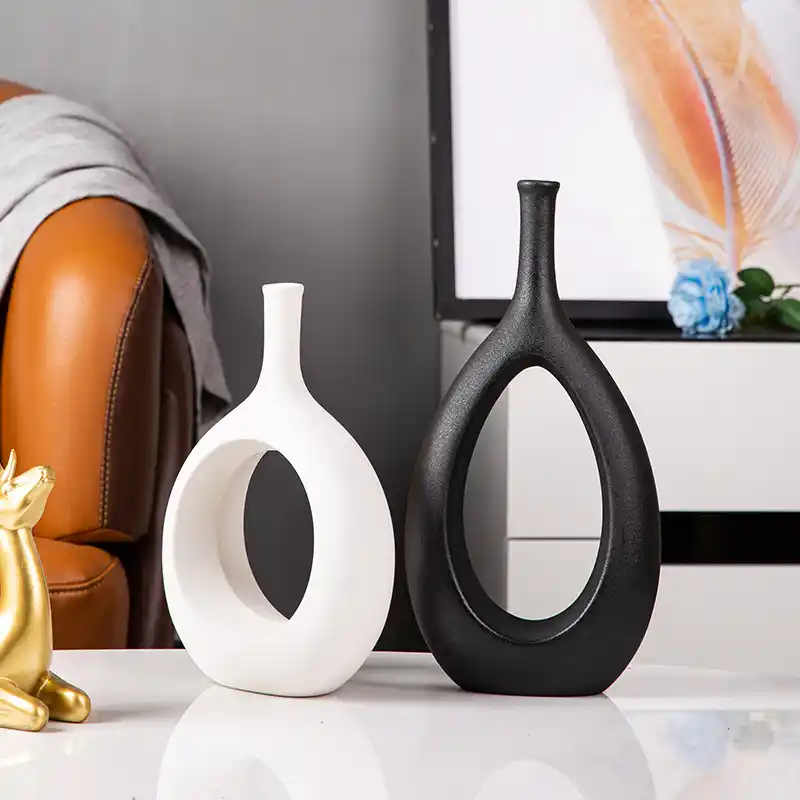
Ceramics: Finish Creates Rhythm, Not Just Decoration
Ceramic decor brings rhythm to an assortment.
It gives the eye a place to land, repeat, and move.
But that only happens when the finish is doing more than being “pretty.”
A ceramic finish needs to help with three things:
- shelf variation
- collection continuity
- perceived craftsmanship
This is why tonal glaze finishes work so well.
They allow pieces to feel different without feeling disconnected.
For example:
- matte cream
- olive reactive glaze
- chalky terracotta
- brushed white over clay body
- low-gloss hand-finished surfaces
These finishes help buyers create depth inside an assortment without making each piece look like it came from a different universe.
Ceramics can carry more personality than mirrors and ottomans.
That is one of their strengths.
But even here, the commercially stronger finish stories tend to stay within a visual family.
That family may be earthy, sun-faded, artisan, playful-organic, or quietly sculptural.
The point is not uniformity.
The point is rhythm.
A Better Comparison: What Each Category Contributes to the Finish Story
| Category | What Finish Does Best | What Buyers Need From It | Common Mistake |
|---|---|---|---|
| Mirrors | Sets tone and visual temperature | A finish that anchors the assortment without overpowering it | Choosing a finish that is too cold, too shiny, or too formal for the rest of the range |
| Ottomans | Adds softness and bridge texture | Upholstery that connects hard goods to livable styling | Using texture that is too niche, too heavy, or too pattern-loud |
| Ceramics | Adds rhythm and artisanal depth | Surface variation that feels curated, not chaotic | Overdoing novelty or allowing too much uncontrolled glaze variation |
The Teruier Cross-Border Design and Manufacturing View
At Teruier, this is where the cross-border design and manufacturing collaboration model becomes practical, not just poetic.
Because the challenge is not only to make attractive products.
The challenge is to make products that can speak to each other across categories, price points, and retail contexts.
That requires more than sourcing.
It requires coordination between:
- trend direction
- material choice
- finish execution
- category role
- buyer positioning
- shelf logic
A brushed mirror frame is not only a mirror finish decision.
It is also a ceramics decision, an upholstery decision, and an assortment decision.
That is the real work.
The best finish strategy is rarely made by looking at one sample in isolation.
It is made by asking what that sample allows the rest of the collection to become.
How Buyers Can Build a Better Finish Story
A practical way to do this is to think in layers.
Start with the anchor finish.
Usually that is the most visually dominant category, often the mirror.
Then add the bridge finish.
That is often the ottoman, bench, or upholstered piece that softens the look.
Then add the rhythm finish.
That is usually the ceramic or decorative object layer that repeats, enriches, and personalizes the assortment.
A useful formula looks like this:
- Anchor: brushed bronze, warm black, or dark wood mirror frame
- Bridge: neutral woven or textured ottoman upholstery
- Rhythm: matte or tonal ceramic finish with controlled variation
That combination gives buyers three things at once:
- structure
- comfort
- detail
Which, frankly, is also what many customers want from their homes.
FAQ: Materials & Finishes for Assortment Building
What is a finish story in home decor?
A finish story is the visual logic that connects different products through tone, texture, reflectivity, and material feel, so the assortment looks intentional instead of random.
Do all products in a collection need matching finishes?
No. Matching is not the goal. Cohesion is. Products should feel related, not cloned.
Why do some assortments feel expensive even when individual products are simple?
Because the materials and finishes are coordinated well. Buyers often respond to overall finish harmony more than isolated complexity.
Should mirrors always be the finish anchor?
Not always, but often. Because mirrors are visually strong, their finish can influence the perceived tone of the whole assortment.
What kind of ottoman finish is easiest to place commercially?
Textured neutrals with visible depth usually work well because they add warmth without limiting styling flexibility.
How much ceramic variation is too much?
Enough that two units feel like different products, not related pieces. Good ceramic variation adds life. Bad variation breaks continuity.
Final Thought
Great assortments do not happen because every product is special.
They happen because every product knows its role.
The mirror sets the tone.
The ottoman carries the softness.
The ceramics create rhythm.
And the finishes are what make that conversation work.
That is why strong buyers do not ask only, “Is this finish beautiful?”
They ask, “What does this finish help the whole range become?”
That is a much better question.
And usually, a much more profitable one.



