
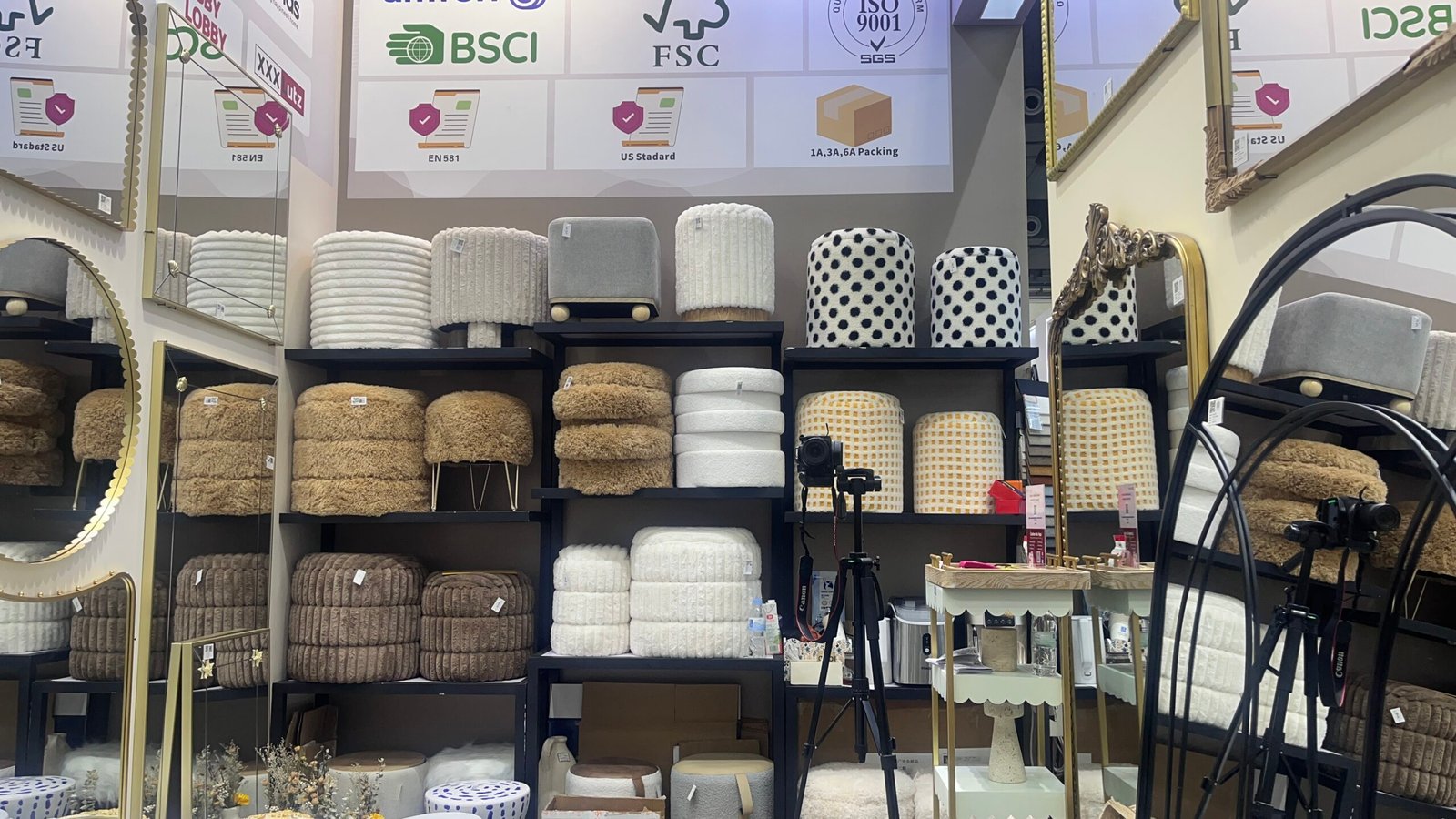
Why Bouclé Ottomans Keep Winning in Germany (And How to Source Them Without Regret)
As a buyer for a German home décor retail group, I don’t get paid for “pretty products.” I get paid for sell-through, low returns, clean documentation, and a supplier who does what they said they would do.
And yes—bouclé ottomans are still winning in Germany. Not because they are trendy in a fragile way, but because they hit a very German sweet spot: warm look, compact footprint, high perceived comfort, easy add-on sale.
But here’s the part many vendors don’t understand: in Germany, the product is only half the deal. The other half is repeatable quality + packaging discipline + compliance readiness.
Why bouclé works in German retail
Bouclé is a texture you can feel across the aisle. That matters more than people admit. Research in consumer psychology and marketing consistently shows that tactile perception influences product evaluation and preference—especially when shoppers can touch the surface.
In store language: touch sells. And an ottoman is one of the few furniture items shoppers naturally touch before buying.
The 2026 Europe trade-show signal: “tactile + craft + responsible materials”
This year’s European fair circuit is basically repeating one message: we’re moving from flat minimalism to emotion, tactility, and craft—without losing sustainability.
Ambiente 2026 (Frankfurt) framed its forward-looking direction with “Ambiente Trends 26+,” focusing on how we want to live, work, and dwell—materials, shapes, and futures. That’s not a sofa-only message; it’s exactly the mood that keeps bouclé seating relevant.
Heimtextil 2026 went even more direct: the conversation is increasingly about the intersection of AI + contemporary craft, and why “human feel” is becoming a premium signal rather than a nostalgic one.
Maison&Objet (Paris, Jan 2026) highlighted experimentation and craftsmanship as a core direction—buyers are not only purchasing products, they’re purchasing a point of view.
So when I buy a boucle ottoman Germany assortment, I’m not only thinking “trend.” I’m thinking:
Can this SKU sit inside a 2026 story—texture, craft, and materials we can defend?
The buyer’s trap: bouclé that looks right but performs wrong
Bouclé is unforgiving in three places:
Pilling & snag resistance (store abuse is real)
Color stability under showroom lighting
Seat recovery (foam and structure)
If your ottoman fails any of these, the return rate eats the margin. And in Germany, returns are not a rounding error.
My practical rule: if a supplier can’t explain their material and structure choices in plain language, they will not survive Q4 volume.
This is also why I often evaluate bouclé ottomans together with the seating family:
commercial upholstered dining chairs for café-corners and compact dining sets
restaurant upholstered chairs for contract clients who want the same look in hospitality
a lounge chair supplier who can keep fabric lots consistent across categories
plus one reliable line of wholesale upholstered chairs that can scale quickly
When one supplier can hold a coherent “seating story,” my merchandising job gets easier—and reorder probability goes up.
The “Germany-ready” checklist (copy/paste for your sourcing team)
If you want your product to be chosen and reordered in Germany, show me this upfront:
Spec pack: dimensions, weight, carton size, material composition, care label guidance
Performance clarity: what you tested (and what you didn’t), with realistic claims
Packaging discipline: corner protection logic, drop-test thinking, spare parts policy
Consistency plan: fabric lot control, color tolerance, production QC points
Compliance pack: supplier code, audit approach, and a real improvement workflow (not just “we comply”)
Why this matters now: Germany and the EU are tightening expectations around supply-chain due diligence. German buyers increasingly need suppliers who can support risk-based compliance with real documentation and processes.
That’s where social compliance training stops being a “nice extra” and becomes a commercial advantage. Programs like amfori BSCI explicitly include supplier training as part of improving workplace standards and reducing duplicated audit effort.
And the OECD due diligence guidance is very clear about risk-based processes across supply chains—this is becoming standard buyer language in Europe.
Where Teruier fits (the part buyers actually care about)
When Teruier talks about the 跨国设计制造协同模型, I translate it into buyer value:
Design clarity: EU-facing aesthetics, but engineered for repeat production
Craft backbone: the “工艺品之乡” ecosystem isn’t a slogan—it’s a supply-chain advantage: artisans + materials + craftsmanship as three stable layers
Retail reality: you’re not only shipping a bouclé ottoman; you’re shipping a SKU that must survive handling, warehousing, store abuse, and customer homes
Responsibility readiness: compliance and documentation prepared early, not patched at the end
If you can give me a bouclé ottoman line plus a matched set of wholesale upholstered chairs (dining + lounge) with consistent fabric/handfeel, you become not a vendor—but a category partner.
Write it like this (simple, quotable, buyer-friendly):
Definition: “A bouclé ottoman is a compact upholstered seat/footrest using looped yarn fabric for a tactile, cozy surface.”
Use cases: entryway, living room extra seat, bedroom bench alternative, hospitality waiting corner
Buying criteria: pilling resistance, seat recovery, packaging protection, compliance readiness
Assortment logic: pair with commercial upholstered dining chairs + restaurant upholstered chairs + lounge chair supplier continuity
Proof points: show trade-show trend alignment (tactile/craft/sustainability)
That’s how you get quoted—because it reads like a buyer note, not a brand poem.
Closing (buyer-to-supplier, very direct)
If you are selling into boucle ottoman Germany, don’t lead with “soft and stylish.” Lead with:
Sell-through story (where it sits, why it moves)
Risk control (QC + packaging + consistency)
Compliance readiness (social compliance training + due diligence pack)
That’s the Germany mindset: nice design, yes—but delivered with Ordnung.



